
Glossophobia: The Fear of Public Speaking
This guide is for general information only and isn't medical advice. It isn't written or reviewed by a licensed clinician. Talk to a doctor or qualified healthcare professional before starting, stopping, or changing any medication or treatment.
Quick Answer
Glossophobiais the fear of public speaking, affecting roughly 75% of people to some degree, making it the most common phobia worldwide. It happens because the amygdala, the brain's threat-detection system, misreads social evaluation as physical danger, triggering the same fight-or-flight response as a real threat: racing heart, trembling voice, sweating, and a mind that suddenly goes blank. It is a conditioned fear response rather than a personality trait; for most people it's manageable discomfort, though 10-15% experience significant life impairment. Classified as a specific social phobia under DSM-5, it's highly treatable. Cognitive Behavioural Therapy is the gold-standard approach, with an 80-90% response rate; systematic desensitisation and beta-blockers like propranolol also help. Crucially, glossophobia is maintained by avoidance, each avoided presentation confirms to your brain that speaking is dangerous. The way out is graduated exposure, starting with low-threat private practice such as AI-powered coaching, before working up to a live audience.
Glossophobia is the fear of public speaking. Derived from the Greek glossa (tongue) and phobos (fear), it affects approximately 75% of people to some degree, making it the most common phobia worldwide. Glossophobia is a specific phobia classified under social anxiety disorders in the DSM-5, characterized by intense anxiety when speaking in front of an audience.
The most common social phobia in the world. If you have it, you are not unusual — you are the majority.
MBA, Bayes Business School · Founder, Cavefish · May 2026
TL;DR: Glossophobia Essentials
- Prevalence: 75% of people experience some degree of speech anxiety
- Cause: Brain's threat detection system treating social evaluation as danger
- Maintained by: Avoidance — each avoided presentation reinforces the fear
- Treatment: CBT, systematic desensitisation, beta-blockers (for symptoms)
- Key insight: It's a conditioned fear response, not a personality trait
- Path out: Graduated exposure starting with low-threat private practice
of people experience fear of public speaking to some degree. Glossophobia is not a personal failing — it is the brain's threat detection system doing exactly what it evolved to do.
What is glossophobia?
Glossophobia is a specific social phobia characterised by intense fear or anxiety when speaking in front of others. The term comes from the Greek glossa (tongue) and phobos (fear). It can occur as an isolated specific phobia or as part of broader social anxiety disorder.
It is not the same as shyness or introversion. Many highly extroverted people experience severe glossophobia. It is a conditioned fear response with identifiable neurological roots — not a personality trait, and not a fixed part of who you are.
- Glossophobia
- Specific phobia of public speaking. From Greek glossa (tongue) + phobos (fear). Classified as a specific social phobia under DSM-5.
- Fight-or-flight response
- The physiological stress response the brain triggers when it perceives a social threat. Releases adrenaline and cortisol, causing racing heart, shallow breathing, and muscle tension — all common presentation symptoms.
What causes it
The threat appraisal system
The amygdala interprets public speaking as a social threat. Evolutionarily, being judged by a group was genuinely dangerous — exclusion from the tribe meant death. The brain has not updated this threat model. Speaking in front of people triggers the same fight-or-flight response as physical danger.
Negative conditioning
A humiliating experience — stumbling in class, being laughed at, forgetting your lines — can create a conditioned fear association. The brain learns: speaking in public = danger. Avoidance reinforces the association with every avoided presentation.
Perfectionism
Glossophobia is strongly correlated with perfectionism. The fear is not of speaking — it is of being seen to fail. The higher the standards you hold, the greater the perceived threat of not meeting them in public.
Physical symptoms
These are all caused by adrenaline and cortisol flooding your system — they are physiological facts, not signs of weakness:
Evidence-based treatments
Cognitive Behavioural Therapy (CBT)
Targets the cognitive distortions that maintain glossophobia — catastrophising, mind reading, all-or-nothing thinking. Gold-standard intervention with the strongest evidence base for social phobias.
Systematic desensitisation
Graduated exposure to speaking situations, starting with low-threat scenarios and progressively increasing audience size and stakes. The mechanism is extinction learning: repeated non-threatening exposure teaches the brain that speaking is not genuinely dangerous.
Beta-blockers
Propranolol blocks adrenaline receptors, preventing the physical symptoms of anxiety. Effective for specific presentations. Prescription-only. Addresses symptoms rather than the underlying fear — best combined with exposure.
AI-powered practice
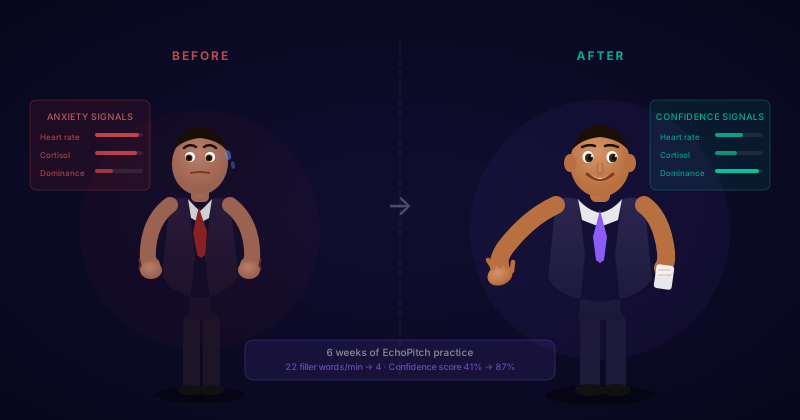
Provides the graduated exposure component of systematic desensitisation without requiring a therapist or a real audience. You speak; the AI gives instant, non-judgemental feedback on confidence and delivery. No social threat response — which means practice actually happens consistently.
Kessler, R.C. et al. (2005) National Comorbidity Survey Replication. Archives of General Psychiatry 62(6). Ollendick, T.H. & Hirshfeld-Becker, D.R. (2002) The developmental psychopathology of social anxiety disorder. Biological Psychiatry 51(1). Stein, M.B. & Stein, D.J. (2008) Social anxiety disorder. The Lancet 371.
Start practising without an audience
EchoPitch gives you private AI coaching — no judgement, no observers. Just instant feedback on confidence, pace, and delivery that builds the procedural memory to replace fear with competence.
Try EchoPitch →