
Does Presentation Anxiety Go Away? The Honest Answer
People want to know if it gets better on its own, or if they have to actively work at it. The research gives a clear answer — but it's not quite what most people hope to hear.
Quick Answer
Presentation anxiety rarely goes away entirely on its own — it may soften slightly over years of unavoidable exposure, but the mechanism that maintains it is avoidance: each time you skip a presentation, your brain's threat model gets reinforced rather than tested, so time alone doesn't reliably fix it. What does improve without effort: familiarity with routine, repeated contexts, and general baseline anxiety levels, which tend to decline slightly with age. What doesn't improve without deliberate work: performance in new high-stakes situations, catastrophic thinking patterns, and avoidance behaviour itself, which typically becomes more entrenched over time. The evidence-based path to change is extinction learning, presenting and discovering you survive it, which is why CBT, an 80–90% response rate, and graduated exposure produce durable results, with most people seeing meaningful change within 2–3 months of consistent practice. Importantly, "better" rarely means zero anxiety; it means anxiety that's manageable, physical symptoms that fade faster, and no longer avoiding opportunities to present because of fear.
MBA, Bayes Business School · Founder, Cavefish · June 2026
reduction in anxiety symptoms in CBT participants at 12-month follow-up in the largest meta-analysis of public speaking anxiety treatment — the strongest evidence that it changes, not just temporarily improves.
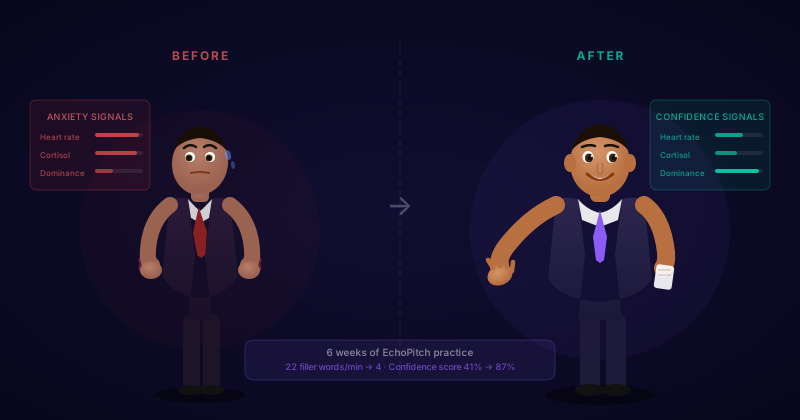
The short answer
Presentation anxiety rarely resolves entirely without deliberate intervention. It may become slightly less intense over years of unavoidable exposure — the brain does update its threat models slowly through experience. But the mechanism that maintains glossophobia is avoidance: every time you avoid presenting, the brain receives confirmation that it was genuinely dangerous. Avoidance keeps the fear alive regardless of how much time passes.
That said, the picture is more nuanced than "it never gets better". Some aspects improve naturally; others require active work. Understanding which is which helps you focus effort where it matters.
The brain learns that speaking is safe only through experience of speaking — and surviving. Time alone is not enough; the experience has to happen.
The neuroscience of why it persists
Presentation anxiety is maintained by a well-documented neural mechanism: the conditioned fear response. The amygdala has learned that public speaking is dangerous (usually from one or more negative experiences or from observed social consequences). Each time you avoid presenting, the amygdala's threat model is reinforced without being tested — the fear becomes more entrenched, not less.
The only mechanism that reliably reduces a conditioned fear response is extinction learning — the experience of encountering the feared stimulus without the feared consequence. In practice: presenting and not being catastrophically humiliated. Each successful presentation slightly updates the threat model downward. This is the mechanism behind all evidence-based treatments for anxiety.
What makes glossophobia particularly persistent is that most people's lives allow significant avoidance. Unlike a fear of elevators in a city building, the fear of public speaking can be accommodated for years or decades. This accommodation prevents the extinction learning that would reduce it.
What gets better without deliberate work
Some aspects of presentation anxiety do improve through normal life experience:
Very routine, familiar contexts
Status updates to the same team, weekly reports, familiar meetings — these become less anxiety-provoking over years through natural exposure. The brain learns these specific contexts are survivable.
Baseline arousal with age
General anxiety levels tend to decline slightly across adulthood, which reduces the baseline from which presentation anxiety operates. Older presenters often report less intense physical symptoms.
Self-assessment accuracy
With experience, most people develop a more accurate sense of how they appear to audiences — which is usually calmer and more competent than they feel internally. This recalibration reduces catastrophic thinking over time.
What doesn't improve without deliberate work
High-stakes novel contexts
The ability to present confidently to new audiences, senior stakeholders, or in unfamiliar settings does not develop from routine experience. Each new high-stakes context reactivates the full anxiety response — it has to be built specifically.
Catastrophic thinking patterns
The cognitive distortions that maintain anxiety — catastrophising, mind-reading, all-or-nothing thinking — do not dissolve with time. They require active cognitive work (CBT or similar) to change.
Avoidance behaviour
The pattern of avoiding presenting opportunities typically becomes more entrenched, not less. Each avoided presentation makes the next one feel higher-stakes.
Performance under genuine pressure
Presenting well in high-pressure situations requires procedural memory built through deliberate practice under pressure-like conditions. It doesn't develop from low-stakes presenting alone.
The role of experience — and why "just present more" isn't enough
A common and understandable belief is that simply doing more presentations will reduce the anxiety over time. The research is more complicated. Uncontrolled, high-stress exposure without adequate coping resources can occasionally worsen anxiety — particularly if the experience goes badly and confirms catastrophic beliefs.
What the research supports is graduated exposure with success experiences — starting with lower-stakes situations and working up. The key variable is that the exposure must be manageable enough to be completed and must result in the brain learning that survival is the outcome, not humiliation.
This is why the first high-stakes presentation someone gives after years of avoidance is often so difficult — they've skipped the graduated steps that would have built tolerance progressively.
What the evidence says actually changes it
| Intervention | Evidence strength | Typical timeline | Durability |
|---|---|---|---|
| CBT | Very strong | 12–16 sessions | High (12-month maintained) |
| Graduated exposure | Strong | 2–4 months | High if exposure continues |
| Beta-blockers | Strong (symptoms only) | Immediate | Symptom relief only |
| Deliberate practice with feedback | Moderate-strong | 8–12 sessions | Moderate-high |
| Time + experience alone | Weak | Years | Low |
| Positive thinking / confidence advice | Very weak | N/A | Negligible |
What "better" actually looks like
It's worth setting realistic expectations. For most people who engage with deliberate work on presentation anxiety, "better" does not mean no anxiety. It means:
- Anxiety that is present but manageable — not overwhelming
- Physical symptoms that are reduced in intensity and duration
- No more avoidance — saying yes to presenting opportunities
- Recovery that is faster when anxiety does spike
- Accurate self-assessment — knowing you look calmer than you feel
The most effective presenters in the world — including many who present professionally — retain some pre-presentation anxiety. The goal is not eliminating anxiety but developing the skills and exposure history to perform effectively despite it.
Key terms
- Extinction learning
- The reduction of a conditioned fear response through repeated non-threatening exposure. The mechanism by which deliberate presentation practice reduces anxiety over time.
- Conditioned fear response
- A learned anxiety reaction triggered by a previously neutral stimulus (public speaking) that has been associated with threat or negative outcome.
Sources
- Powers, M. B., et al. (2008). A meta-analytic review of psychological treatments for social anxiety disorder — Cochrane Database of Systematic Reviews.
- Phelps, E. A., & LeDoux, J. E. (2005). Contributions of the amygdala to emotion processing — Neuron, 48(2), 175-187.
- Stein, M. B., & Stein, D. J. (2008). Social anxiety disorder — The Lancet, 371(9618), 1115-1125.
Get the confidence guide — free
A weekly email covering one practical technique for managing presentation anxiety. No fluff — just what the research says works.
No spam. Unsubscribe anytime.
Start building the exposure history that changes it
EchoPitch provides the low-stakes practice environment where the extinction learning happens — without requiring a real audience. Each session builds the evidence that presenting is survivable.
Try EchoPitch →Get daily tips on Reddit
Join our community for presentation tips, Q&A, and support.