
Why Do I Go Red When Presenting?
This guide is for general information only and isn't medical advice. It isn't written or reviewed by a licensed clinician. Talk to a doctor or qualified healthcare professional before starting, stopping, or changing any medication or treatment.
Your face isn't betraying you — it's just following orders from your autonomic nervous system. Here's what's actually happening, and what evidence says helps.
MBA, Bayes Business School · Founder, Cavefish · May 2026
Quick Answer
Blushing when presenting is an involuntary adrenaline response: adrenaline causes cutaneous vasodilation,widening blood vessels near the skin’s surface in your face, neck, and chest. This is controlled by your autonomic nervous system — the same system that regulates your heartbeat — so you cannot stop it through willpower, and trying to suppress it typically makes it worse. Around 1 in 3 people experience noticeable flushing in high-stakes speaking situations, and research consistently shows blushers dramatically overestimate how visible their blush actually is to observers. Effective management includes diaphragmatic breathing before presenting (inhale for 4 counts, hold for 2, exhale for 6, which activates the parasympathetic nervous system), graduated exposure to reduce the threat response over repeated sessions, and acceptance rather than suppression, since fighting the blush adds a second anxiety response on top of the first. In severe cases, beta-blockers like propranolol can help. Interestingly, observers rate people who blush as more trustworthy and sincere than those who show no physical response at all.
people experience noticeable flushing in high-stakes speaking situations. You are not an outlier — you are typical.
What's actually happening
When your brain identifies public speaking as a social threat, it releases adrenaline. One of adrenaline's effects is cutaneous vasodilation — blood vessels near the skin surface in your face, neck, and chest widen and fill with more blood. That's the blush.
This is controlled by your autonomic nervous system — the same system that regulates your heartbeat. You cannot will yourself to stop blushing any more than you can will your heart to slow down. Trying to suppress it typically makes it worse.
Trying to stop blushing with willpower adds a second anxiety response on top of the first — which is why the more you try, the worse it gets.
Why it feels worse than it looks
Research consistently shows that blushers dramatically overestimate how visible their blush is. Your perception is calibrated to internal sensations — the warmth, the tingling — not to what the audience sees. Studies using observer ratings vs self-ratings find that blushers rate their blush as significantly more visible than independent observers do.
What actually helps
Diaphragmatic breathing before you present
Slow, deep belly breathing activates the parasympathetic nervous system — the calming counterpart to fight-or-flight. Five minutes of extended-exhale breathing (inhale 4, hold 2, exhale 6) measurably reduces adrenaline levels before presenting.
Graduated exposure
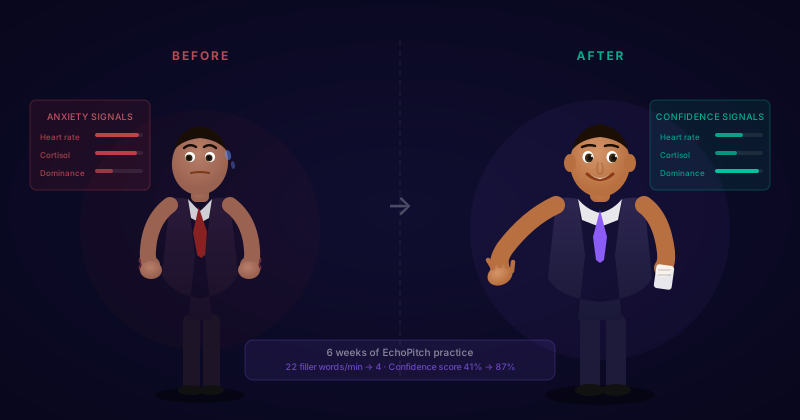
The most evidence-based long-term fix. Repeated exposure to speaking in progressively more challenging situations teaches your nervous system that it's not a genuine threat. The adrenaline response diminishes with each successful session.
Acceptance, not suppression
Accepting that you may blush — "it's fine, the audience probably won't notice, and if they do it doesn't matter" — significantly reduces the secondary anxiety that amplifies the response. Fighting it adds fuel; accepting it removes it.
Beta-blockers (discuss with your GP)
Propranolol blocks adrenaline receptors, preventing the vasodilation that causes blushing. Effective for specific situations. Prescription-only. Addresses the symptom rather than the underlying anxiety — best combined with exposure practice.
What doesn't work
- Trying to consciously suppress the blush — increases secondary anxiety
- Avoiding presenting — reinforces the association between speaking and danger
- Heavy makeup — minimal coverage for active vasodilation, increases self-consciousness
- Telling yourself to "calm down" — the blush is subcortical and doesn't respond to conscious commands
Key terms
- Erythrophobia
- Fear of blushing. When anxiety about blushing is severe enough to cause avoidance of social situations, it may meet diagnostic criteria as a form of social anxiety disorder.
- Vasodilation
- Widening of blood vessels near the skin surface, caused by adrenaline. Produces the visible redness of blushing.
Drummond, P.D. (1997) Adrenergic blockade on blushing. Psychophysiology 34(2). Leary, M.R. et al. (1992) Blushing as a social emotion. Journal of Social & Clinical Psychology 11(3).
Build exposure without an audience
EchoPitch lets you practise presenting privately — no observers, no social threat, just AI feedback. Each session builds the neural pathways that reduce threat appraisal over time.
Start practising free →