
Improving Executive Presence and Vocal Authority: The Complete Guide to Professional Presence Coaching
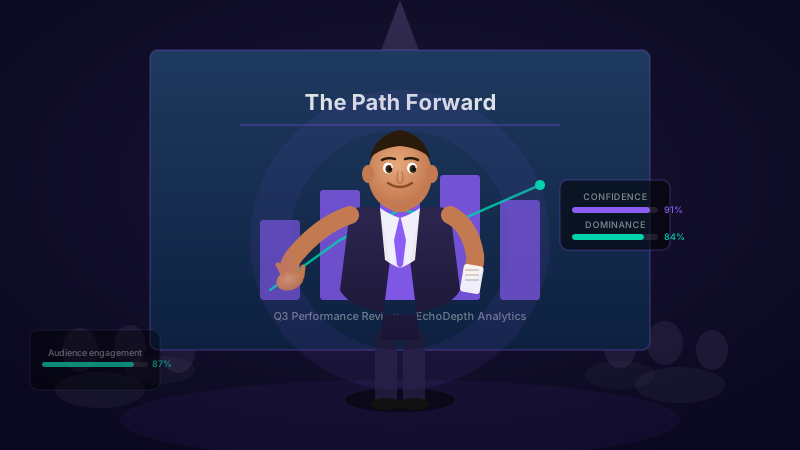
Research reveals a striking truth: executive presence accounts for 26% of what it takes to get promoted to senior leadership. Yet most professionals receive no formal training in the presence skills that determine who advances and who plateaus. Professional presence coaching addresses this gap by systematically developing the gravitas, communication style, and vocal authority that distinguish leaders.
Quick Answer
Professional presence coaching is structured training — often AI-powered — that develops the gravitas, communication style, and vocal authority that determine who gets promoted into senior leadership. Research from the Center for Talent Innovation found that executive presence accounts for 26% of what it takes to reach senior leadership, and it breaks down into three measurable components: gravitas (confidence, decisiveness, composure under pressure) makes up 67% of the total, communication skills (vocal authority, clarity, assertiveness) account for 28%, and appearance contributes only 5%. This means presence is overwhelmingly about how you act and speak, not how you look, and it can be systematically trained rather than treated as a fixed personality trait. Coaching typically targets specific, measurable habits: eliminating vocal patterns like upspeak, vocal fry, and filler words (the target is fewer than two per minute), developing a lower, steadier tone, and building composure through deliberate practice of high-stakes scenarios. Most professionals see measurable improvement within 4-8 weeks, with filler-word reduction visible within two weeks.
MBA, Bayes Business School · Founder, Cavefish · June 2026
Key Takeaways
- •Executive presence accounts for 26% of promotion decisions to senior leadership
- •Gravitas comprises 67% of executive presence - it is the dominant factor
- •Communication skills account for 28% while appearance is only 5%
- •Vocal authority can be systematically developed through deliberate practice
- •Measurable improvement typically appears within 4-8 weeks of consistent coaching
What Is Executive Presence?
Executive presence is one of those qualities that everyone recognizes but few can articulate. When someone with executive presence walks into a room, attention shifts. When they speak, people listen. They project an aura of leadership capability that inspires confidence in their ability to handle senior responsibilities.
But executive presence is not magic or an innate personality trait. Research from the Center for Talent Innovation has decomposed executive presence into its component parts, revealing that it can be systematically developed through targeted professional presence coaching.
of what it takes to get promoted to senior leadership is executive presence (Center for Talent Innovation research)
This statistic demands attention. When technical competence, strategic thinking, and results delivery are table stakes, executive presence becomes the differentiator. Two equally qualified candidates for a senior role will be separated by their presence - how they carry themselves, how they communicate, and the confidence they project.
The challenge is that executive presence operates largely unconsciously. Most people cannot articulate why they perceive one person as leadership-ready and another as not. This invisibility makes executive presence both powerful and frustrating - powerful because it influences decisions; frustrating because it seems difficult to develop without understanding its components.
The Three Pillars of Executive Presence
Landmark research has identified three distinct pillars that comprise executive presence. Understanding these components transforms presence from a vague concept into specific, developable skills.
Pillar One: Gravitas (67% of Executive Presence)
Gravitas is the heavyweight component of executive presence - literally, the quality of having weight. It accounts for a remarkable 67% of what people perceive as executive presence. When senior leaders describe what they look for in high-potential talent, they consistently emphasize gravitas-related qualities.
Components of Gravitas
- •Confidence: Projecting certainty without arrogance; owning your expertise
- •Decisiveness: Making decisions confidently, especially in ambiguity
- •Composure: Remaining calm and collected under pressure
- •Emotional Intelligence: Reading situations and people accurately
- •Integrity: Consistent authenticity that builds trust
- •Vision: Demonstrating strategic, forward-thinking perspective
Gravitas is often misunderstood as requiring a domineering personality or aggressive communication style. This is incorrect. True gravitas comes from inner confidence and self-assurance, not from intimidation. The most effective leaders project gravitas through quiet authority - they do not need to raise their voices or dominate conversations because their presence commands attention naturally.
Developing gravitas requires expanding your comfort zone gradually. Each time you handle a challenging situation with composure, your gravitas grows. Each time you make a decision confidently rather than hedging, you build the pattern. Professional presence coaching accelerates this development by creating safe environments to practice high-stakes scenarios.
Pillar Two: Communication (28% of Executive Presence)
Communication accounts for 28% of executive presence. This encompasses both how you speak (vocal qualities, delivery) and how you structure your message (clarity, persuasiveness). For many professionals, communication is the most accessible entry point for presence development because specific skills can be measured and improved.
Gravitas - how you act
Communication - how you speak
Communication in the context of executive presence goes beyond public speaking. It includes commanding attention in meetings, asserting your point of view without being aggressive, reading the room and adjusting accordingly, and the ability to make complex topics accessible. These skills directly influence how leadership-ready you appear.
The communication pillar is also where vocal authority lives - the specific vocal qualities that project confidence and command respect. Vocal authority can be systematically developed through targeted practice, making it one of the highest-return areas for presence coaching investment.
Pillar Three: Appearance (5% of Executive Presence)
Appearance accounts for only 5% of executive presence - far less than many assume. This is good news: you do not need to look a certain way or conform to narrow physical standards to develop strong executive presence. The appearance that matters is professional presentation and grooming, appropriate attire for your context, and physical presence (posture, how you occupy space).
While appearance is the smallest component, it can create barriers when significantly out of alignment with professional norms. The goal is not perfection but appropriateness - ensuring that appearance does not distract from gravitas and communication.
Developing Vocal Authority
Vocal authority is one of the most powerful and developable aspects of executive presence. Your voice is the primary instrument through which you communicate leadership capability. When vocal qualities project confidence and competence, people are more likely to follow, agree, and trust.
The Physiology of Vocal Authority
Understanding how voice works helps in developing vocal authority. Your voice is produced when air from your lungs passes through your vocal cords, creating vibrations that are shaped by your throat, mouth, and nasal passages. Every aspect of this process can be influenced through practice.
Key Vocal Authority Components
- •Pitch: Lower, steadier pitches are perceived as more authoritative
- •Pace: Measured pace (120-150 WPM) signals confidence; rushing suggests anxiety
- •Volume: Full volume without shouting projects confidence
- •Resonance: Chest resonance adds depth and authority to voice
- •Articulation: Clear consonants and full vowels enhance intelligibility
- •Pausing: Strategic pauses demonstrate control and create emphasis
Vocal Patterns That Undermine Authority
Before building vocal authority, it helps to identify patterns that undermine it. These patterns often operate unconsciously - speakers do not realize they are doing them until they receive feedback through professional presence coaching.
Upspeak - ending statements with rising intonation, as if asking a question - is perhaps the most damaging vocal pattern for authority. It makes declarative statements sound uncertain, implicitly seeking validation. When a leader says "We should pursue this market?" with rising intonation, it invites challenge rather than commanding agreement.
Vocal fry - the creaky, gravelly sound at the end of phrases - has become common, particularly among younger speakers. While it can add emphasis in moderation, excessive vocal fry reduces clarity and can distract listeners from content.
Filler words - um, uh, like, you know, basically, actually - are perhaps the most common authority-undermining pattern. Research suggests that excessive filler words reduce perceived competence and confidence. The target for executive communication is fewer than two filler words per minute.
Target filler word frequency for executive-level communication
Building Vocal Authority Through Practice
Vocal authority develops through deliberate practice with feedback. The process involves several elements that professional presence coaching addresses systematically.
Breath control is foundational. Shallow breathing leads to thin, unsupported voice that rises in pitch under pressure. Deep diaphragmatic breathing provides the airflow needed for full, resonant voice. Practice breathing from your belly rather than your chest, and notice how your voice changes.
Pitch anchoring helps establish a baseline tone that projects authority. Record yourself speaking normally, then experiment with speaking from a slightly lower, more centered place. The goal is not artificially deep voice, but finding your natural lower register that sounds authoritative without sounding forced.
Pace modulation involves practicing different speaking speeds and learning when each is appropriate. In high-stakes situations, consciously slowing down prevents the nervous rushing that undermines authority. Strategic variation in pace - slowing for emphasis, speeding through supporting details - creates engaging, dynamic delivery.
Pause mastery may be the highest-impact vocal skill. Learning to pause confidently - without filling silence with um or uh - dramatically increases perceived authority. Pauses before key points create anticipation. Pauses after important statements let them land. Most speakers underestimate how long a pause can be before it becomes uncomfortable.
Practice Techniques for Executive Presence
Developing executive presence requires moving beyond reading about it to actually practicing presence skills. The research on deliberate practice is clear: improvement requires specific, challenging activities with immediate feedback. Here are proven techniques for presence development.
Video Self-Review
Recording yourself and reviewing the footage is uncomfortable but transformational. Most people have significant blind spots about their presence - they do not realize they touch their face constantly, or that their voice rises when they are uncertain, or that they rush through key points.
Record yourself in realistic scenarios: giving a presentation, participating in a mock meeting, handling a difficult conversation. Review with specific questions: How is my posture? Where do I look? How does my voice sound? What patterns emerge? This self-review accelerates awareness that is essential for change.
The Power Pose Technique
Research by social psychologist Amy Cuddy demonstrated that adopting expansive, open postures for just two minutes can change hormone levels - increasing testosterone (associated with confidence) and decreasing cortisol (associated with stress). While some aspects of this research have been debated, the practical experience of thousands of professionals suggests that intentional posture shifts before high-stakes moments can improve performance.
Before important meetings or presentations, find a private space and adopt an expansive posture: feet wide, hands on hips, chin raised. Hold for two minutes while breathing deeply. This is not about the specific biochemistry but about entering high-stakes situations from a confident physical state rather than a contracted, anxious one.
Practice tip: Before your next important meeting, take two minutes alone to adopt an expansive posture, breathe deeply, and visualize yourself speaking with authority. This simple ritual can significantly shift your presence in the room.
Scenario Rehearsal
Executive presence is context-dependent - the presence required in a board meeting differs from a team all-hands differs from a media interview. Effective professional presence coaching involves practicing specific scenarios you will actually face.
For each upcoming high-stakes situation, create a practice scenario that simulates the real conditions. If you are presenting to executives, practice with challenging questions. If you are having a difficult conversation, practice different ways it might unfold. If you are speaking to a large audience, practice in a large space.
The goal is to reduce novelty during the actual event. When the real situation feels familiar because you have practiced similar scenarios, anxiety decreases and your trained presence skills emerge more naturally.
Progressive Challenge Expansion
Presence develops through gradually expanding your comfort zone. This means deliberately seeking situations that stretch you slightly beyond your current capability - not so far that you fail, but far enough that you grow.
Map your current comfort zone for presence challenges. Perhaps you are comfortable in small meetings but anxious in large groups. Comfortable presenting when prepared but rattled by unexpected questions. Comfortable with peers but intimidated by senior executives.
Design a progression that expands each boundary. If large groups are challenging, first present to a medium group. Then a larger one. Then a larger one still. Each successful expansion builds both skill and confidence for the next level.
Feedback Integration
Improvement requires feedback, but feedback is only useful if you can integrate it. Many professionals receive presence feedback and fail to change because they do not have a system for practice and integration.
When you receive feedback - from a coach, peer, or self-review - translate it immediately into a specific practice focus. "You need more gravitas" is too vague. "Practice pausing for two seconds after making your main point" is actionable. Create specific practice opportunities for each feedback item.
The Role of AI in Professional Presence Coaching
Traditional executive coaching for presence development has significant limitations. Sessions are expensive, scheduling is constrained, and many professionals feel uncomfortable revealing presence weaknesses to another human. AI-powered professional presence coaching addresses these barriers while providing capabilities human coaches cannot match.
Unlimited Private Practice
Perhaps the most valuable aspect of AI coaching is psychological safety. You can practice board presentations, difficult conversations, or media interviews without anyone seeing your early attempts. This privacy removes ego barriers that prevent many professionals from investing in presence development.
The volume of practice matters enormously. Research on deliberate practice shows that skill development requires high repetition with feedback. AI coaching enables unlimited practice sessions, whereas human coaching typically limits professionals to periodic sessions due to cost and scheduling.
Objective Measurement
AI provides consistent, objective measurement of presence indicators that human coaches assess subjectively. An AI system will identify exactly how many filler words you used, precisely when your pace accelerated, and specific moments when your facial expression contradicted your message.
Metrics Tracked by AI Presence Coaches
- •Vocal metrics: Pace, pitch, filler words, pause patterns, volume variation
- •Facial expression: Engagement level, emotion display, eye contact
- •Body language: Posture, gestures, movement patterns
- •Content delivery: Structure, clarity, key message emphasis
- •Confidence signals: Composite score from multiple presence indicators
Real-Time Feedback
Unlike human coaching which provides feedback after sessions, AI coaching can provide guidance during practice. As you speak, the system identifies patterns and suggests adjustments. This immediate feedback loop accelerates skill development compared to delayed feedback models.
Progress Tracking Over Time
AI systems maintain detailed records of your performance across all sessions, enabling visualization of progress over time. You can see exactly how your filler word frequency has decreased, how your confidence scores have improved, and which scenarios still challenge you. This data maintains motivation and identifies areas needing additional focus.
Building a Presence Development Program
Sustainable presence development requires structured practice rather than occasional effort. Here is a framework for building an effective program using professional presence coaching principles.
Assessment Phase (Week 1-2)
Begin with honest assessment of your current presence across different contexts. Record yourself in several scenarios: presenting formally, participating in a meeting, handling a difficult conversation. Review recordings and note patterns. Use an AI coaching tool to establish baseline metrics.
Also gather external feedback. Ask trusted colleagues specific questions: How do I come across in meetings? What could make my presentations more impactful? Where do you see me hesitate or lose confidence? Triangulate self-assessment with external perception.
Priority Setting (Week 2-3)
Based on assessment, identify 2-3 priority areas for development. Trying to improve everything simultaneously leads to improvement in nothing. Focus on areas with highest impact for your specific situation:
If you are preparing for promotion discussions, prioritize gravitas signals and assertive communication. If you are leading a growing team, prioritize presence in all-hands settings and coaching conversations. If you are fundraising, prioritize pitch delivery and confidence under questioning.
Daily Practice Phase (Ongoing)
Establish a sustainable daily practice routine. Even 10-15 minutes daily produces better results than occasional intensive sessions. A sample structure:
Sample Daily Presence Practice Routine
- Minutes 1-3:Breathing exercises and posture reset; set physical foundation for the day
- Minutes 4-8:Vocal warm-up: pitch anchoring, pace exercises, articulation drills
- Minutes 9-15:Scenario practice: run through one scenario with AI feedback, focusing on priority skill
Event Preparation (As Needed)
Before high-stakes events, invest in intensive preparation. For important presentations, complete 10-15 full practice runs over 1-2 weeks. For difficult conversations, practice multiple ways the interaction might unfold. For board meetings or investor pitches, practice with tough questions until your responses are confident and natural.
Review and Adjustment (Monthly)
Monthly, review progress and adjust priorities. Look at AI coaching analytics to assess improvement in tracked metrics. Revisit external feedback - are others noticing changes? Identify new priority areas as previous ones improve. Adjust daily practice to address emerging needs.
Presence in High-Stakes Moments
All presence development builds toward performance in high-stakes moments - the presentations, meetings, and conversations where presence determines outcomes. Here are strategies for bringing your best presence to these moments.
Pre-Event Priming
In the hour before a high-stakes event, use specific techniques to prime your presence state. Find a private space for physical preparation: expansive posture, deep breathing, facial muscle relaxation. Do vocal warm-up: humming, lip trills, speaking opening lines aloud.
Mental preparation is equally important. Visualize yourself speaking with authority and composure. Recall past successes in similar situations. Affirm your expertise and right to be in the room. This is not empty positive thinking but deliberate state management.
In-the-Moment Techniques
During high-stakes moments, specific techniques help maintain presence when anxiety threatens to undermine it:
Grounding: Feel your feet on the floor, your weight in your seat or stance. This physical awareness anchors you in the present rather than future worry or past mistakes.
Breath anchoring: When you notice anxiety rising, take one deep breath before continuing. This prevents the shallow breathing that accelerates anxiety spirals.
Strategic pausing: Use pauses to collect yourself. After a challenging question, pause to think rather than rushing to fill silence. This projects composure even when you feel uncertain.
Posture resets: When you notice yourself contracting (hunched shoulders, crossed arms), deliberately expand. Sit or stand taller, open your chest, relax your face.
Recovery Techniques
Even well-prepared professionals have moments when presence slips - a stumbled answer, a flash of visible anxiety, a lost train of thought. Recovery techniques help you regain presence quickly.
The most important recovery principle is not drawing attention to the slip. Acknowledge it briefly if necessary ("Let me rephrase that"), then move on with full presence. Dwelling on mistakes or over-apologizing extends the damage.
Physical reset helps after a slip. A breath, a pause, a posture adjustment. These physical actions interrupt the anxiety spiral and create space to re-engage from a confident state.
The bottom line: Executive presence is not a fixed trait but a developable skill set. The three pillars - gravitas, communication, and appearance - can all be systematically improved through deliberate practice. Professional presence coaching, particularly AI-powered coaching that enables unlimited private practice with objective feedback, accelerates this development dramatically. The professionals who invest in presence development gain a significant advantage in promotion decisions, leadership effectiveness, and career advancement.
Develop Your Executive Presence
EchoPitch provides AI-powered professional presence coaching with real-time feedback on vocal authority, confidence signals, and delivery. Practice presentations, meetings, and difficult conversations privately with objective measurement and progress tracking.
Get daily tips on Reddit
Join our community for presentation tips, Q&A, and support.
Sources: Center for Talent Innovation executive presence research; Harvard Business Review leadership studies; Amy Cuddy power pose research; Journal of Personality and Social Psychology voice perception studies; deliberate practice research from cognitive psychology.