
Leadership Communication Coaching for Startup Teams: The Complete Guide
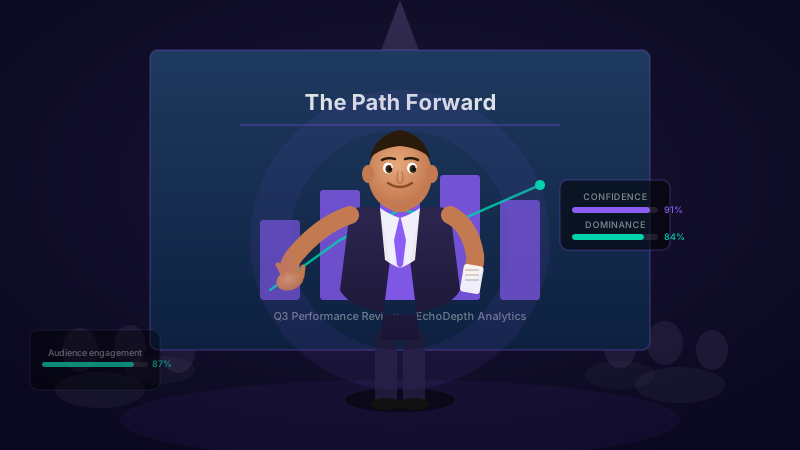
The data is stark: 60% of startup failures trace back to team communication breakdowns. Yet most founders receive zero formal training in the communication skills that determine whether their companies survive scaling. A leadership communication coaching tool changes this equation fundamentally.
Quick Answer
A leadership communication coaching tool is AI-powered software that analyzes and improves how leaders communicate with their teams, giving real-time feedback on delivery, tone, clarity, and persuasiveness. It matters because 60% of startup failures trace back to team communication breakdowns, and founders spend 50% or more of their working hours in communication activities including investor updates, all-hands meetings, and one-on-ones. Research from the Journal of Finance found vocal enthusiasm and positive emotional display in pitch videos lift funding by 27% and 17% respectively, while Gallup research shows 50% of employees have left a job specifically to escape poor management communication. AI coaching tools provide unlimited private practice without judgment, tracking metrics like speaking pace, filler word frequency, and confidence signals that human coaches can only assess subjectively. Combined with human coaching for strategic guidance, founders typically see measurable improvement within 2-4 weeks of consistent, deliberate practice.
MBA, Bayes Business School · Founder, Cavefish · June 2026
Key Takeaways
- •60% of startup failures trace to team communication breakdowns
- •Founders spend 50%+ of their time in communication activities
- •Communication that works at 10 people breaks at 50 people
- •AI coaching tools provide unlimited private practice without judgment
- •Measurable improvement typically appears within 2-4 weeks of consistent practice
Why Startups Need Leadership Communication Coaching
The startup ecosystem celebrates product innovation, technical excellence, and market timing. What it often ignores is the communication infrastructure that enables everything else. When a startup fails, the post-mortem rarely says "poor communication"—yet dig deeper into almost any failure, and you will find communication breakdowns at the root.
Consider the pattern: A technical founder builds something remarkable. Early customers love it. Investors write checks. The team grows from 5 to 15 to 50 people. And somewhere in that scaling journey, things start to fracture. Priorities misalign. Key employees leave citing "culture issues." Decisions that once happened in hallway conversations now require formal processes that nobody has built.
of startup failures can be traced to team communication breakdowns (CB Insights, Startup Genome research)
The underlying cause is almost always the same: the founder's communication style that worked brilliantly with a small team does not scale. And unlike product skills or technical architecture, communication skills rarely receive deliberate development investment.
This is where a leadership communication coaching tool becomes essential—not as a nice-to-have for self-improvement, but as critical infrastructure for company survival.
The Founder Communication Challenge
Founders face a unique communication paradox. The same traits that make someone a successful entrepreneur—conviction, speed, bias toward action—can become liabilities as communication requirements change.
The Time Investment Problem
Research consistently shows that founders spend 50% or more of their working hours in communication activities. This includes investor updates and board meetings, team all-hands and one-on-ones, customer calls and partner negotiations, and media and public speaking. As companies scale, this percentage typically increases, not decreases. A founder who was brilliant at building product now spends most of their time talking about product to various audiences.
Founder time spent on communication
Increase in communication complexity from seed to Series B
The Context-Switching Challenge
Unlike a product manager who can specialise in one communication mode, founders must constantly switch contexts. The communication style that inspires a team in an all-hands meeting differs fundamentally from the style that builds trust with a skeptical investor, which differs again from the style that coaches an underperforming team member.
Each context requires different pacing, different emotional registers, different structures. Most founders never receive explicit training in any of these modes—they learn through trial and error, often discovering their gaps through costly failures.
The Scaling Communication Gap
Perhaps the most dangerous challenge is the gap between communication that works at one scale and communication that works at another. Consider the progression:
Communication Evolution by Company Stage
- Seed (5-10)High-bandwidth informal communication. Everyone knows everything. Decisions happen in real-time conversations.
- Series A (20-50)Information silos emerge. Formal all-hands required. One-on-ones become structured. Written documentation becomes essential.
- Series B+ (100+)Communication becomes asynchronous. The founder's words are amplified and interpreted. Culture is transmitted through communication rituals.
The founder who succeeded through informal brilliance at 10 people often struggles at 50 people—not because they lack intelligence or work ethic, but because they never developed the formal communication skills that larger organizations require.
The Five Critical Communication Competencies
Effective leadership communication coaching focuses on five competencies that determine whether founders can scale their influence as their companies grow.
1. Vision Articulation
Every stakeholder—employees, investors, customers, partners—needs to understand where the company is going and why it matters. Vision articulation is not about grand speeches. It is about consistent, clear, emotionally resonant communication that creates alignment and motivation.
The technical founder who can explain complex systems often struggles here. They default to feature descriptions when stakeholders need to understand meaning and purpose. A leadership communication coaching tool helps by providing feedback on whether the "why" is clear, whether the emotional tone creates engagement, and whether the vision connects to listener concerns.
2. Difficult Conversation Handling
Startups require constant difficult conversations: performance feedback, strategic pivots, funding challenges, team restructuring. Many founders avoid these conversations or handle them poorly, creating ambiguity and eroding trust.
Effective difficult conversation skills include directness without harshness, acknowledging emotions while maintaining focus, providing clear next steps and accountability, and maintaining relationship quality through conflict. These skills can be systematically developed through practice with realistic scenarios.
3. Investor Pitch Delivery
Fundraising success depends heavily on presentation quality. Research from Harvard Business School shows that investor decisions are significantly influenced by delivery factors independent of business fundamentals: confidence signals, clarity of explanation, and response to questions.
Research insight: Hu and Ma's Journal of Finance study found that vocal enthusiasm and positive emotional display in pitch videos were associated with 27% and 17% funding lifts respectively. The way founders communicate matters as much as what they communicate.
4. All-Hands Presence
As companies grow, the all-hands meeting becomes the primary venue for culture transmission. The founder's presence in these settings—how they carry themselves, how they handle questions, how they acknowledge challenges while maintaining optimism—shapes organizational psychology.
Many founders who excel in small group settings struggle with all-hands presence. The larger audience triggers different anxiety responses. The formal setting feels unnatural. The stakes feel higher because mistakes are amplified across the organization.
5. Coaching Conversations
Great leaders develop other leaders. This requires coaching conversations that develop team members rather than just directing them. Coaching communication involves asking questions rather than giving answers, creating space for self-discovery, providing feedback that motivates rather than deflates, and building accountability without micromanagement.
Technical founders often default to problem-solving mode when coaching mode is required. A leadership communication coaching tool can help identify these patterns and develop more effective coaching behaviors.
How AI-Powered Leadership Communication Coaching Works
Traditional executive coaching has significant limitations for startup founders. Sessions are expensive ($500-1500 per hour), scheduling is constrained, and many founders feel uncomfortable revealing weaknesses to another human. AI-powered coaching addresses these barriers while providing capabilities human coaches cannot match.
Unlimited Practice Without Judgment
The most significant advantage of AI coaching is psychological safety. Founders can practice difficult conversations, investor pitches, or all-hands presentations without fear of appearing incompetent. This is particularly valuable for introverted founders and those experiencing imposter syndrome—a surprisingly common condition among successful entrepreneurs.
Research on deliberate practice shows that skill development requires high volume of repetitions with feedback. A leadership communication coaching tool enables unlimited repetitions, whereas human coaching typically limits founders to one or two practice sessions per week.
Objective Measurement
AI coaching provides consistent, objective measurement of communication metrics that human coaches assess subjectively:
Key Metrics Tracked by AI Leadership Coaches
- •Speaking pace: 120-150 WPM optimal for leadership communication
- •Filler words: Target under 2 per minute for executive presence
- •Confidence signals: Vocal steadiness, eye contact, posture
- •Emotional tone: Variation and appropriateness for context
- •Message clarity: Key point articulation and structure
- •Persuasion structure: Problem-solution-action frameworks
Real-Time Feedback
Unlike human coaching which provides feedback after sessions, AI coaching can provide real-time guidance. As you speak, the system identifies patterns and suggests adjustments. This immediate feedback loop accelerates skill development dramatically compared to delayed feedback models.
Scenario Flexibility
AI coaching systems can simulate diverse scenarios that would be impractical to arrange with human coaches: hostile investor questions, emotional employee conversations, media interviews, board presentations. This flexibility allows founders to prepare for specific upcoming challenges rather than generic communication improvement.
The Business Case for Leadership Communication Coaching
Investment in leadership communication coaching generates measurable returns across multiple dimensions.
Fundraising Success
Founders who practice their investor pitches systematically outperform those who do not. The research is clear: presentation delivery significantly impacts funding outcomes independent of business fundamentals. A founder who invests 20 hours in pitch practice before a fundraising round may improve their odds of success by 20-30%.
Funding lift from vocal enthusiasm
Lift from positive emotional display
Average VC attention span on pitch decks
Team Retention
Gallup research indicates that 50% of employees have left a job specifically to escape poor management communication. In startups where equity compensation assumes long-term tenure, communication-driven turnover is particularly costly. The departure of a senior engineer or key salesperson can set companies back months.
Clear, consistent, empathetic founder communication directly correlates with team retention—especially during challenging periods like pivots, funding gaps, or market downturns when employees have the most reason to consider leaving.
Operational Efficiency
Poor communication creates operational drag. Decisions must be explained multiple times. Misunderstandings generate rework. Information asymmetries create coordination failures. A founder who communicates clearly reduces organizational friction and accelerates execution.
Culture Quality
Company culture is transmitted primarily through communication patterns. How the founder handles conflict, celebrates wins, acknowledges failures, and treats team members in daily interactions shapes organizational behavior far more than written values statements.
Building a Leadership Communication Practice
Effective use of a leadership communication coaching tool requires structured practice rather than occasional use.
Weekly Practice Structure
The most effective development pattern involves three types of practice:
Recommended Weekly Practice Schedule
- Daily (5-10 min):Quick practice of a single scenario with focus on one metric (filler words, pace, or confidence)
- Weekly (30 min):Full session practicing upcoming real-world communications (board meeting, all-hands, investor call)
- Monthly (60 min):Review of analytics and progress with human coach to set development priorities
Preparing for Specific Events
Before high-stakes communications, intensive practice pays dividends:
Investor pitches: 10-15 complete run-throughs with AI feedback over 1-2 weeks, focusing on different sections each session.
All-hands presentations: 3-5 practice sessions focusing on opening impact, key message clarity, and Q&A handling.
Difficult conversations: Multiple scenario practices exploring different ways the conversation might unfold, building flexibility and confidence.
Measuring Progress
Effective leadership communication coaching tools provide analytics dashboards showing progress over time. Key indicators to track include filler word trends (should decrease steadily), confidence scores (should stabilize at higher levels), pace consistency (should narrow variance around optimal range), and scenario comfort (anxiety levels should decrease with exposure).
Common Founder Communication Patterns to Address
Certain communication patterns appear repeatedly in founders who struggle to scale their leadership effectiveness.
The Technical Explainer
Technical founders often default to explaining how things work rather than why they matter. This pattern alienates non-technical stakeholders and fails to create emotional engagement. AI coaching helps by identifying when explanations become too detailed and when the "so what" is missing.
The Rapid Talker
Founders under pressure often accelerate their speech, making them harder to follow and signaling anxiety rather than confidence. Pace feedback helps identify when speed increases and develops awareness of speaking rhythm.
The Filler Word User
"Um," "uh," "like," "you know," "basically"—these verbal fillers undermine authority and suggest uncertainty. Most people dramatically underestimate their filler word frequency until objective measurement reveals it. Reduction typically shows within 5-10 practice sessions.
The Avoider
Some founders avoid difficult messages, burying bad news or failing to provide direct feedback. This pattern creates information asymmetries and erodes trust. Practice with difficult conversation scenarios builds the skill and confidence for direct communication.
The Monologuer
Founders accustomed to pitching sometimes struggle with two-way communication. They speak when they should listen and miss opportunities to understand stakeholder concerns. AI coaching can flag response length patterns and encourage more balanced dialogue.
Integrating AI and Human Coaching
The most effective leadership communication development combines AI tools with human coaching. Each serves different purposes:
| Capability | AI Coaching | Human Coaching |
|---|---|---|
| Practice volume | Unlimited | Limited by schedule |
| Feedback timing | Real-time | Post-session |
| Measurement | Objective metrics | Subjective assessment |
| Availability | 24/7 | Scheduled |
| Strategic guidance | Limited | Deep expertise |
| Contextual wisdom | Generic | Industry-specific |
| Accountability | Self-directed | Relationship-based |
The optimal pattern: use AI coaching daily for skill building and metrics tracking, while meeting with a human coach monthly for strategic guidance, blind spot identification, and accountability.
Getting Started with Leadership Communication Coaching
For founders ready to invest in their communication effectiveness, the path forward is straightforward:
Start with assessment. Use an AI coaching tool to establish baseline metrics across different scenarios: pitch delivery, all-hands presentations, difficult conversations. Understand your current patterns before trying to change them.
Identify priority areas. Not all communication skills are equally important for your specific situation. A founder preparing for Series A should prioritize investor pitch delivery. A founder scaling from 20 to 100 people should focus on all-hands presence and delegation communication.
Build consistent practice habits. Even 10 minutes daily of deliberate practice with feedback outperforms occasional intensive sessions. Consistency creates lasting skill development.
Prepare for specific events. Before high-stakes communications, invest in intensive preparation. The return on 10 hours of pitch practice before a crucial investor meeting far exceeds the return on general communication improvement.
Track progress over time. Use analytics to maintain motivation and identify when patterns shift. Communication skills development is visible in data if you measure consistently.
The bottom line: Leadership communication is not a personality trait. It is a skill that compounds with deliberate practice. The founders who invest in developing this skill systematically outperform those who assume communication ability is fixed.
Develop Your Leadership Communication
EchoPitch provides AI-powered leadership communication coaching with real-time feedback on delivery, confidence, and presence. Practice investor pitches, team presentations, and difficult conversations privately with objective measurement.
Get daily tips on Reddit
Join our community for presentation tips, Q&A, and support.
Sources: CB Insights startup failure analysis; Startup Genome research; Gallup management communication studies; Harvard Business School investor decision research; Hu-Ma Journal of Finance pitch presentation research; Frontiers in Virtual Reality (2023) deliberate practice studies.