
Overcoming Public Speaking Anxiety with Modern Tools
Technology has transformed how we manage presentation anxiety. Here is a comprehensive guide to the tools that actually work — backed by research and practical experience.
Quick Answer
The best presentation anxiety tools fall into four categories: AI coaching platforms that provide real-time feedback on delivery, biofeedback devices that make physiological stress responses visible and controllable, VR exposure therapy that simulates speaking environments with virtual audiences, and breathing or mindfulness apps that activate the parasympathetic nervous system for immediate calm. These work because presentation anxiety is a neurobiological threat response rooted in the amygdala, not a character flaw, and it responds to repeated non-catastrophic exposure through extinction learning. Research shows 77% of people experience some level of speaking anxiety, with 15-20% experiencing severe glossophobia that affects their careers, so this is a near-universal problem with evidence-based solutions. VR exposure therapy reduces anxiety symptoms by roughly 65% in clinical studies, biofeedback training shows measurable improvement in stress regulation after just 4-6 weeks, and consistent AI coaching practice typically produces lasting improvement within 8-12 weeks. The most effective approach combines several tools: AI coaching and VR exposure for lasting change, plus breathing apps for immediate relief.
MBA, Bayes Business School · Founder, Cavefish · June 2026
of people experience some level of speaking anxiety. Modern presentation anxiety tools offer evidence-based solutions that were impossible just a decade ago.
Key Takeaways
- 1.Presentation anxiety tools work best when combined — use AI coaching, biofeedback, and breathing apps together
- 2.VR exposure therapy reduces anxiety by 65% in clinical studies — now accessible via consumer headsets
- 3.AI coaching provides the repetition needed for extinction learning without requiring live audiences
- 4.Biofeedback devices teach you to consciously control stress responses — a skill that transfers to real presentations
- 5.Breathing apps offer immediate anxiety relief — even 3 minutes of guided breathing measurably reduces cortisol
Understanding Presentation Anxiety: Why Tools Matter
Presentation anxiety is not a character flaw or something you can simply decide to overcome. It is a neurobiological response rooted in the amygdala — the brain region responsible for threat detection. When you stand up to present, your brain interprets the evaluating eyes of an audience as a social threat, triggering the same fight-or-flight response that evolved to protect humans from physical danger.
This is why telling yourself to "just relax" does not work. The anxiety response operates below conscious thought. However, modern presentation anxiety tools work precisely because they target the actual mechanisms driving the fear — not the surface symptoms.
The good news: research demonstrates that anxiety responses can be modified through repeated experience. The amygdala learns through data, not argument. Every successful presentation — even a simulated one — provides evidence that public speaking is not actually dangerous. This process, called extinction learning, is what modern tools are designed to accelerate.
The Four Categories of Presentation Anxiety Tools
Effective presentation anxiety tools fall into four main categories, each addressing different aspects of the fear response. Understanding what each category does helps you build a toolkit that addresses your specific needs.
AI Coaching Platforms
Provide real-time feedback on delivery, enabling unlimited low-stakes practice that builds procedural memory and triggers extinction learning.
Biofeedback Devices
Make unconscious stress responses visible, teaching you to consciously regulate heart rate, breathing, and skin conductance.
VR Exposure Therapy
Simulate realistic speaking environments with virtual audiences, providing graduated exposure without requiring real audiences.
Breathing & Mindfulness Apps
Guide evidence-based techniques that activate the parasympathetic nervous system, offering immediate pre-presentation calm.
AI Coaching: The Foundation of Modern Practice
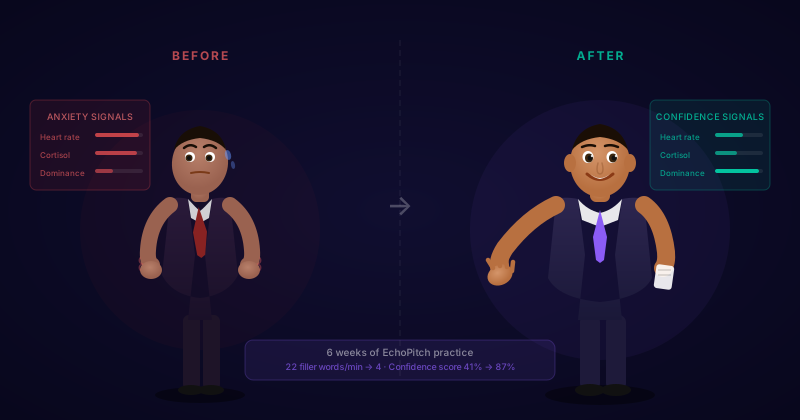
AI-powered presentation coaching represents the most significant advancement in managing speaking anxiety in the past decade. These platforms — including EchoPitch — use machine learning to analyse your vocal delivery, body language, and content in real-time, providing the kind of detailed feedback that previously required expensive human coaches.
But the real power of AI coaching for anxiety management is not the feedback itself — it is the ability to practice repeatedly in a low-threat environment. Each practice session creates a mild activation of the anxiety response (you know you are being observed and evaluated, even by an AI) without the full social threat of a live audience. This is exactly what the amygdala needs to begin updating its threat assessment.
What AI coaching tools measure
- Vocal patterns: Pace, pitch variation, volume, filler words (um, uh, like, you know), and pauses
- Body language: Eye contact, facial expressions, hand gestures, posture, and nervous movements
- Content delivery: Clarity, structure, key message emphasis, and audience engagement signals
- Emotional tone: Confidence signals, anxiety markers, and authenticity indicators
The objectivity of AI feedback addresses another significant source of presentation anxiety: the gap between how you think you appeared and how you actually appeared. Many anxious presenters ruminate for hours after presentations, convinced they were visibly nervous or performed poorly. AI coaching provides data that either confirms concerns (giving you something specific to work on) or — more commonly — demonstrates that your anxiety was far less visible than it felt.
weeks of consistent AI coaching practice typically produces meaningful, lasting improvement in both delivery skills and anxiety levels. The amygdala needs this repetition to update its threat model.
Biofeedback: Learning to Control What You Cannot See
Biofeedback devices make the invisible visible. They measure physiological stress indicators — heart rate variability (HRV), skin conductance (how much you sweat), breathing patterns, and sometimes brainwave activity — and display them in real-time. This awareness enables conscious regulation of previously unconscious processes.
For presentation anxiety, biofeedback is powerful because much of the distress comes from feeling out of control. Your heart races, your palms sweat, your voice shakes — and there seems to be nothing you can do about it. Biofeedback training demonstrates that you can, in fact, influence these responses. The skill transfers: once you have learned to lower your heart rate during biofeedback training, you can apply the same techniques before and during presentations.
Key biofeedback metrics for anxiety
- Heart Rate Variability (HRV): Higher HRV indicates better stress resilience. Training to increase HRV improves your ability to handle presentation pressure.
- Skin Conductance: Measures sympathetic nervous system activation. Learning to reduce skin conductance teaches direct anxiety control.
- Respiratory Rate: Slow, controlled breathing is both a cause and effect of calm. Biofeedback helps optimise breathing patterns.
- Muscle Tension: EMG biofeedback reveals unconscious tension in face, shoulders, and jaw — common sites of presentation-related stress.
Consumer biofeedback devices have become remarkably affordable and accessible. Wearables like the Garmin and Apple Watch provide basic HRV data. Dedicated devices like Muse (EEG), Lief (HRV), and various finger sensors offer more detailed training. Even 4-6 weeks of regular biofeedback practice produces measurable improvements in stress regulation ability.
VR Exposure Therapy: Simulating What You Fear
Exposure therapy is the gold standard treatment for anxiety disorders, including public speaking anxiety. The principle is simple: repeated exposure to the feared situation, without the catastrophe the brain predicts, gradually extinguishes the fear response. The problem with traditional exposure therapy for presentation anxiety is that it requires actual audiences — which are not always available, and which produce full-intensity anxiety that can be counterproductive early in treatment.
Virtual reality solves this problem. VR exposure therapy applications simulate speaking environments — conference rooms, auditoriums, boardrooms, even TED-style stages — with virtual audiences that can be programmed to behave in various ways. The research is compelling: VR exposure produces anxiety reduction comparable to real-world exposure, with the advantage of being accessible on-demand and fully controllable.
Exposure therapy reduces presentation anxiety by approximately 65% in clinical studies. VR exposure produces similar outcomes with greater accessibility and control.
How VR exposure therapy works
VR applications for public speaking anxiety typically include:
- Progressive environments: Start with small groups in low-stakes settings, gradually progress to larger audiences and higher-stakes scenarios
- Customisable audiences: Virtual attendees can be attentive, distracted, hostile, or supportive — enabling practice for specific feared scenarios
- Realistic distractions: Simulate phone-checking, side conversations, and late arrivals that trigger many presenters
- Performance recording: Review your virtual presentations to observe your delivery objectively
Consumer VR headsets like Meta Quest make VR exposure therapy accessible without clinical supervision. Applications like VirtualSpeech, Ovation, and Public Speaking VR offer graduated exposure programmes that you can complete at home. For severe glossophobia, combining VR exposure with guidance from a therapist produces the best outcomes.
Breathing and Mindfulness Apps: Immediate Calm
While AI coaching, biofeedback, and VR exposure build long-term resilience, breathing and mindfulness apps offer immediate anxiety relief. They work because breathing is the only autonomic function you can consciously control — a direct pathway to the nervous system.
The science is straightforward: slow exhalation activates the vagus nerve, which triggers parasympathetic nervous system dominance. This directly counteracts the sympathetic (fight-or-flight) activation that produces presentation anxiety symptoms. Even 3-5 minutes of controlled breathing measurably reduces cortisol levels and subjective anxiety.
Evidence-based techniques available in apps
- 4-7-8 Breathing: Inhale for 4 counts, hold for 7, exhale for 8. The extended exhale maximises vagus nerve activation.
- Box Breathing: 4 counts in, 4 hold, 4 out, 4 hold. Simple to remember, effective anywhere. Used by Navy SEALs for stress management.
- Physiological Sigh: Double inhale through nose, long exhale through mouth. Stanford research shows this is the fastest single intervention for acute stress.
- Coherent Breathing: 5-second inhale, 5-second exhale (6 breaths per minute). Optimises heart rate variability over time.
Popular breathing apps include Breathwork, Calm, Headspace, and the Apple Watch Breathe feature. Many are free or have free tiers that include the core techniques. The key is not which app you choose — it is establishing the habit of using breathing techniques before every presentation until it becomes automatic.
Evidence-Based Approaches: What the Research Shows
Not all presentation anxiety tools are equally effective. Here is what the research actually supports:
Exposure therapy (including VR)
Strong evidence. Multiple meta-analyses confirm 60-70% symptom reduction. The most reliably effective intervention for specific phobias including glossophobia.
Cognitive behavioural therapy (CBT)
Strong evidence. CBT addresses the cognitive distortions that amplify anxiety. Combined with exposure, it produces the best long-term outcomes.
Biofeedback training
Moderate-to-strong evidence. Significant improvements in anxiety regulation after 4-8 weeks of training. Benefits persist after training ends.
Breathing techniques
Strong evidence for immediate anxiety reduction. Less evidence for long-term anxiety modification without exposure components.
AI coaching
Emerging evidence. Studies show improvements in delivery skills and self-efficacy. The exposure component likely explains anxiety reduction benefits.
Mindfulness meditation
Moderate evidence. Regular practice reduces baseline anxiety and improves stress resilience. Effects are general rather than presentation-specific.
The research consensus is clear: exposure-based approaches produce the most reliable long-term results. Tools that provide exposure — AI coaching, VR therapy — should form the foundation of any comprehensive approach. Breathing and mindfulness tools are valuable complements but work best when combined with systematic practice.
Building Your Personal Anxiety Toolkit
The most effective approach to managing presentation anxiety is not choosing one tool — it is building a toolkit that addresses different aspects of the anxiety response at different timescales.
A comprehensive toolkit might include:
Long-term development (weeks to months)
- -AI coaching platform: Weekly practice sessions to build skills and provide extinction learning
- -VR exposure therapy: Graduated exposure to increasingly challenging scenarios
- -Biofeedback training: Building conscious control of stress responses
Pre-presentation (hours to days before)
- -Practice runs with AI coaching: Final rehearsals with feedback
- -Mindfulness meditation: Reducing anticipatory anxiety
- -VR simulation of the specific scenario: Mental preparation for the environment
Immediate pre-presentation (minutes before)
- -Breathing app: 3-5 minutes of guided 4-7-8 or box breathing
- -Physiological sigh: Immediate calm in the final moments
- -Quick biofeedback check: Confirming you are in a good state
Choosing tools based on your specific anxiety pattern
Different anxiety presentations respond better to different tools:
- Physical symptoms dominate (racing heart, shaking, sweating): Prioritise biofeedback and breathing apps
- Catastrophic thoughts dominate: Prioritise CBT-based apps and AI coaching that provides objective feedback
- Avoidance is the main pattern: Prioritise graduated exposure through VR and AI practice
- Specific scenarios trigger anxiety: Use VR to simulate and desensitise to those specific scenarios
- Generalised anxiety: Combine all tools with particular emphasis on regular mindfulness practice
Getting Started: A Practical Roadmap
If you are new to using technology to manage presentation anxiety, here is a practical sequence:
- Week 1-2: Establish a breathing practice. Download a breathing app and use it for 5 minutes daily. This builds the foundation for immediate anxiety management.
- Week 3-4: Add AI coaching. Sign up for a platform like EchoPitch and complete 2-3 practice sessions per week. Focus on getting comfortable with the process rather than perfecting your delivery.
- Week 5-8: Introduce VR exposure if physical symptoms are significant. Start with low-stakes virtual environments and gradually increase difficulty.
- Week 8+: Consider biofeedback if you want deeper control over physiological responses. This is most valuable for people with prominent physical symptoms.
- Ongoing: Before every real presentation, use your pre-presentation toolkit: AI practice run, breathing exercises, and if available, VR simulation of the specific scenario.
The most important factor is consistency. Brief, regular use of presentation anxiety tools produces better results than intensive but sporadic engagement. The amygdala learns through repeated experience — give it the data it needs.
The Future of Presentation Anxiety Tools
Technology for managing presentation anxiety continues to advance rapidly. Emerging developments include:
- Real-time anxiety detection: AI systems that detect rising anxiety during practice and provide immediate intervention prompts
- Adaptive VR audiences: Virtual audiences that respond to your delivery in real-time, providing more realistic social feedback
- Wearable biofeedback: Discreet devices that can provide real-time coaching during actual presentations
- Personalised AI coaching: Systems that learn your specific patterns and provide increasingly tailored feedback and exercises
The trajectory is clear: presentation anxiety tools will become more personalised, more integrated, and more effective. What is already available today represents a dramatic improvement over what was possible even five years ago. People who struggled with presentation anxiety in previous generations had far fewer options.
Conclusion: Technology as a Bridge to Confidence
Modern presentation anxiety tools do not eliminate the need for courage — you still have to show up and practice. But they dramatically reduce the barriers to that practice. AI coaching lets you rehearse without booking a room of colleagues. VR exposure lets you face virtual audiences before facing real ones. Biofeedback lets you see and control what was previously invisible and automatic. Breathing apps put an evidence-based calming technique in your pocket.
The research is consistent: presentation anxiety responds to intervention. The neurological fear response can be modified through systematic practice. And modern tools make that systematic practice more accessible than ever before.
If you have avoided presentations, limited your career, or suffered through speaking opportunities you should have enjoyed, the tools now exist to change that trajectory. The question is not whether they work — the evidence is clear. The question is whether you will use them consistently enough to give your brain the data it needs to update its threat assessment.
Start small. Pick one tool. Use it consistently for a month. Then add another. Build your toolkit gradually. The goal is not to eliminate nervousness entirely — some arousal improves performance. The goal is to reduce anxiety to manageable levels so you can deliver the presentations your career and ideas deserve.
Sources
- Powers, M. B., et al. (2008). A meta-analytic review of psychological treatments for social anxiety disorder — Cochrane Database of Systematic Reviews.
- Phelps, E. A., & LeDoux, J. E. (2005). Contributions of the amygdala to emotion processing — Neuron, 48(2), 175-187.
- Kessler, R. C., et al. (2005). Lifetime prevalence and age-of-onset distributions of DSM-IV disorders — Archives of General Psychiatry, 62(6), 593-602.
- Stein, M. B., & Stein, D. J. (2008). Social anxiety disorder — The Lancet, 371(9618), 1115-1125.
Start Building Your Toolkit Today
EchoPitch provides AI-powered presentation coaching designed for anxiety reduction. Practice in a low-stakes environment that triggers extinction learning — start today.
Try EchoPitch →Get daily tips on Reddit
Join our community for presentation tips, Q&A, and support.