
The Neuroscience of Stage Fright: Why Your Brain Treats Presenting Like a Bear Attack
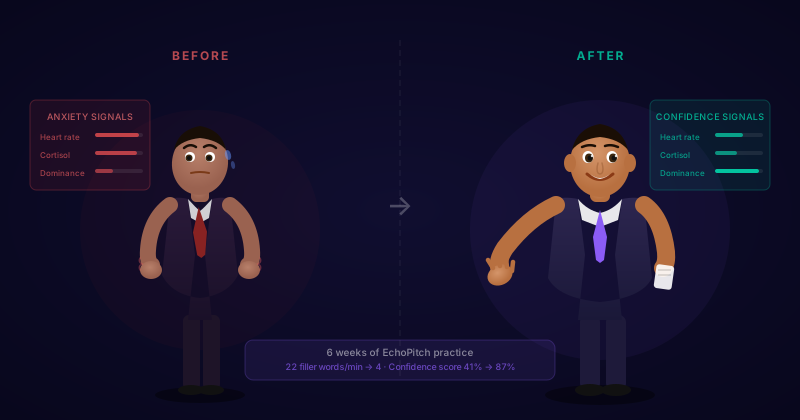
The fear response to public speaking and the fear response to mortal danger use identical neural hardware. That is not a metaphor.
Quick Answer
Stage fright happens because your amygdala — the brain's threat detection center — reads being watched and evaluated by a group as existential danger, triggering the hypothalamic-pituitary-adrenal axis and sympathetic nervous system so that cortisol and adrenaline begin circulating within seconds. This response is subcortical, meaning it fires before conscious thought, which is why telling yourself to calm down doesn't work: by the time your prefrontal cortex generates reassurance like 'this is fine,' the sympathetic nervous system has already activated and cortisol is already suppressing that same rational function. The amygdala evolved to treat social threat as mortal threat because for most of human history, exclusion from the group genuinely meant death. It only unlearns fear through extinction learning — repeatedly experiencing public speaking without the catastrophe it predicts. One successful presentation isn't enough; it takes dozens of non-catastrophic experiences to meaningfully reduce the response. Even recording yourself alone creates enough mild threat activation to begin this extinction learning process without a live audience.
MBA, Bayes Business School · Founder, Cavefish · May 2026
What Actually Happens in Your Brain When You Present?
The moment you stand up to present — or even the moment you know a presentation is coming — a small almond-shaped structure in the centre of your brain called the amygdala receives a social threat signal. Being watched and evaluated by a group reads to the amygdala as existential danger. This is not metaphorical. The same neural circuits that respond to physical threats fire in response to the social threat of public scrutiny.
The amygdala does not consult the prefrontal cortex (the rational, deliberate part of your brain) before responding. It triggers the hypothalamic-pituitary-adrenal (HPA) axis and the sympathetic nervous system simultaneously. Cortisol and adrenaline begin circulating within seconds.
Why Telling Yourself to Calm Down Does Not Work
This is the central frustration of presentation anxiety. You know intellectually that a Zoom call is not dangerous. You know the audience is not hostile. You know the worst that can happen is embarrassment. And yet the body does not care what you know. Why?
Because the amygdala’s threat response is subcortical — it fires before conscious thought. By the time your prefrontal cortex is generating the reassurance (“this is fine, they are just people”), the sympathetic nervous system has already activated. Cortisol is already suppressing prefrontal function. You are, neurologically speaking, trying to calm a house fire with a glass of water while the fire hose is being turned off.
Why Did This Evolve?
Being observed, evaluated, and potentially rejected by a social group was genuinely life-threatening for most of human evolutionary history. Exclusion from the tribe meant death — no protection, no food, no reproduction. The amygdala evolved to treat social threat as mortal threat because, for hundreds of thousands of years, it was. The modern conference room has not updated this threat model.
How Does the Brain Unlearn the Fear Response?
The amygdala learns through experience, not through argument. The only way to update its threat assessment of public speaking is to repeatedly experience public speaking without the catastrophe it is predicting. Each successful experience — each presentation that does not end in social exclusion or death — is a data point that slowly modifies the threat response.
This process is called extinction learning, and it requires repeated exposure. The critical word is repeated. One successful presentation does not extinguish years of conditioned fear. Dozens of presentations, consistently experienced as non-catastrophic, gradually reduce the amygdala’s threat response to manageable levels.
Why Private Practice Helps Even Without a Real Audience
Recording yourself presenting creates a mild activation of the threat response — enough to begin the extinction learning process without the full social threat of a live audience. Your body knows you are performing even without observers. The camera creates genuine mild stress. Repeated non-catastrophic experiences in this setting gradually reduce the baseline threat response.
This is the neurological foundation of why consistent private practice with tools like EchoPitch can reduce presentation anxiety even without a live audience. The amygdala is learning. It just needs enough data points.
Sources
- LeDoux, J. (2015). Anxious: Using the Brain to Understand and Treat Fear and Anxiety — Viking/Penguin.
- Phelps, E. A., & LeDoux, J. E. (2005). Contributions of the amygdala to emotion processing — Neuron, 48(2), 175-187.
- McEwen, B. S. (2007). Physiology and neurobiology of stress and adaptation — Annual Review of Psychology, 58, 145-173.
Give Your Amygdala Better Data
Every EchoPitch session is an extinction learning event. Consistent practice across weeks genuinely reduces the threat response. 5 sessions, paid once. No subscription.
Start practising free →Get daily tips on Reddit
Join our community for presentation tips, Q&A, and support.