
Why Am I So Nervous Before Presentations?
You know your material. You have prepared. The nervousness still arrives. Here is exactly why — and why knowing the reason changes how you approach fixing it.
Quick Answer
You get nervous before presentations because your amygdala interprets being watched and evaluated by a group as a social threat, releasing adrenaline and triggering fight-or-flight regardless of how well-prepared you are — for most of human evolutionary history, being singled out by the group carried genuine survival risk, and that ancient threat-detection system hasn't caught up to modern presentations. Preparation reduces the risk of losing your thread, but it doesn't touch this threat response, which is why you can know your material perfectly and still feel terrified. Several mechanisms make it feel worse than the actual risk: negativity bias, which weights potential embarrassment more heavily than the higher likelihood of things going fine; the spotlight effect, where research by Gilovich et al. shows people overestimate how much others notice their mistakes; and catastrophising about consequences that are almost always shorter-lived than feared. Roughly 74% of people rate public speaking fear among their greatest fears, so disproportionate nervousness despite preparation is the majority experience, not a personal failing.
MBA, Bayes Business School · Founder, Cavefish · June 2026
of people in one survey rated fear of public speaking as their greatest fear — ahead of death, financial ruin, and serious illness. Feeling disproportionately nervous before presenting is the majority experience.
Why do I get so nervous before presentations even when I know my material?
Preparation reduces the risk of content failure but doesn't address the threat your brain has identified. The amygdala responds to the presence of an evaluating group regardless of how well-prepared you are — it is responding to being observed and judged, not to whether you know your slides.
The evolutionary explanation
The nervousness before a presentation is not irrational — it is running on outdated software. For the vast majority of human evolutionary history, being singled out and evaluated by a group carried genuine risk. Exclusion from the tribe meant death. Being seen to fail in front of peers had real survival consequences.
The amygdala — the brain's threat-detection and emotional memory centre — still processes "a group of people are watching and judging me" as a social threat equivalent to physical danger. It releases adrenaline and activates the fight-or-flight response in exactly the same way it would for a physical threat. The fact that the "threat" is a presentation to colleagues does not compute at this level of the nervous system.
This is not a malfunction. It is the correct operation of a system designed for a different environment. Your nervous system is not broken — it is running a programme that evolved for different circumstances.
The nervousness before a presentation is your body preparing to fight a threat that doesn't physically exist. The discomfort is real; the danger isn't.
Why preparation doesn't stop the nerves
This is the most common and understandable misconception: if I prepare enough, I won't be nervous. It is almost entirely wrong, and believing it causes significant distress.
Preparation reduces the risk of content failure — not knowing what to say, losing your thread, not being able to answer questions. It does not address the threat response. The amygdala does not check whether you know your slides before it decides to release adrenaline. It responds to the presence of an evaluating audience, full stop.
What preparation does do: it builds procedural memory, which is more resistant to stress impairment than declarative memory. A highly practised presentation can be delivered on near-automatic, freeing cognitive resources to manage the anxiety response. But preparation alone cannot eliminate the response itself.
This is why someone can know their material perfectly and still feel terrified. And why, conversely, someone who knows little about a topic might feel completely comfortable presenting on it — they have nothing riding on the evaluation.
Why it feels worse than the actual risk warrants
Presentation anxiety consistently produces a threat appraisal that significantly outstrips the actual risk. Several cognitive mechanisms explain this:
Negativity bias
The brain weights potential negative outcomes — embarrassment, losing credibility — more heavily than the actual probability of those outcomes occurring. A 5% chance of a bad presentation feels worse than a 95% chance of a good one.
The spotlight effect
Research by Gilovich et al. (2000) consistently demonstrates that people overestimate how much others notice their appearance, behaviour, and errors. Presenters believe the audience is cataloguing their mistakes; audiences are largely focused on the content and their own experience.
Catastrophising
Presentation anxiety typically involves all-or-nothing thinking: 'if this goes badly, my reputation is ruined.' The actual consequence of even a genuinely poor presentation is almost always far less severe than anticipated and far shorter-lived than feared.
Status amplification
When senior people, clients, or people with power over your career are in the room, the threat appraisal increases significantly because more is genuinely at stake. This is not irrational — it is a calibrated response to real differential in consequence. It also explains why someone can be completely comfortable in low-stakes situations and genuinely anxious in high-stakes ones.
Anticipatory anxiety
Much of the suffering of presentation anxiety occurs not during the presentation but in the hours and days before it. Anticipatory anxiety — imagining worst-case scenarios, rehearsing catastrophes — extends the distress far beyond what the actual event produces.
Why "just be confident" is the worst advice
Telling someone with presentation anxiety to "just be confident" is equivalent to telling someone with a broken leg to "just walk normally". Confidence is not a decision — it is a state that emerges from a combination of skill, experience, and accurate self-assessment. You cannot choose to be confident any more than you can choose to be tall.
More specifically: the anxiety response is subcortical. It operates in the amygdala, below the level of conscious thought. Instructing yourself to stop being nervous is a prefrontal cortex command to a system that doesn't take instructions from it. The amygdala does not respond to rational argument.
Why some situations are far worse than others
Not all presentations produce the same anxiety. The factors that amplify threat appraisal include:
- Audience status — presenting to senior leaders, investors, or people who have power over your career activates significantly more threat response than presenting to peers
- Novelty — presenting to people who don't know you yet is more threatening than presenting to familiar colleagues
- Stakes — presentations where the outcome genuinely matters (funding decisions, job interviews, major pitches) produce proportionally more anxiety
- Exposure without preparation — being asked to speak without notice eliminates the protective function of preparation and produces acute anxiety
- History of bad experiences — previous presentation humiliation creates conditioned fear responses that can be triggered years later in similar contexts
What this means for fixing it
Understanding the cause precisely changes the approach. If the nervousness is caused by a subcortical threat response to social evaluation, then:
- More preparation alone will not eliminate it
- Positive thinking will not eliminate it
- Telling yourself to calm down will not eliminate it
- Physiological interventions (breathing) work because they access the autonomic nervous system
- Graduated exposure works because it updates the amygdala's threat model through direct experience
- CBT works because it addresses the cognitive distortions that amplify the baseline response
Key terms
- Amygdala
- The brain region responsible for threat detection and emotional memory. Interprets public speaking as a social threat and triggers the fight-or-flight response regardless of rational assessment.
- Spotlight effect
- The cognitive bias causing people to overestimate how much others notice their appearance, behaviour, and errors. Research by Gilovich et al. demonstrates this consistently in presentation contexts.
Address the threat response directly
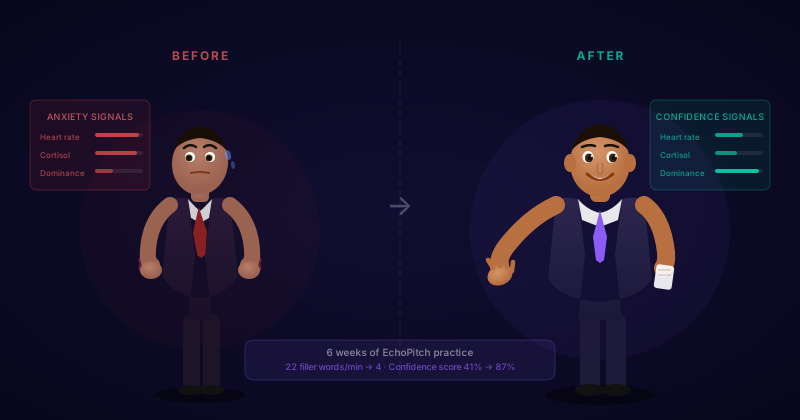
EchoPitch provides the graduated exposure that updates the amygdala's threat model — without requiring a real audience to do it. Start with zero social threat; build from there.
Try EchoPitch →Get daily tips on Reddit
Join our community for presentation tips, Q&A, and support.
Sources
- Gilovich, T., Medvec, V. H., & Savitsky, K. (2000). The spotlight effect in social judgment — Journal of Personality and Social Psychology, 78(2), 211-222.
- Phelps, E. A., & LeDoux, J. E. (2005). Contributions of the amygdala to emotion processing — Neuron, 48(2), 175-187.
- Kessler, R. C., et al. (2005). Lifetime prevalence of DSM-IV disorders — Archives of General Psychiatry, 62(6), 593-602.