
Managing Stage Fright Before a High-Stakes Presentation: 15 Proven Tips
You have an important presentation coming up. The stakes are real. Here are the evidence-based strategies that actually work — before, during, and after the moment you step up to speak.
Quick Answer
Managing stage fright before a high-stakes presentation combines physiological techniques with mental preparation, both before and during the moment you speak. The most effective strategy is deep breathing — 4-7-8 or box breathing for 10-15 minutes beforehand reduces cortisol by roughly 25% and activates the parasympathetic nervous system. Arrive at least 30 minutes early to familiarize yourself with the space, which lowers anxiety triggered by unfamiliar surroundings. Visualize success rather than catastrophe, since the brain treats vivid imagined experience similarly to real experience. Avoid caffeine on presentation day, since it amplifies every anxiety symptom, and exercise earlier in the day to burn off excess adrenaline. In the moment, power poses and the physiological sigh (double inhale, long exhale) calm the nervous system quickly. If you stumble, pause, use a prepared recovery phrase, and continue — research shows graceful recovery increases perceived confidence more than flawless delivery does. About 77% of people experience stage fright, so this response is normal, not a sign of inadequate preparation.
MBA, Bayes Business School · Founder, Cavefish · June 2026
of people experience stage fright. You are not alone — and this fear responds predictably to the right interventions.
Key Takeaways
- 1.Deep breathing reduces cortisol by approximately 25% — practice 4-7-8 or box breathing 10-15 minutes before presenting
- 2.Arrive 30 minutes early to familiarize yourself with the space and eliminate last-minute stress
- 3.Visualization creates neural patterns similar to real experience — mentally rehearse success, not catastrophe
- 4.Physical preparation matters: avoid caffeine, eat light, exercise earlier in the day to burn off adrenaline
- 5.Prepare a recovery phrase for mistakes — graceful recovery actually increases perceived confidence
Understanding Stage Fright: Why Your Brain Reacts This Way
Before diving into the tips, it helps to understand what you are actually dealing with. Stage fright is not weakness or inadequate preparation — it is a neurobiological response that evolved to keep your ancestors alive. The amygdala, your brain's threat detection centre, interprets the evaluating eyes of an audience as a social threat equivalent to physical danger.
For most of human evolutionary history, being singled out and judged by a group carried genuine survival risk. Exclusion from the tribe meant death. Your nervous system has not updated for the modern conference room. It responds to "a group of people are watching and judging me" with the same fight-or-flight cascade it would use for a charging predator: adrenaline, cortisol, increased heart rate, rapid breathing, blood flow away from the prefrontal cortex (where complex thought happens) toward the limbs (for running or fighting).
This explains why telling yourself to "just calm down" rarely works. The anxiety response operates below conscious thought. But here is the good news: while you cannot argue with the amygdala, you can work with the body's systems to interrupt and reduce the threat response. That is what these strategies target.
reduction in cortisol from deep breathing exercises. Breathing is one of the most evidence-based interventions because it directly accesses the nervous system.
Pre-Presentation Techniques: The Days and Hours Before
Effective stage fright management starts well before you step up to present. These strategies address the anticipatory anxiety that often causes more suffering than the presentation itself.
Tip 1: Practice extensively in a low-stakes environment
The amygdala learns through experience, not argument. Every successful practice run — even without a real audience — provides data that presenting is not actually dangerous. This is called extinction learning, and it requires repetition. One practice run does not rewire years of conditioned fear. Ten practice runs, twenty, thirty — these begin to shift the baseline threat response.
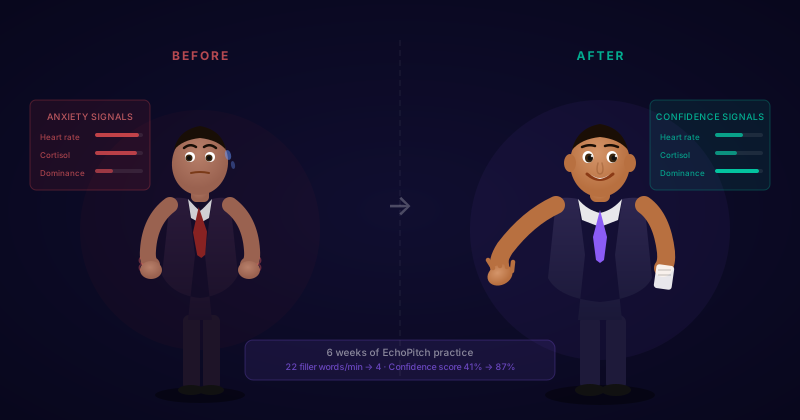
AI coaching tools like EchoPitch allow unlimited practice with feedback, creating mild anxiety activation (you know you are being recorded and evaluated) without the full social threat of a live audience. This is exactly what the amygdala needs to update its threat assessment.
Tip 2: Visualize success, not catastrophe
Most anxious presenters spend the days before a presentation imagining everything that could go wrong. This is counterproductive — each catastrophic visualization reinforces the amygdala's assessment that presenting is dangerous.
Instead, deliberately visualize success. Close your eyes and vividly imagine: walking into the room with confidence, seeing the audience receptive, hearing your voice clear and steady, feeling calm in your body, receiving positive feedback afterward. The brain cannot fully distinguish between vividly imagined experiences and real ones. Visualization provides "evidence" of safety.
Tip 3: Prepare your opening cold
The first 30-60 seconds are when anxiety peaks. If you can deliver your opening on autopilot, you buy time for your prefrontal cortex to come back online and for the initial adrenaline surge to subside. Practice your opening until you could deliver it half-asleep. Memorize it word-for-word if helpful. Once you are past the opening, the body typically begins to calm.
Tip 4: Avoid caffeine the day of the presentation
Caffeine amplifies every anxiety symptom: increased heart rate, jitteriness, difficulty concentrating. If you normally drink coffee, either skip it entirely or have a small amount much earlier in the day. Never caffeinate in the two hours before a high-stakes presentation. The temporary alertness is not worth the amplified physical symptoms of anxiety.
Tip 5: Exercise earlier in the day
Physical exercise metabolizes excess adrenaline and cortisol. A morning workout, brisk walk, or even a short jog 3-4 hours before presenting can significantly reduce baseline anxiety levels. Exercise too close to the presentation leaves you sweaty and rushed; too far before loses the benefit. Morning of the presentation is ideal for most people.
Immediately Before: The Final 30 Minutes
The half-hour before a high-stakes presentation is critical. These techniques target the acute anxiety response.
Tip 6: Arrive early and claim the space
Arrive at least 30 minutes before presenting. Rushing in at the last minute dramatically increases cortisol. Early arrival allows you to: test all technology (projector, clicker, microphone), understand the room layout, stand where you will present and imagine the audience, identify potential issues (lighting, sight lines, technical problems), and complete your calming routines without time pressure.
Walk around the space. Touch the podium or table. Stand at the front. This territorial claiming reduces the novelty threat when you actually present — the space becomes familiar rather than foreign.
Tip 7: Practice deep breathing (4-7-8 or box breathing)
Breathing is the fastest route to nervous system regulation because it is the only autonomic function you can consciously control. Ten to fifteen minutes before presenting, find a private space and practice controlled breathing:
- 4-7-8 technique: Inhale for 4 seconds, hold for 7 seconds, exhale for 8 seconds. Repeat 4-6 cycles.
- Box breathing: Inhale for 4 seconds, hold for 4 seconds, exhale for 4 seconds, hold for 4 seconds. Repeat 4-6 cycles.
The key is the extended exhale — this activates the vagus nerve and triggers parasympathetic nervous system dominance, directly counteracting fight-or-flight.
Tip 8: Use power poses (with realistic expectations)
Amy Cuddy's research suggests that holding expansive body positions for 2 minutes can increase confidence and reduce anxiety. Stand tall, hands on hips, chest open. Or raise your arms in a V like you just won a race. Do this in private — the bathroom, an empty room, anywhere you will not be observed.
While the hormonal mechanisms have been questioned in replication studies, the psychological benefits appear real. At minimum, power poses interrupt the hunched, protective posture that anxious people naturally adopt, which itself signals threat to the nervous system.
Tip 9: Release physical tension
Anxiety accumulates as muscle tension, particularly in the shoulders, jaw, and face. Before presenting:
- Roll your shoulders slowly backward several times
- Open your mouth wide, then gently massage your jaw
- Shake out your hands vigorously
- Do a progressive muscle relaxation: tense each muscle group for 5 seconds, then release
Physical release creates feedback to the brain that danger has passed. If your body is relaxed, your brain receives fewer threat signals.
Tip 10: Use the physiological sigh for immediate calm
Stanford research identifies the physiological sigh as the fastest single intervention for acute stress. It takes 10 seconds:
- Take a deep breath in through your nose
- At the top, add a second shorter inhale (a "sip" of air)
- Exhale slowly and completely through your mouth
One to three physiological sighs can shift your nervous system state almost immediately. Use this in the final moments before stepping up to present.
During the Presentation: Managing Anxiety in Real-Time
Once you begin presenting, your options are more limited — but not absent. These strategies help you manage anxiety while delivering your content.
Tip 11: Focus on one friendly face
A room full of faces can feel overwhelming. Instead, identify one or two people who appear receptive (nodding, smiling, engaged) and direct significant portions of your presentation to them. This reduces the amygdala's assessment of threat — you are having a conversation with someone who seems supportive, not performing for a hostile crowd.
Move your attention between a few friendly faces rather than trying to scan the entire room. This feels more natural and reduces the cognitive load of audience monitoring.
Tip 12: Embrace the pause
Anxious presenters often rush, trying to get through the ordeal as quickly as possible. This usually makes things worse — rushing increases breathlessness, invites mistakes, and signals nervousness to the audience. Pauses, by contrast, project confidence.
When you feel anxiety rising, deliberately pause. Take a breath. The pause feels much longer to you than it does to the audience. What feels like an awkward 5 seconds to you is barely perceptible to them. Use pauses strategically: after making an important point, before transitioning to a new section, when you need to collect your thoughts.
Tip 13: Use physical grounding
When anxiety spikes during a presentation, physical grounding can interrupt the spiral. Without anyone noticing:
- Press your feet firmly into the floor and notice the sensation
- If you are holding a clicker or notes, focus on the feeling in your hands
- Take one slow, deep breath disguised as a natural pause
- Roll your shoulders back slightly to open your posture
Grounding brings attention back to the present moment and physical sensations, interrupting the catastrophic thinking that amplifies anxiety.
Recovery from Mistakes: When Things Go Wrong
Mistakes happen. Words get lost, technology fails, questions stump you. How you recover matters far more than the mistake itself.
Tip 14: Have a recovery phrase prepared
When your mind blanks or you lose your place, having a prepared recovery phrase buys you time:
- "Let me rephrase that..."
- "Actually, the key point here is..."
- "To return to the main idea..."
- "Let me take a moment to address that differently..."
These phrases are bridges — they give your prefrontal cortex a few seconds to come back online while you appear to be making a deliberate rhetorical choice. Practice saying them out loud so they come naturally under pressure.
Tip 15: Graceful recovery increases perceived confidence
Here is a counterintuitive truth: audiences do not penalize mistakes as much as anxious presenters fear. What they remember is how you handled the mistake. A presenter who stumbles, pauses, takes a breath, and smoothly continues appears more confident and human than someone who delivers flawlessly but robotically.
When something goes wrong:
- Do not apologize profusely or draw attention to the error
- Take a brief pause (one slow breath)
- Use your recovery phrase if needed
- Continue with slightly slower pace
Research shows that audiences often do not even notice errors that feel catastrophic to the presenter. The spotlight effect — the tendency to overestimate how much others notice about us — is especially strong during presentations.
Before the Presentation
Practice extensively with AI coaching, visualize success, avoid caffeine, exercise earlier in the day, prepare your opening cold
30 Minutes Before
Arrive early and claim the space, practice deep breathing (4-7-8 or box), use power poses, release physical tension through stretching
During the Presentation
Focus on friendly faces, embrace pauses, use physical grounding techniques, maintain slow deliberate breathing
Recovering from Mistakes
Use prepared recovery phrases, pause rather than rush, do not over-apologize, continue with slightly slower pace
The Long-Term Approach: Building Lasting Confidence
The strategies above are effective for managing acute stage fright before specific presentations. But for lasting change, you need to address the underlying fear response. This requires consistent exposure.
Every successful presentation — including every successful practice session — provides the amygdala with evidence that speaking in front of others is not actually dangerous. Over time, with enough repetitions, the baseline threat response diminishes. This is why people who present frequently often (though not always) become more comfortable: they have accumulated enough non-catastrophic experiences to update their brain's threat model.
If you present infrequently, you need to create practice opportunities. AI coaching tools, VR exposure therapy, Toastmasters groups, and volunteering for low-stakes speaking opportunities all provide the repetitions your amygdala needs. The goal is not to eliminate nervousness entirely — some arousal improves performance — but to reduce it to manageable levels.
Numbered Summary: 15 Tips for Managing Stage Fright
- Practice extensively in a low-stakes environment — extinction learning requires repetition
- Visualize success, not catastrophe — the brain treats vivid imagination similarly to real experience
- Prepare your opening cold — automate the first 60 seconds when anxiety peaks
- Avoid caffeine the day of — it amplifies every anxiety symptom
- Exercise earlier in the day — metabolize excess adrenaline and cortisol
- Arrive early and claim the space — familiarity reduces threat
- Practice deep breathing (4-7-8 or box) — 25% cortisol reduction in minutes
- Use power poses — expansive posture signals safety to the nervous system
- Release physical tension — shoulders, jaw, hands accumulate anxiety
- Use the physiological sigh for immediate calm — double inhale, long exhale
- Focus on one friendly face — reduce the overwhelming audience to one receptive person
- Embrace the pause — silence feels longer to you than to the audience
- Use physical grounding — feet on floor, sensation in hands
- Have a recovery phrase prepared — "Let me rephrase that..."
- Know that graceful recovery increases perceived confidence — mistakes are forgettable, recovery is memorable
When to Seek Professional Help
For most people, the strategies in this article — applied consistently — produce meaningful improvement. However, if your stage fright is so severe that it significantly limits your career, causes physical symptoms that interfere with daily life, or does not respond to these interventions after months of consistent effort, consider professional support.
Cognitive Behavioural Therapy (CBT) is highly effective for specific phobias including glossophobia (fear of public speaking). Some people benefit from short-term use of beta-blockers, which block the physical symptoms of anxiety without sedation. A therapist specializing in performance anxiety can create a tailored exposure programme that addresses your specific triggers.
Sources
- Kessler, R. C., et al. (2005). Lifetime prevalence and age-of-onset distributions of DSM-IV disorders — Archives of General Psychiatry, 62(6), 593-602.
- McEwen, B. S. (2007). Physiology and neurobiology of stress and adaptation — Annual Review of Psychology, 58, 145-173.
- Carney, D. R., Cuddy, A. J. C., & Yap, A. J. (2010). Power posing — Psychological Science, 21(10), 1363-1368.
- Phelps, E. A., & LeDoux, J. E. (2005). Contributions of the amygdala to emotion processing — Neuron, 48(2), 175-187.
Practice Managing Stage Fright in a Low-Stakes Environment
EchoPitch provides AI-powered presentation practice that creates the mild anxiety activation needed for extinction learning — without requiring a real audience. Build confidence one practice session at a time.
Start practicing →Get daily tips on Reddit
Join our community for presentation tips, Q&A, and support.