
The Meaning of Glossophobia and How to Beat It
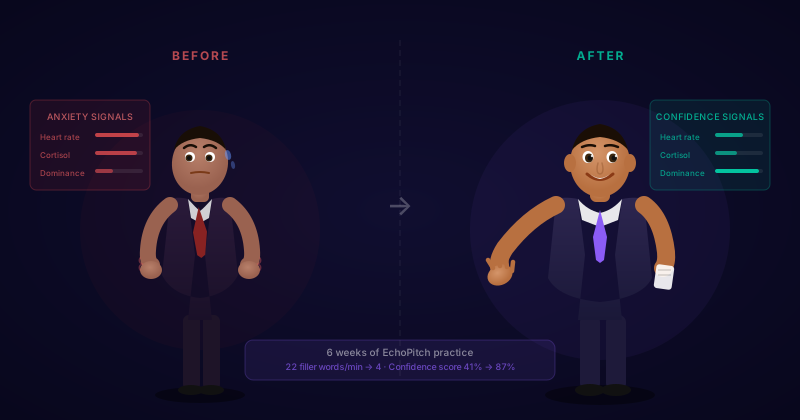
Glossophobia is more than just "stage fright." It is a clinical condition that affects the majority of adults — and it is entirely treatable once you understand what it actually means.
Quick Answer
Glossophobia is the clinical term for the fear of public speaking, from the Greek words "glossa" (tongue) and "phobos" (fear). Classified as a specific phobia under the DSM-5's social anxiety disorders, it affects approximately 77% of the population to some degree, with about 10% experiencing symptoms severe enough for clinical diagnosis. Physical symptoms include racing heart, trembling, sweating, and dry mouth, while psychological symptoms include catastrophic thinking, negative self-talk, and avoidance behavior. Despite being highly treatable through cognitive behavioral therapy, exposure therapy, relaxation techniques, and deliberate practice, only 8% of people with glossophobia ever seek professional help. Left untreated, it carries real costs: research links social anxiety to roughly 10% lower wages and 14% reduced likelihood of holding professional or managerial roles. The good news is that 12-16 weeks of regular, deliberate practice can produce significant, lasting reduction in symptoms.
MBA, Bayes Business School · Founder, Cavefish · June 2026
Key Takeaways
- ✓ Glossophobia means "fear of the tongue" in Greek — the clinical term for fear of public speaking
- ✓ Affects approximately 77% of the population to some degree
- ✓ Physical symptoms include racing heart, trembling, sweating, and dry mouth
- ✓ Psychological symptoms include fear of judgment, avoidance behaviour, and negative self-talk
- ✓ Evidence-based treatments include CBT, exposure therapy, and deliberate practice
- ✓ Only 8% of people with glossophobia seek professional help — but those who do see significant improvement
What Is the Meaning of Glossophobia?
Glossophobia is the clinical term for the fear of public speaking. It is not simply "being nervous before a presentation" — it is a recognised psychological condition that can significantly impact a person's personal and professional life.
Glossophobia (noun): The fear of public speaking
Etymology: From Greek "glossa" (tongue) + "phobos" (fear)
Pronunciation: /ˌɡlɒsəˈfəʊbiə/ (gloss-oh-FOE-bee-ah)
Also known as: Speech anxiety, public speaking anxiety, speech phobia, performance anxiety (when related to speaking)
The word "glossophobia" combines two Greek roots: "glossa" (γλῶσσα), meaning tongue or language, and "phobos" (φόβος), meaning fear or aversion. Literally translated, glossophobia means "fear of the tongue" — a reference to the organ most associated with speech.
In clinical terms, glossophobia is classified as a specific phobia under the broader umbrella of social anxiety disorders in the DSM-5 (Diagnostic and Statistical Manual of Mental Disorders). However, it is important to note that experiencing anxiety about public speaking does not automatically mean you have a diagnosable condition. The clinical threshold requires that the fear causes significant distress or impairment in daily functioning.
How Common Is Glossophobia?
Glossophobia is extraordinarily common. Multiple studies have confirmed that public speaking anxiety affects a significant majority of the population.
of the population experiences some degree of glossophobia (National Institute of Mental Health)
This statistic is so widely cited that it has become almost a cliche in public speaking coaching. But its prevalence does not diminish its significance. When more than three-quarters of the population share a fear, we are looking at something deeply rooted in human psychology — not a personal failing or weakness.
The Chapman University Survey of American Fears consistently ranks public speaking among the top fears, often ahead of death itself. This has led to the famous (if slightly hyperbolic) observation that people would rather die than give a speech.
Experience some speaking fear
Have severe glossophobia
Seek professional help
Of those who experience glossophobia, approximately 10% have symptoms severe enough to be classified as a clinical phobia — meaning the fear causes significant distress or impairment in their daily lives. Despite this, only about 8% of people with public speaking anxiety ever seek structured help. This treatment gap means that millions of people are living with a treatable condition without realising that improvement is possible.
The Etymology: Where Does the Word "Glossophobia" Come From?
Understanding the etymology of glossophobia helps clarify what the term actually describes. The word is a medical compound formed from two ancient Greek words:
- Glossa (γλῶσσα) — meaning "tongue" or, by extension, "language" or "speech." The same root gives us words like "glossary" (a list of terms) and "polyglot" (someone who speaks multiple languages).
- Phobos (φόβος) — meaning "fear" or "aversion." This root appears in countless medical and psychological terms: arachnophobia (fear of spiders), claustrophobia (fear of enclosed spaces), and agoraphobia (fear of open or crowded spaces).
The term "glossophobia" emerged in the late 19th and early 20th centuries as psychology began to classify specific fears into distinct categories. While the experience of fearing public speech is as old as public speaking itself — ancient Greek and Roman rhetoricians wrote about stage fright — the clinical terminology developed much more recently.
It is worth noting that glossophobia is sometimes used interchangeably with "speech anxiety" or "public speaking anxiety," though technically, glossophobia refers specifically to a phobic response (an irrational, disproportionate fear) rather than normal nervousness.
Glossophobia vs. Normal Nervousness: What Is the Difference?
Not all anxiety about public speaking qualifies as glossophobia. A certain degree of nervousness before speaking is normal, healthy, and even beneficial — it can sharpen focus and improve performance.
The distinction between normal nervousness and glossophobia lies in three factors:
- Intensity: Glossophobia involves fear that is disproportionate to the actual threat. The physical and psychological response is significantly more severe than the situation warrants.
- Avoidance: People with glossophobia often go to great lengths to avoid speaking situations, even when doing so damages their careers or relationships.
- Impairment: The fear causes significant distress or impairment in work, education, or social functioning. It is not just uncomfortable — it is limiting.
If you feel nervous before a presentation but are able to push through and perform adequately, you likely have normal pre-presentation anxiety. If the thought of presenting causes you to avoid opportunities, lose sleep, or experience debilitating physical symptoms, you may be dealing with glossophobia.
Physical Symptoms of Glossophobia
Glossophobia triggers the sympathetic nervous system — the same fight-or-flight response that would activate if you encountered a physical threat. The brain does not distinguish well between social threats (like potential embarrassment) and physical threats (like a predator). The result is a cascade of physical symptoms that can feel overwhelming.
Cardiovascular Symptoms
Racing heart (tachycardia), elevated blood pressure, palpitations. These occur because adrenaline signals the heart to pump more blood to muscles in preparation for action.
Muscular Symptoms
Trembling hands, shaking legs, muscle tension, voice tremor. Adrenaline-primed muscles release energy through tremor when physical action does not occur.
Autonomic Symptoms
Sweating, flushing, dry mouth, nausea, digestive discomfort. The parasympathetic system (rest and digest) is suppressed, causing these secondary symptoms.
Cognitive Symptoms
Mind going blank, difficulty concentrating, racing thoughts, memory lapses. Cortisol impairs working memory and prefrontal cortex function.
One of the most frightening aspects of glossophobia is that these symptoms can become self-reinforcing. You notice your heart racing, which increases your anxiety, which makes your heart race faster. This feedback loop can escalate rapidly if not interrupted.
Psychological Symptoms of Glossophobia
Beyond the physical manifestations, glossophobia involves distinct psychological patterns:
- Anticipatory Anxiety: Worrying about a speaking event days or weeks in advance. The anticipation often feels worse than the actual event.
- Catastrophic Thinking: Imagining worst-case scenarios — forgetting everything, being laughed at, career-ending humiliation.
- Negative Self-Talk: Internal dialogue such as "I'm terrible at this," "Everyone will see how nervous I am," or "I'm going to fail."
- Hypervigilance: Scanning the audience for signs of boredom, disapproval, or judgment.
- Post-Event Rumination: Replaying the presentation repeatedly afterward, focusing on perceived mistakes.
- Avoidance Behaviour: Declining opportunities, delegating presentations to others, calling in sick on presentation days.
These psychological patterns often persist even when the physical symptoms are manageable. Someone might be able to control their shaking hands but still experience intense dread and negative thoughts for weeks before a presentation.
What Causes Glossophobia?
Glossophobia rarely has a single cause. Instead, it typically develops through a combination of factors:
1. Evolutionary Roots
From an evolutionary perspective, standing alone in front of a group triggers primal threat detection. For our ancestors, being observed by multiple people often meant being evaluated — and social rejection could mean exclusion from the group, which historically reduced survival chances. The brain treats potential judgment from an audience as a genuine threat.
2. Negative Past Experiences
A single embarrassing public speaking experience — especially during childhood or adolescence — can create lasting anxiety. Being laughed at, forgetting lines in a school play, or being criticised by a teacher can establish a fear response that persists for decades.
3. Learned Behaviour
Observing others (particularly parents or authority figures) express anxiety about public speaking can teach children that speaking is something to fear. This modelling effect can transmit glossophobia across generations without any direct negative experience.
4. Genetic Predisposition
Research suggests that anxiety disorders, including specific phobias, have a heritable component. If close family members have anxiety disorders, you may have a higher baseline vulnerability to developing glossophobia.
5. Personality Factors
Traits such as perfectionism, introversion, high sensitivity to criticism, and low self-esteem can increase susceptibility to glossophobia. Perfectionists in particular may fear public speaking because it is inherently imperfect — mistakes are visible and cannot be undone.
6. Lack of Experience
Simply not having practiced public speaking creates a skills gap that increases anxiety. The less you speak, the more uncertain you are about your ability — and uncertainty breeds fear.
How Is Glossophobia Treated?
The good news is that glossophobia is highly treatable. Multiple evidence-based approaches have been shown to significantly reduce symptoms:
Cognitive Behavioural Therapy (CBT)
CBT is the gold-standard treatment for specific phobias, including glossophobia. It works by identifying and challenging the distorted thoughts that fuel anxiety (e.g., "Everyone will notice I'm nervous") and replacing them with more realistic assessments. CBT also teaches coping strategies and gradually exposes patients to feared situations.
Exposure Therapy
Systematic desensitisation involves gradual, repeated exposure to public speaking situations in a controlled way. Starting with less threatening scenarios (speaking to a small friendly group) and progressively increasing difficulty (larger audiences, higher stakes) allows the brain to learn that the threat is not real. Each successful exposure reduces the fear response.
Relaxation Techniques
Diaphragmatic breathing, progressive muscle relaxation, and mindfulness meditation can reduce the physical symptoms of anxiety. These techniques work by activating the parasympathetic nervous system (rest and digest), which counteracts the fight-or-flight response.
Medication
In some cases, beta-blockers (which reduce heart rate and trembling) or anti-anxiety medications may be prescribed for situational use. These are typically considered a short-term solution while other treatments take effect, not a long-term strategy.
Deliberate Practice
Perhaps the most accessible treatment is simply practicing. Regular exposure to speaking situations — even in low-stakes environments — teaches the brain that presenting is safe. Each practice session is evidence against the fear.
How Deliberate Practice Helps Overcome Glossophobia
Practice is not just about improving your speaking skills — though it does that too. On a neurological level, repeated exposure to public speaking changes how your brain responds to the situation.
The Science: Each time you practice speaking without a catastrophic outcome, your amygdala (the brain's threat detection centre) receives evidence that public speaking is not dangerous. Over time, this accumulates into a reduced fear response.
The key is that practice must be deliberate and structured. Simply "going through the motions" is less effective than:
- Practising in conditions that simulate the real situation (standing, speaking aloud, using slides)
- Receiving feedback on specific elements (pace, eye contact, filler words)
- Gradually increasing the difficulty and stakes
- Reflecting on what went well, not just what went wrong
Research suggests that 12-16 weeks of regular, deliberate practice can produce significant, lasting reduction in glossophobia symptoms. Some people notice improvement after just a few sessions.
Why Most People Never Overcome Glossophobia
Despite glossophobia being highly treatable, the statistics are sobering: only about 8% of people with public speaking anxiety ever seek structured help. Why the gap?
- Avoidance Feels Safer: In the short term, avoiding presentations eliminates the anxiety. The relief is immediate. The long-term costs (missed promotions, stunted careers) are abstract and distant.
- Normalisation: Because so many people share the fear, it feels normal. "Everyone hates public speaking" becomes an excuse not to address it.
- Shame: Admitting you need help with something as "basic" as speaking can feel embarrassing, especially for professionals.
- Lack of Accessible Solutions: Traditional therapy requires time, money, and scheduling. Public speaking courses require showing up in front of strangers. Many people do not have easy access to these options.
The result is that glossophobia persists unnecessarily. The 8% who do seek help are disproportionately represented in leadership positions, high-earning roles, and positions that require influence.
The Career Cost of Untreated Glossophobia
Glossophobia is not just uncomfortable — it is expensive. Research published in the American Journal of Psychiatry found that individuals with social anxiety (of which glossophobia is the most common expression) earned wages approximately 10% lower than peers without the condition. They were also 14% less likely to hold professional or managerial roles.
Over a 40-year career, this wage penalty compounds into hundreds of thousands of dollars in lost earnings. Add the missed promotions, foregone opportunities, and career limitations, and the true cost of untreated glossophobia becomes clear.
Average wage penalty for those with speaking anxiety
Less likely to hold professional/managerial roles
First Steps: What You Can Do Today
If you recognise yourself in this article, here are practical steps you can take immediately:
- Name It: Simply acknowledging that you have glossophobia (rather than vaguely "not being good at presentations") is the first step. The condition is specific, understood, and treatable.
- Assess Severity: Take a validated assessment to understand where you fall on the spectrum from mild nervousness to severe phobia. This helps you choose appropriate interventions.
- Start Small: Begin practicing in low-stakes environments. Record yourself on your phone. Present to a trusted friend. The goal is repeated exposure, not perfection.
- Learn the Physiology: Understanding why your body reacts the way it does makes symptoms less frightening. The racing heart is just adrenaline — it will subside in 2-3 minutes.
- Consider Professional Help: If your glossophobia is significantly impairing your life or career, working with a therapist trained in CBT or exposure therapy can accelerate your progress.
Summary: What Glossophobia Means — and What You Can Do About It
Glossophobia is the clinical term for the fear of public speaking. Derived from the Greek words for "tongue" and "fear," it describes a specific phobia that affects approximately 77% of the population to some degree. While the experience ranges from mild nervousness to debilitating anxiety, the condition is highly treatable through cognitive behavioural therapy, exposure therapy, relaxation techniques, and deliberate practice.
The majority of people with glossophobia never seek help, which means they continue to pay the professional and personal costs of an untreated condition. But those who do address their fear — through any of the evidence-based approaches available — consistently report significant improvement.
If glossophobia has been limiting your career, your opportunities, or your quality of life, know this: it does not have to be permanent. The fear of speaking is one of the most well-understood and treatable conditions in psychology. The first step is understanding what it means — and the next step is deciding to address it.
Ready to Address Your Glossophobia?
EchoPitch provides a private, judgement-free space to practice your speaking skills with instant AI feedback. Each session teaches your nervous system that presenting is safe — gradually reducing the severity of symptoms over time.
Get daily tips on Reddit
Join our community for presentation tips, Q&A, and support.
Sources
- Dwyer, K. K., & Davidson, M. M. (2012). Is public speaking really more feared than death? — Communication Research Reports, 29(2), 99-107.
- National Institute of Mental Health — Specific Phobia prevalence statistics.
- Chapman University Survey of American Fears — Annual survey ranking public speaking among top fears.
- Stein, M. B., & Stein, D. J. (2008). Social anxiety disorder. The Lancet. — Clinical overview of social anxiety disorders including glossophobia.
- DSM-5 (Diagnostic and Statistical Manual of Mental Disorders) — American Psychiatric Association diagnostic criteria for specific phobias.