
The Science of Mock Interview Feedback via AI: How Technology Transforms Interview Preparation
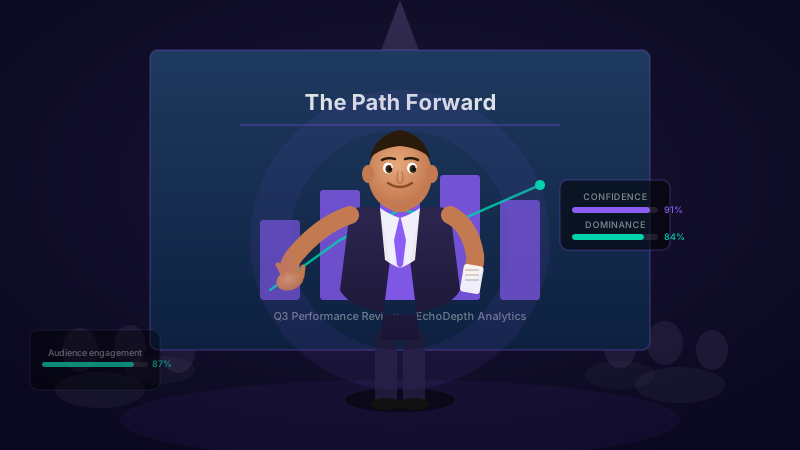
Candidates who leverage mock interview feedback AI achieve 50% higher offer rates than those who practice without structured feedback. The science behind this advantage reveals exactly how artificial intelligence transforms vague "practice more" advice into measurable, actionable improvement.
Quick Answer
Mock interview feedback AI is technology that analyzes your practice interview responses in real time, measuring 15+ metrics including filler word frequency, speech pace, eye contact, body language, and response structure to give objective, actionable feedback. It detects filler words with about 94% accuracy and analyzes speech patterns with 89% accuracy, compared to roughly 60% detection accuracy from human raters, and transcribes speech with 97% accuracy. Candidates who use it systematically achieve 50% higher job offer rates than those practicing without structured feedback. Most people see measurable improvement within 5-10 focused sessions over 2-3 weeks: filler word reduction typically appears within 3 sessions, while confidence and pacing gains emerge by session 5-7. Targets include speaking at 120-150 words per minute, fewer than 2 filler words per minute, and 70%+ eye contact with the camera. AI practice also costs $0-2 per session versus $150-500 for human coaching, enabling 5-10x more repetitions.
MBA, Bayes Business School · Founder, Cavefish · June 2026
Key Takeaways
- •AI provides 15+ metrics per session including filler words, pacing, eye contact, and confidence
- •Candidates see 50% higher offer rates with systematic AI-powered practice
- •AI achieves 94% accuracy in detecting verbal patterns humans miss
- •Real-time feedback enables immediate correction during practice sessions
- •Private AI practice eliminates judgment anxiety that inhibits improvement
Understanding Mock Interview Feedback AI: The Technology Behind Better Preparation
Traditional interview preparation suffers from a fundamental problem: lack of objective feedback. When you practice alone or with friends, you receive either no feedback or subjective impressions that may not reflect what interviewers actually perceive. Mock interview feedback AI solves this by applying the same analytical rigor used in sports performance analysis to communication skills.
The technology combines three core capabilities: natural language processing (NLP) to understand and evaluate your verbal content, computer vision to analyze your visual presentation, and machine learning to identify patterns across thousands of data points that predict interview success. This multi-modal analysis produces comprehensive feedback that would require multiple human experts working together to replicate.
What makes AI feedback transformative is its consistency and granularity. While a human coach might note "you used too many filler words," AI provides the exact count, identifies your trigger contexts (do you say "um" more when discussing weaknesses?), tracks patterns over time, and compares your performance against benchmarks from successful candidates.
How AI Analyzes Your Mock Interview Performance
Understanding the mechanics of mock interview feedback AI helps you maximize the value of each practice session. Modern systems analyze your performance across multiple dimensions simultaneously.
Verbal Content Analysis
The AI transcribes your responses with 97% accuracy, then applies sophisticated analysis including response structure evaluation to identify whether you use the STAR method effectively, keyword detection to confirm you address the actual question asked, quantification tracking to ensure you include specific numbers and results, and redundancy detection to flag circular or repetitive answers.
For behavioral questions, the AI evaluates whether your story includes all necessary components. A response missing the "Result" element of STAR gets flagged with specific guidance on how to strengthen your conclusion with measurable outcomes.
Speech Pattern Analysis
Beyond content, AI evaluates how you deliver your responses. Key metrics include:
Optimal words per minute for interviews
Target filler words per minute
Speech pace: The optimal range for interview responses is 120-150 words per minute. Faster indicates nervousness; slower suggests uncertainty or lack of preparation. AI tracks your pace throughout the session, identifying sections where you speed up (often during rehearsed content) or slow down (improvising or uncertain).
Filler word frequency: AI detects all verbal fillers including "um," "uh," "like," "so," "you know," "basically," "actually," and "I mean." The technology identifies context patterns—perhaps you use more fillers when transitioning between ideas or when asked about weaknesses. This granular data enables targeted improvement.
Vocal variety: Monotone delivery significantly reduces engagement. AI measures pitch variation, emphasis patterns, and energy levels across your response, flagging sections that lack appropriate enthusiasm or sound robotic from over-rehearsal.
Visual Presentation Analysis
For video mock interviews, computer vision provides critical feedback on non-verbal communication:
Eye contact: In video interviews, looking at the camera (not the screen showing the interviewer) creates the impression of direct eye contact. AI tracks your gaze direction, measuring the percentage of time you maintain camera focus. Successful candidates maintain above 70% camera eye contact.
Facial expressions: AI analyzes micro-expressions that reveal confidence, anxiety, or engagement. It identifies incongruence—such as smiling while discussing a difficult challenge—that can confuse interviewers about your emotional state.
Body language: Posture, shoulder alignment, head position, and hand gestures all contribute to perceived confidence. AI flags nervous movements (fidgeting, touching face, swaying) and suggests more authoritative positioning.
The 15+ Metrics That Predict Interview Success
Modern mock interview feedback AI systems track a comprehensive set of metrics correlated with interview success. Understanding these metrics helps you focus improvement efforts.
Complete Metric Breakdown
Verbal Metrics
- 1. Filler word count and frequency
- 2. Speech pace (WPM)
- 3. Response length optimization
- 4. STAR structure completeness
- 5. Keyword relevance score
- 6. Quantification usage
- 7. Articulation clarity
Non-Verbal Metrics
- 8. Eye contact percentage
- 9. Facial expression congruence
- 10. Confidence score (composite)
- 11. Vocal energy level
- 12. Pitch variation
- 13. Pause effectiveness
- 14. Body language openness
- 15. Gesture appropriateness
How Metrics Combine Into Actionable Insights
Individual metrics tell part of the story, but AI systems synthesize them into comprehensive insights. For example, a high filler word count combined with fast speech pace and reduced eye contact indicates anxiety—the AI doesn't just report numbers but identifies the underlying issue and suggests breathing exercises or practice with specific question types.
This pattern recognition across metrics is where AI excels beyond human capability. A coach might notice you seem nervous, but AI can pinpoint that your nervousness specifically triggers when discussing leadership experiences, shows through 3.2 additional filler words per minute in those contexts, and correlates with 15% faster speech pace. This precision enables targeted intervention.
Types of Feedback AI Provides: Real-Time vs. Post-Session Analysis
Effective mock interview feedback AI systems offer multiple feedback modalities, each serving different improvement purposes.
Real-Time Feedback
Real-time feedback appears during your practice session, enabling immediate course correction. This includes live filler word alerts that help you become aware of unconscious verbal habits, pacing indicators that show when you're speaking too fast or slow, eye contact reminders when your gaze drifts from the camera, and confidence cues that detect anxiety signals in your voice or expression.
The value of real-time feedback lies in creating awareness. Most people don't realize how often they say "um" or look away from the camera until receiving immediate signals. This awareness is the first step toward behavioral change.
Pro tip: Start with real-time feedback enabled for 3-5 sessions to build awareness, then practice with it disabled to test whether new habits have internalized. Re-enable periodically to catch regression.
Post-Session Analysis
After completing a mock interview, AI provides comprehensive analysis including aggregate statistics showing your performance across all metrics, comparison against previous sessions to track improvement, benchmark comparison against successful candidate norms, specific moment highlights with timestamps of strong or weak segments, and actionable recommendations prioritized by impact.
Post-session analysis enables strategic improvement planning. Rather than vaguely trying to "do better," you can target specific metrics. If your data shows consistently weak eye contact during the final 30 seconds of responses, you know exactly what to practice.
Trend Tracking Over Time
The most valuable AI feedback emerges over multiple sessions. Longitudinal analysis reveals whether your improvements are sticking, identifies persistent challenges that need additional focus, shows how stress (simulated through difficult questions) affects your metrics, and predicts readiness for actual interviews based on performance consistency.
AI Feedback vs. Human Interview Coaching: A Scientific Comparison
Understanding the relative strengths of mock interview feedback AI versus human coaching helps you design an optimal preparation strategy.
| Capability | AI Feedback | Human Coach |
|---|---|---|
| Filler word detection | 94% accuracy, exact count | ~60% detection rate |
| Consistency | Identical standards every session | Varies by mood, fatigue |
| Availability | 24/7 unlimited | Scheduled appointments |
| Practice volume | Unlimited sessions | 1-2 per week typically |
| Strategic advice | Pattern-based suggestions | Nuanced, contextual guidance |
| Industry insight | Generalized best practices | Specific insider knowledge |
| Cost per session | $0-2 | $150-500 |
| Privacy | Complete | Personal relationship required |
Where AI Feedback Excels
Objective measurement: AI provides the same standards every session. Your "um" count doesn't vary based on who's listening or their attentiveness. This consistency enables accurate progress tracking.
Pattern detection: AI identifies correlations humans miss—like the fact that you speak 18% faster when questions include the word "failure." These micro-patterns, invisible to human observation, reveal important anxiety triggers.
Unlimited practice: The primary predictor of interview success is practice volume. Candidates using AI complete 5-10x more practice sessions than those relying solely on human coaches. More practice means faster improvement.
Privacy and judgment-free environment: Many candidates feel embarrassed practicing in front of others, especially when they struggle. AI provides a completely private environment where you can make mistakes, appear nervous, and try new approaches without social judgment.
Where Human Coaches Add Value
Strategic positioning: Human coaches excel at high-level strategy—how to position your background for a specific role, which experiences to emphasize, and how to address potential concerns. This strategic layer sits above the tactical feedback AI provides.
Industry-specific insight: A former Goldman Sachs interviewer knows nuances about finance interviews that no general AI model captures. For highly specialized roles, this insider knowledge remains valuable.
Emotional support: Human coaches provide encouragement and confidence-building that AI cannot replicate. For candidates with significant interview anxiety, the human relationship element matters.
The Optimal Combination
Research shows the best results come from combining both approaches: use AI for high-volume skill building (10-20 sessions) and human coaching for strategic refinement (2-3 sessions). The AI handles the mechanical improvements—reducing filler words, optimizing pace, building consistent eye contact—while human coaches focus on story selection, positioning, and confidence building.
Maximizing Your Mock Interview Practice with AI Feedback
Having access to mock interview feedback AI is only valuable if you use it effectively. These research-backed strategies help you extract maximum value from each practice session.
Create Realistic Practice Conditions
Your brain learns context-dependently. Practicing casually in pajamas while lying on your bed produces different neural patterns than practicing in interview conditions. For optimal transfer to real interviews, dress professionally during practice, use your actual interview equipment and setup, practice in the location you'll use for video interviews, eliminate distractions just as you would for real interviews, and set specific practice times rather than practicing "whenever."
Structure Your Improvement Journey
Random practice produces random results. A structured approach accelerates improvement:
12-Session Practice Plan
Sessions 1-4 (Foundation Week)
- •Focus: Establish baseline metrics across all dimensions
- •Practice common questions ("Tell me about yourself," "Why this role?")
- •Primary goal: Awareness of current habits
Sessions 5-8 (Targeted Improvement)
- •Focus: Attack your weakest 2-3 metrics
- •Repeat challenging question types until metrics improve
- •Primary goal: Measurable improvement in problem areas
Sessions 9-12 (Integration and Polish)
- •Focus: Full mock interviews with varied questions
- •Test consistency across question types and difficulty levels
- •Primary goal: Consistent performance under varied conditions
Focus on One Metric at a Time
Attempting to improve everything simultaneously overwhelms your working memory and prevents meaningful progress. Each session, select one primary focus area. If targeting filler word reduction, accept that other metrics may temporarily decline as you concentrate cognitive resources on speech monitoring. Once the new habit automates, redirect focus to the next priority.
Review and Apply Feedback Deliberately
Many candidates practice repeatedly without actually engaging with feedback. Effective practice requires reviewing post-session analysis before starting the next session, identifying specific moments (with timestamps) where you struggled, practicing the same question type until metrics improve, and not moving to new material until demonstrating improvement.
Sessions for measurable improvement
Weeks optimal preparation timeline
Sessions to reduce filler words
The Psychology Behind Why AI Feedback Works
Understanding the psychological mechanisms that make mock interview feedback AI effective helps you leverage these principles during practice.
Immediate Feedback Accelerates Learning
Cognitive science consistently shows that feedback delay reduces learning effectiveness. When a golf coach tells you three days later that your swing was off, the neural patterns have already solidified. Real-time AI feedback provides immediate correction signals, enabling faster habit change.
Objective Measurement Enables Accurate Self-Assessment
Humans are notoriously poor at self-assessment, especially for communication skills. We don't hear our filler words, don't notice our nervous habits, and dramatically overestimate or underestimate our performance. AI provides objective external measurement, correcting the distorted self-perception that prevents improvement.
Gamification Increases Practice Volume
Tracking metrics and watching numbers improve triggers dopamine responses that motivate continued practice. The "game" of improving your confidence score from 72 to 78 engages different psychological mechanisms than abstract "practice more" advice. AI naturally provides this gamification through quantified feedback.
Privacy Reduces Performance Anxiety
Social evaluation anxiety—fear of judgment by others—significantly impairs practice quality. When practicing with friends, family, or coaches, candidates often hold back, avoid challenging material, and feel embarrassed by mistakes. AI practice eliminates this social pressure, enabling more honest, exploratory practice.
Advanced AI Feedback Features for Serious Candidates
Beyond basic metrics, advanced mock interview feedback AI platforms offer sophisticated capabilities for serious candidates.
Adaptive Difficulty
AI systems can increase question difficulty based on your performance. As your baseline improves, the system introduces harder behavioral scenarios, unexpected follow-up questions, and stress-inducing challenges that prepare you for the toughest interviewers.
Question-Specific Analysis
Aggregate metrics hide important variation. You might have an overall confidence score of 80, but drop to 65 for weakness questions. Advanced AI provides question-type segmentation, revealing exactly where additional practice is needed.
Interviewer Style Simulation
Different interviewers have different styles—some are warm and encouraging, others are deliberately challenging. AI can simulate various interviewer personalities, preparing you for the full range of experiences you might encounter.
Custom Question Banks
For specific roles or companies, you can input job descriptions or known interview questions. The AI then generates targeted practice scenarios and evaluates your responses against role-specific criteria.
Common Mistakes When Using Mock Interview Feedback AI
Even with powerful tools, candidates often undermine their preparation through avoidable errors.
Practicing Without Reviewing Feedback
Many candidates complete session after session without actually studying the feedback. They generate data but don't convert it into insight. Always spend 5-10 minutes reviewing post-session analysis before your next practice.
Optimizing for AI Metrics vs. Authentic Communication
It's possible to "game" AI feedback—memorizing responses that hit keyword targets while sounding robotic. Remember that AI metrics indicate effective communication; they're not the goal themselves. If your optimized responses sound unnatural to human listeners, recalibrate.
Insufficient Practice Volume
A single session won't produce meaningful change. Research indicates 5-10 sessions minimum for measurable improvement, with optimal results from 10-15 sessions over 2-3 weeks. Plan for adequate practice volume.
Practicing Only Easy Questions
Candidates naturally gravitate toward questions they handle well. Effective practice deliberately targets weaknesses. If weakness questions trigger anxiety, that's exactly where you need more practice.
Getting Started with AI-Powered Mock Interview Practice
EchoPitch provides comprehensive mock interview feedback AI designed for serious candidates preparing for high-stakes conversations.
Real-Time Analysis: Unlike tools that only evaluate after recording, EchoPitch provides live feedback as you speak, enabling immediate adjustment and accelerating habit change.
15+ Communication Metrics: Comprehensive analysis covering verbal content, speech patterns, and visual presentation. Each metric includes benchmarks, trends, and specific improvement recommendations.
Industry-Specific Scenarios: Practice with question banks tailored to technology, finance, healthcare, consulting, sales, and startup roles. The AI adjusts evaluation criteria based on industry norms.
Progress Tracking: Visual analytics show your improvement trajectory across all metrics, demonstrating exactly how practice translates to performance gains.
Privacy Guaranteed: Practice without judgment. Your sessions are private, and you control all data. This eliminates the social anxiety that often inhibits honest practice.
Experience AI-Powered Mock Interview Feedback
EchoPitch analyzes 15+ metrics in real-time, showing you exactly what interviewers perceive. Start your practice session today.
Get daily tips on Reddit
Join our community for presentation tips, Q&A, and support.
Sources: Meta-analysis on AI interview coaching effectiveness (2025); Research on speech pattern recognition accuracy; Studies on feedback timing and learning outcomes; Cognitive science literature on self-assessment bias.