
The Ultimate Guide to Using an AI Interview Coach: Everything You Need to Know in 2026
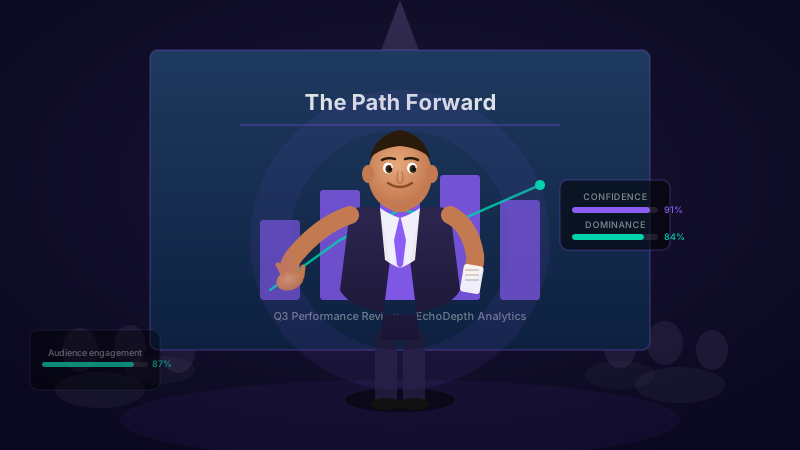
In the competitive 2026 job market, candidates who use an AI interview coach are 50% more likely to receive job offers than those who practice without structured feedback. This comprehensive guide covers everything you need to know about leveraging artificial intelligence to transform your interview preparation and land your dream role.
Quick Answer
An AI interview coach is software that simulates job interviews, analyzes your responses in real time, and gives feedback on verbal delivery, body language, and content quality — the same objective analysis a human coach would provide, without the cost or scheduling constraints. Modern (2025-2026) systems combine natural language processing, computer vision, and emotion recognition to track 15+ communication metrics, including filler words, pacing, eye contact, and confidence signals. Candidates who practice systematically with AI coaching report 50% higher job offer rates than those who prepare without structured feedback, largely because they complete 5-10x more practice sessions than is realistic with a human coach, with measurable improvement typically appearing within 5-10 focused sessions. Pricing also differs sharply: AI coaching runs roughly $0-50/month, compared with $150-500 per session for a human interview coach, which is why most candidates now use AI practice as their primary preparation method and reserve human coaching for final polish before high-stakes interviews.
MBA, Bayes Business School · Founder, Cavefish · June 2026
Key Takeaways
- •50% higher offer rates for candidates using AI interview coaching systematically
- •AI coaches analyze 15+ communication metrics including filler words, pacing, eye contact, and confidence
- •Users complete 5-10x more practice sessions with AI than with human coaches alone
- •Measurable improvement appears after just 5-10 focused sessions
- •AI coaching costs $0-50/month vs. $150-500/session for human coaches
- •Private practice eliminates judgment anxiety that inhibits authentic improvement
Table of Contents
- 1. What Is an AI Interview Coach?
- 2. How AI Interview Coaches Work
- 3. Benefits of AI vs. Human Coaching
- 4. Types of Interviews AI Can Help With
- 5. Key Features to Look For
- 6. Step-by-Step: How to Use Effectively
- 7. Advanced Strategies for Power Users
- 8. Common Mistakes to Avoid
- 9. AI Interview Coach Tool Comparison
- 10. Industry-Specific Preparation
- 11. Measuring Progress and ROI
- 12. The Future of AI Interview Coaching
What Is an AI Interview Coach?
An AI interview coach is a software application that uses artificial intelligence to simulate job interviews, analyze your responses in real-time, and provide actionable feedback on your verbal delivery, body language, and content quality. Unlike practicing alone in front of a mirror or with reluctant friends, AI interview coaching offers objective, consistent analysis of exactly how you communicate under pressure.
The concept of automated interview preparation has evolved dramatically since the early 2020s. The first generation of interview preparation tools were simple question banks with sample answers. The second generation introduced basic speech analysis, counting filler words and measuring response length. Today's third-generation AI interview coaches represent a quantum leap forward, combining natural language processing, computer vision, emotion recognition, and machine learning to provide comprehensive feedback that rivals—and in some ways exceeds—human coaching.
The Evolution of Interview Preparation Technology
2015-2018: Question Banks and Video Recording
Early tools focused on providing interview questions and allowing candidates to record responses. Feedback was limited to self-review or sharing recordings with friends. No automated analysis existed.
2019-2022: Basic Speech Analysis
The introduction of speech-to-text APIs enabled basic analysis: filler word counting, response length measurement, and simple keyword detection. Feedback was helpful but limited to verbal content.
2023-2024: Multimodal AI Analysis
Advances in computer vision and natural language processing enabled analysis of facial expressions, eye contact, body language, and emotional congruence. Real-time feedback became possible.
2025-2026: Comprehensive AI Coaching
Current systems integrate all analysis modalities, provide personalized improvement recommendations based on machine learning, track progress over time, and adapt difficulty based on performance. The gap between AI and human coaching has narrowed significantly.
Applications per corporate job posting
Time to form first impression
Why AI Interview Coaching Matters in 2026
The stakes of interview performance have never been higher. Consider these realities of the modern job market:
Intense competition: The average corporate job posting receives 250+ applications. By the time you reach the interview stage, you're competing against 5-10 equally qualified candidates. Your technical skills got you in the room—your communication determines whether you get the offer.
First impressions are decisive: Research shows that interviewers form preliminary judgments about candidates within the first 7 seconds of meeting. Your opening moments set the tone for the entire conversation, and recovering from a weak start is nearly impossible.
Remote interviews amplify weaknesses: Video interviews—now standard even for roles that will be in-person—create unique challenges. Poor eye contact, nervous fidgeting, and filler words become more noticeable on camera. A 2024 LinkedIn study found that 78% of hiring managers noticed communication weaknesses more clearly in video interviews than in-person meetings.
Qualified candidates fail regularly: Studies consistently show that interview performance predicts hiring decisions more strongly than actual qualifications. Candidates who communicate confidently often beat more qualified competitors who present poorly. This reality makes interview preparation a critical career investment.
How AI Interview Coaches Work
Understanding the technology behind an AI interview coach helps you maximize its value and interpret feedback more effectively. Modern systems combine multiple AI technologies working in concert to analyze your performance comprehensively.
Natural Language Processing (NLP)
NLP technology processes the actual content of your responses. The AI transcribes your speech with 97%+ accuracy, then analyzes multiple dimensions:
- •Response structure: Does your answer follow logical progression? For behavioral questions, does it include all STAR elements (Situation, Task, Action, Result)?
- •Keyword relevance: Are you addressing the actual question asked? Do your responses include terminology relevant to the role?
- •Quantification: Are you providing specific numbers and results, or vague generalities?
- •Filler word detection: AI identifies every "um," "uh," "like," "so," "you know," "basically," and similar verbal fillers with 94% accuracy—far exceeding human detection rates of approximately 60%.
- •Redundancy analysis: Does your response circle back on itself? Are you repeating points unnecessarily?
Speech Analysis
Beyond the words themselves, AI evaluates how you deliver your responses through sophisticated audio analysis:
Pacing (words per minute): The optimal range for interview responses is 120-150 WPM. Speaking faster signals nervousness and makes complex ideas hard to follow. Speaking slower suggests uncertainty or lack of preparation. AI tracks your pace throughout the session, identifying sections where you speed up (often during rehearsed content) or slow down (improvising or uncertain).
Vocal variety: Monotone delivery significantly reduces engagement. AI measures pitch variation across your response, flagging sections that lack appropriate emphasis or sound robotic from over-rehearsal.
Vocal energy and confidence: AI analyzes voice steadiness, energy levels, and confidence markers. Tremor, hesitation, and dropping volume at the ends of sentences all signal uncertainty.
Pause patterns: Strategic pauses for emphasis indicate confidence and control. Awkward silences while searching for words indicate lack of preparation. AI distinguishes between these pause types.
Optimal WPM for interviews
Target filler words per minute
Target camera eye contact
Computer Vision Analysis
For video-based practice, computer vision provides critical feedback on non-verbal communication—often more important than verbal content:
Eye contact tracking: In video interviews, looking at the camera (not the screen showing the interviewer) creates the impression of direct eye contact. AI tracks your gaze direction frame-by-frame, measuring the percentage of time you maintain camera focus. Successful candidates maintain above 70% camera eye contact.
Facial expression analysis: AI identifies micro-expressions revealing confidence, anxiety, engagement, or confusion. It flags incongruence—such as smiling while discussing a difficult challenge—that can confuse interviewers about your emotional state.
Body language assessment: Posture, shoulder alignment, head position, hand gestures, and nervous movements all contribute to perceived confidence. AI flags problematic patterns like fidgeting, touching face, swaying, or slumping.
Professional presentation: Background cleanliness, lighting quality, and framing all affect interviewer perception. AI provides feedback on these technical elements that many candidates overlook.
Machine Learning and Pattern Recognition
The most sophisticated capability of modern AI interview coaches is pattern recognition across thousands of data points:
Correlation analysis: AI identifies relationships between metrics that humans miss. For example, you might speak 18% faster and use 3.2 additional filler words per minute specifically when questions include the word "failure." This granular pattern detection reveals your anxiety triggers.
Benchmark comparison: Your performance is compared against aggregated data from successful candidates in similar roles. This contextualization makes raw metrics actionable—knowing your pace is 165 WPM becomes meaningful when you learn successful candidates average 135 WPM.
Personalized recommendations: Rather than generic advice, AI generates specific improvement suggestions based on your unique performance patterns. Two candidates with the same overall confidence score might receive different recommendations based on the underlying drivers of that score.
The AI Coaching Session Flow
- Select your scenario (industry, role level, interview type)
- Receive a question (behavioral, technical, or situational)
- Record your response (video or audio)
- Receive real-time feedback alerts during recording (optional)
- Get comprehensive post-response analysis with specific metrics
- Review trends and comparisons against previous sessions
- Receive prioritized improvement recommendations
- Practice the same or similar questions incorporating feedback
Benefits of AI vs. Human Coaching
Understanding the relative strengths of an AI interview coach versus human coaching helps you design an optimal preparation strategy. Each approach has distinct advantages, and the most successful candidates often combine both.
| Factor | AI Coach | Human Coach |
|---|---|---|
| Availability | 24/7 unlimited | Scheduled appointments |
| Practice Volume | Unlimited sessions | 1-2 sessions per week |
| Cost | Free-$50/month | $150-500/session |
| Feedback Speed | Real-time or instant | 24-48 hours typical |
| Consistency | Identical standards | Varies by mood/fatigue |
| Objectivity | Data-driven metrics | Subjective impressions |
| Pattern Detection | Micro-patterns across thousands of data points | General impressions |
| Privacy | Complete anonymity | Personal relationship |
| Strategic Advice | Pattern-based suggestions | Nuanced, contextual guidance |
| Industry Insight | Generalized best practices | Specific insider knowledge |
| Emotional Support | Limited | Encouragement, confidence building |
Where AI Interview Coaching Excels
Unlimited practice volume: The single most important predictor of interview success is practice volume. Candidates using AI complete 5-10x more practice sessions than those relying solely on human coaches. With AI, you can practice at 2 AM, during lunch breaks, or whenever anxiety strikes—no scheduling required. This accessibility translates directly to faster improvement.
Objective measurement and consistency: AI provides identical standards every session. Your filler word count doesn't vary based on who's listening or their attentiveness. This consistency enables accurate progress tracking over time. You'll know definitively whether you're improving, not just subjectively feel like you might be.
Granular pattern detection: AI identifies correlations humans miss. A human coach might notice you seem nervous during leadership questions, but AI can quantify that your nervousness specifically manifests as 3.2 additional filler words per minute, 18% faster speech pace, and 15% reduced eye contact. This precision enables targeted intervention.
Privacy and judgment-free practice: Many candidates feel embarrassed practicing in front of others, especially when struggling. This social anxiety inhibits honest practice—you avoid challenging questions, hold back authentic responses, and can't fully explore your weaknesses. Practicing job interviews privately with AI eliminates this barrier completely.
Cost effectiveness: At $0-50 per month for unlimited practice versus $150-500 per human coaching session, AI democratizes access to interview preparation. A candidate can complete 20+ AI practice sessions for the cost of a single human coaching session.
Where Human Coaching Adds Value
Strategic positioning: Human coaches excel at high-level strategy—how to position your background for a specific role, which experiences to emphasize, how to address potential concerns, and what narrative to build. This strategic layer sits above the tactical feedback AI provides.
Industry-specific insight: A former Google interviewer knows nuances about tech interviews that no general AI model captures. For highly specialized roles, this insider knowledge remains valuable. Human coaches can provide company-specific intelligence AI lacks.
Nuanced contextual advice: Some situations require human judgment. How should you address a career gap due to family caregiving? What's the right tone when discussing a difficult departure from a previous role? Human coaches navigate these nuances better than current AI systems.
Emotional support and confidence building: Human coaches provide encouragement that AI cannot replicate. For candidates with significant interview anxiety, the human relationship element matters. A skilled coach builds confidence through personal connection.
The Optimal Combination Strategy
Research shows the best results come from combining both approaches strategically:
Combined Preparation Approach
For maximum interview readiness, use both AI and human coaching in complementary ways:
- •AI coaching (10-20 sessions): High-volume skill building—reducing filler words, optimizing pace, building consistent eye contact, improving response structure
- •Human coaching (2-3 sessions): Strategic refinement—story selection, positioning, addressing specific concerns, industry insights, confidence building
- •Timeline: Start AI practice 3-4 weeks before interviews; schedule human coaching 1-2 weeks before to refine strategy
Types of Interviews AI Can Help With
An AI interview coach adapts to multiple interview formats, providing tailored feedback for each type. Understanding how AI helps with different interview formats enables you to customize your practice effectively.
Behavioral Interviews
Behavioral interviews—the most common format—ask you to describe past experiences that demonstrate competencies ("Tell me about a time when..."). AI excels at analyzing behavioral responses by evaluating STAR structure completeness, identifying missing elements like quantified results, detecting vague generalities versus specific examples, and measuring response length to ensure comprehensive but concise answers.
For behavioral questions, AI provides particularly valuable feedback because structure matters enormously. A response missing the "Result" element of STAR gets flagged with specific guidance on how to strengthen your conclusion with measurable outcomes. AI-powered mock interview feedback can transform vague stories into compelling evidence of your competencies.
Technical Interviews
While AI doesn't evaluate the technical correctness of your answers, it provides crucial feedback on how you communicate technical concepts. This includes clarity when explaining complex ideas, problem-solving narration style, confidence when discussing challenges or limitations, pacing during whiteboard-style explanations, and avoiding jargon overload versus appropriate terminology.
Technical excellence means nothing if you can't communicate it effectively. Many technically brilliant candidates fail interviews because they explain concepts poorly, seem uncertain despite knowing the material, or fail to structure their problem-solving narration. AI addresses these communication gaps.
Case Interviews
Consulting and business case interviews require structured problem-solving communicated clearly. AI helps by analyzing your framework articulation, evaluating logical progression of analysis, measuring confidence during hypothesis development, detecting hedging language that undermines authority, and identifying clear communication of recommendations.
Panel Interviews
Panel interviews with multiple interviewers present unique challenges. AI practice helps by building confidence managing multiple questioners, practicing eye contact distribution techniques, developing poise under pressure, and maintaining consistent energy across longer sessions.
Phone Screen Interviews
Without visual cues, phone screens place all emphasis on vocal delivery. AI provides focused feedback on vocal clarity and projection, pacing without visual engagement feedback, energy levels throughout the conversation, verbal acknowledgment and engagement signals, and filler word frequency which becomes more noticeable on phone.
Video Interviews
Video interviews—now standard for initial screens—require specific skills. Video interview practice and AI coaches provide feedback on camera eye contact versus looking at screen, framing and positioning, lighting and background professionalism, facial expressions visible on camera, and body language within limited frame.
Executive and Leadership Interviews
Senior roles face scrutiny on executive presence and strategic thinking. AI helps develop authoritative vocal delivery, confident body language, concise communication of complex topics, measured pacing appropriate for leadership, and reducing verbal hedges that undermine authority.
Sales and Customer-Facing Interviews
Sales roles require high energy and persuasive communication. AI measures enthusiasm and energy levels, evaluates persuasive language patterns, analyzes active listening signals, assesses objection handling delivery, and tracks rapport-building techniques.
AI accuracy in detecting filler words
Hiring managers notice video interview weaknesses more
Key Features to Look For in an AI Interview Coach
Not all AI interview coach platforms offer the same capabilities. When evaluating tools, prioritize these features based on their impact on your preparation effectiveness:
Essential Features
Real-time feedback: The most valuable AI coaches provide feedback during your practice session, not just after. Real-time alerts for filler words, pacing issues, and eye contact lapses create immediate awareness that accelerates habit change. Tools that only analyze after recording provide less actionable feedback.
Comprehensive metrics: Look for platforms analyzing 15+ metrics across verbal, vocal, and visual dimensions. Limited metrics (filler words only, for example) provide incomplete pictures. The best tools measure filler word frequency, speech pace, vocal variety, eye contact, facial expressions, body language, response structure, and confidence scores.
Progress tracking over time: Single-session feedback matters less than tracking improvement across multiple sessions. Look for visual analytics showing your metrics over time, comparison against previous sessions, and trend identification. Without longitudinal tracking, you can't verify whether practice is actually working.
Question variety and customization: Quality platforms offer extensive question banks covering different interview types (behavioral, technical, situational) and allow custom question input. You should be able to practice with questions specific to your target roles and companies.
Advanced Features
Industry-specific scenarios: Generic practice is less effective than role-specific preparation. Top platforms offer industry-specific question banks and adjust evaluation criteria based on field norms. Tech interviews expect different energy levels than finance interviews, and good AI adapts accordingly.
Adaptive difficulty: AI that increases question difficulty based on your performance prevents stagnation. As your baseline improves, the system should introduce harder scenarios, unexpected follow-up questions, and stress-inducing challenges.
Video analysis capabilities: Since video interviews are standard, choose platforms that analyze visual presentation—eye contact, facial expressions, body language, background, and framing. Audio-only tools miss critical feedback dimensions.
Session recording and playback: The ability to review your recordings alongside AI analysis enables deeper self-reflection. You can observe exactly what the AI flagged and better understand the feedback.
Quality Indicators
Accuracy and reliability: AI feedback is only valuable if accurate. Look for platforms citing accuracy rates for key metrics (filler word detection should exceed 90%) and consistent analysis across similar responses.
Actionable recommendations: Numbers alone aren't helpful. Quality platforms translate metrics into specific improvement suggestions. Instead of just reporting "8 filler words," excellent tools identify your trigger patterns and suggest targeted exercises.
Privacy and data security: Your practice sessions contain sensitive information. Reputable platforms offer encrypted storage, automatic session deletion options, clear privacy policies, and no data sharing with third parties.
Step-by-Step: How to Use an AI Interview Coach Effectively
Having access to an AI interview coach is only valuable if you use it effectively. This detailed guide walks you through maximizing every practice session.
Phase 1: Setup and Environment (Before Practice)
Create realistic conditions: Your brain learns context-dependently. Practicing casually in pajamas produces different neural patterns than practicing in interview conditions. For optimal transfer to real interviews:
- •Dress professionally during practice sessions
- •Use the same device and setup you'll use for actual interviews
- •Practice in your interview location when possible
- •Eliminate distractions just as you would for real interviews
- •Set specific practice times rather than practicing "whenever"
Configure your platform: Select industry, role level, and interview type appropriate to your target position. Enable or disable real-time feedback based on your current practice phase. Ensure camera and microphone are working properly with good lighting.
Phase 2: Foundation Building (Sessions 1-5)
The first sessions establish baseline metrics and build awareness of your current habits.
Session goals:
- •Practice common questions ("Tell me about yourself," "Why this role?", "Why are you leaving your current position?")
- •Don't try to be perfect—focus on capturing authentic baseline performance
- •Review feedback carefully after each session
- •Identify your 2-3 weakest metrics and question types
Key metrics to establish: Document your starting points for filler word frequency, speech pace, eye contact percentage, and confidence score. These baselines will measure your progress.
Phase 3: Targeted Improvement (Sessions 6-12)
With baselines established, focus practice on your weakest areas.
Single-metric focus: Each session, choose ONE primary improvement target. Trying to improve everything simultaneously overwhelms working memory and prevents meaningful progress. If targeting filler word reduction, accept that other metrics may temporarily decline as you concentrate cognitive resources.
Targeted Practice Schedule
- •Sessions 6-7: Focus on your weakest metric (often filler words)
- •Sessions 8-9: Focus on your second-weakest metric
- •Sessions 10-12: Focus on your most challenging question types
Repetition with variation: Practice the same question type multiple times until metrics improve, then try variations. Don't move to new material until demonstrating improvement on current focus areas.
Phase 4: Integration and Polish (Sessions 13-20)
With individual skills improved, integrate them into full interview simulations.
Full mock interviews: Run complete practice sessions with mixed question types, varying difficulty, and no pauses between questions. Measure consistency of performance across the entire session rather than individual responses.
Stress testing: Practice under challenging conditions—difficult questions, curveball scenarios, time pressure. Your metrics under stress reveal true readiness.
Final refinement: Identify any persistent weaknesses and dedicate final sessions to addressing them. Your goal is consistent, confident performance regardless of question type.
Pro tip: Most candidates have 2-3 questions that consistently trip them up: "What's your greatest weakness?", "Why did you leave your last role?", or "Where do you see yourself in 5 years?" Identify yours and practice them repeatedly until your response feels completely natural.
Phase 5: Maintenance and Pre-Interview (Ongoing)
Week before interviews: Conduct 2-3 full mock interviews to confirm readiness. Review metrics to ensure no regression. Focus on confidence and consistency rather than trying to make last-minute changes.
Day before: One light practice session to warm up without exhausting yourself. Trust your preparation.
Between interviews: After each real interview, practice again to reinforce skills and address any weaknesses that emerged.
Advanced Strategies for Power Users
Once you've mastered fundamentals, these advanced strategies help serious candidates extract maximum value from their AI interview coach.
Question-Specific Analysis
Aggregate metrics hide important variation. You might have an overall confidence score of 80, but drop to 65 for weakness questions. Advanced practice involves segmenting your performance by question type.
- •Track metrics separately for different question categories (behavioral, technical, situational)
- •Identify specific topics that trigger anxiety (leadership questions, failure questions, salary discussion)
- •Target practice specifically at high-anxiety question types
Stress Inoculation Training
Practice under artificially stressful conditions to build resilience:
- •Practice with shorter response time limits than actual interviews
- •Include deliberately difficult or uncomfortable questions
- •Practice after exercise when your heart rate is elevated
- •Introduce unexpected follow-up questions
When real interviews feel easier than practice, you've successfully stress-inoculated.
Deliberate Experimentation
Use AI feedback to test different approaches systematically:
- •Try the same answer at different pacing and compare metrics
- •Experiment with more/less hand gestures and measure impact
- •Test different opening approaches for "Tell me about yourself"
- •Compare metrics when you stand versus sit during video practice
Recording Analysis Deep-Dives
Beyond reading AI feedback, conduct detailed self-analysis:
- •Watch recordings at 0.5x speed to observe subtle behaviors
- •Note timestamps of your strongest and weakest moments
- •Identify what you were thinking/feeling during weak moments
- •Create mental rehearsal strategies for challenging moments
Metric Thresholds for Interview Readiness
Define specific metric targets that indicate readiness for real interviews:
Interview Readiness Benchmarks
- •Filler words: <2 per minute consistently
- •Speech pace: 120-150 WPM with <10% variation
- •Eye contact: >70% camera focus
- •Confidence score: >75/100 across all question types
- •Consistency: <15% variation between sessions
Common Mistakes to Avoid
Even with powerful tools, candidates often undermine their preparation through avoidable errors. Recognizing these pitfalls helps you extract maximum value from your AI interview coach.
Mistake 1: Practicing Without Reviewing Feedback
Many candidates complete session after session without actually studying the feedback. They generate data but don't convert it into insight. The AI provides detailed analysis, but improvement requires deliberate engagement with that analysis. The gains compound: candidates who reduce filler words by half report roughly 40% more positive interviewer responses, but only once they act on what the report shows them.
Solution: Spend 5-10 minutes reviewing post-session analysis before your next practice. Identify specific moments (with timestamps) where you struggled. Create notes on patterns and improvement priorities.
Mistake 2: Trying to Improve Everything Simultaneously
Attempting to reduce filler words while optimizing pace while improving eye contact while strengthening response structure overwhelms cognitive resources. The result is scattered attention and minimal improvement in any area.
Solution: Each session, choose ONE primary focus. Accept that other metrics may temporarily decline while you concentrate on one skill. Once that skill automates, shift focus to the next priority.
Mistake 3: Optimizing for AI Metrics vs. Authentic Communication
It's possible to "game" AI feedback—memorizing responses that hit keyword targets while sounding robotic and rehearsed. Remember that AI metrics indicate effective communication; they're not the goal themselves.
Solution: Periodically record practice sessions and have a friend watch to confirm your optimized responses still sound natural. If your responses feel scripted to human listeners, recalibrate toward authenticity.
Mistake 4: Insufficient Practice Volume
A single session won't produce meaningful change. Some candidates complete 2-3 sessions, see minimal improvement, and conclude AI coaching doesn't work. Research indicates 5-10 sessions minimum for measurable improvement.
Solution: Plan for adequate practice volume before starting. Schedule 10-15 sessions over 2-3 weeks. Track metrics across sessions to observe improvement trajectory.
Mistake 5: Practicing Only Easy Questions
Candidates naturally gravitate toward questions they handle well. Practicing strengths feels good but produces minimal improvement. Effective practice deliberately targets weaknesses.
Solution: Identify your most challenging question types through baseline practice. Dedicate 70% of subsequent practice to these difficult areas. If weakness questions trigger anxiety, that's exactly where you need more practice.
Mistake 6: Unrealistic Practice Conditions
Practicing casually—lying on the couch in pajamas with TV in background—creates neural patterns that won't transfer to formal interview conditions. The context mismatch undermines preparation effectiveness.
Solution: Recreate interview conditions as closely as possible. Dress professionally, use proper equipment, eliminate distractions, and practice in your actual interview location when possible.
Mistake 7: Last-Minute Cramming
Starting AI practice the day before interviews doesn't allow time for skill development. You might increase anxiety by suddenly becoming aware of weaknesses without time to address them.
Solution: Begin AI practice 2-3 weeks before interviews. If you only have a few days, use that time for confidence building rather than trying to make significant changes.
Mistake 8: Ignoring Progress Plateaus
After initial improvement, progress often plateaus. Candidates who don't recognize plateaus continue ineffective practice patterns without adjusting.
Solution: Monitor your progress weekly. If metrics haven't improved in 3+ sessions, change your approach—try different question types, increase difficulty, or shift focus to different metrics.
AI Interview Coach Tool Comparison
The AI interview coach market offers various options with different strengths. This overview helps you select the right tool for your needs.
Key Differentiators to Consider
When evaluating tools, consider these factors:
- •Analysis depth: How many metrics does the platform analyze? Limited tools might only count filler words; comprehensive tools analyze 15+ dimensions.
- •Real-time feedback: Does the tool provide alerts during practice or only after? Real-time feedback accelerates habit change.
- •Video analysis: Does the platform analyze visual presentation or audio only? Video analysis is essential for modern interview preparation.
- •Industry specialization: Does the tool offer industry-specific question banks and evaluation criteria?
- •Progress tracking: Can you see metrics over time and track improvement?
- •Pricing model: Free, subscription, or pay-per-session? What limitations exist on free tiers?
EchoPitch: Comprehensive Real-Time Analysis
EchoPitch provides comprehensive AI interview coaching with real-time feedback as you speak—not just post-session analysis. The platform analyzes 15+ communication metrics including filler words, pacing, confidence score, eye contact, facial expressions, vocal energy, and response structure.
Key strengths include industry-specific scenarios for technology, finance, healthcare, consulting, sales, and startup roles. Visual analytics track your improvement over time across all metrics. The privacy-first approach ensures complete confidentiality during practice.
EchoPitch is particularly valuable for candidates who need immediate feedback for rapid habit change, want comprehensive multi-dimensional analysis, are preparing for video interviews, and value detailed progress tracking.
For a full side-by-side comparison of EchoPitch against Big Interview, Final Round AI, Huru, Yoodli and Google Interview Warmup — including pricing, video analysis and which tool wins for which need — see the best interview practice apps comparison. To practise with EchoPitch itself, start from the interview practice hub.
Choosing the Right Tool
Select your AI interview coach based on your specific needs:
- •For budget-conscious users: Start with free tiers to establish whether AI coaching works for you, then upgrade for comprehensive features
- •For video interviews: Prioritize tools with robust visual analysis capabilities
- •For rapid improvement: Choose platforms with real-time feedback, not just post-session analysis
- •For industry-specific prep: Look for platforms with tailored question banks for your field
Industry-Specific Interview Preparation
While core interview skills transfer across industries, each field has unique expectations. An effective AI interview coach adapts to these differences, and you should customize your practice accordingly.
Technology and Engineering
Interview style: Technical interviews often involve whiteboarding, system design discussions, and coding challenges alongside behavioral questions.
AI practice focus:
- •Clear explanation of complex technical concepts
- •Problem-solving narration—thinking out loud effectively
- •Confident acknowledgment of knowledge limitations
- •Balanced technical depth vs. accessibility
Key metrics: Clarity score, pacing during explanations, confidence when uncertain, structured problem-solving delivery.
Finance and Consulting
Interview style: Case interviews, technical finance questions, and behavioral questions focused on analytical rigor and client interaction.
AI practice focus:
- •Structured framework articulation
- •Confident delivery of quantitative analysis
- •Executive presence and authority
- •Measured pacing (avoid appearing rushed)
Key metrics: Pacing consistency, confidence score, filler word elimination, response structure.
Healthcare and Life Sciences
Interview style: Mix of technical competency questions, patient interaction scenarios, and behavioral questions about handling pressure.
AI practice focus:
- •Empathetic communication style
- •Clear explanation of complex medical/scientific information
- •Calm demeanor under pressure
- •Professional but warm delivery
Key metrics: Vocal warmth indicators, confidence under pressure, clarity for lay audiences.
Sales and Business Development
Interview style: Role-plays, objection handling scenarios, and behavioral questions about closing deals and building relationships.
AI practice focus:
- •High energy and enthusiasm
- •Persuasive language patterns
- •Confident objection handling
- •Active listening signals
Key metrics: Vocal energy, enthusiasm indicators, confidence score, engagement signals.
Executive and Leadership Roles
Interview style: Strategic thinking assessment, leadership scenario discussions, and evaluation of executive presence.
AI practice focus:
- •Authoritative delivery without arrogance
- •Concise communication of complex topics
- •Measured pacing demonstrating thoughtfulness
- •Eliminating verbal hedges that undermine authority
Key metrics: Authority indicators, hedging language elimination, strategic pause usage, confidence consistency.
Startups and Entrepreneurial Roles
Interview style: Culture fit assessment, adaptability questions, and discussions of ambiguity tolerance and self-direction.
AI practice focus:
- •Authentic passion and enthusiasm
- •Comfortable discussing uncertainty and learning
- •Dynamic energy matching startup culture
- •Storytelling about initiative and ownership
Key metrics: Energy levels, authenticity indicators, storytelling effectiveness, enthusiasm signals.
Measuring Progress and ROI
Effective use of an AI interview coach requires measuring whether your investment of time and money is producing results. Here's how to track progress and calculate return on investment.
Key Progress Indicators
Metric improvement over time: Track your core metrics across sessions. Look for consistent improvement trends rather than session-to-session variation. Key indicators include:
- •Filler word frequency: Should decrease 30-50% over 10 sessions
- •Confidence score: Should increase 15-25% over 10 sessions
- •Pacing consistency: Should stabilize with less variation
- •Eye contact: Should increase toward 70%+ target
Consistency across question types: Initially, you may perform well on comfortable questions but poorly on challenging ones. Progress shows as consistency—similar metrics regardless of question difficulty or type.
Recovery speed: Track how quickly you recover from difficult questions. Early in practice, challenging questions might derail the rest of your session. With progress, you should maintain metrics even after stumbling.
Expected filler word reduction
Expected confidence score increase
Sessions for optimal results
Calculating Return on Investment
Direct cost comparison: Consider the cost per effective practice session:
- •AI interview coach: $0-50/month for unlimited sessions = $0-2 per session
- •Human interview coach: $150-500/session
- •A 15-session AI practice program: $0-50 total
- •15 sessions with human coach: $2,250-7,500
Opportunity cost of poor interviews: Consider the value of landing your target role faster:
- •If AI coaching helps you land a job one month faster, the salary you earn during that month far exceeds coaching cost
- •If AI coaching helps you land a better-paying role, the salary difference over time dwarfs the investment
- •50% higher offer rates means fewer applications and interviews needed
Time investment: Calculate your time investment and ensure it's producing proportional value:
- •15 practice sessions x 30 minutes = 7.5 hours
- •If your target salary is $100,000/year, that's ~$50/hour
- •7.5 hours of practice time = $375 opportunity cost
- •Landing a job even slightly faster easily exceeds this investment
Real-World Success Indicators
Beyond metrics, track real-world interview outcomes:
- •Interview advancement rate: What percentage of first-round interviews lead to second rounds?
- •Offer rate: What percentage of final-round interviews result in offers?
- •Interviewer feedback: What qualitative feedback do you receive about your communication?
- •Confidence level: How nervous do you feel before and during interviews?
The Future of AI Interview Coaching
The AI interview coach technology continues advancing rapidly. Understanding emerging trends helps you anticipate how preparation tools will evolve.
Near-Term Developments (2026-2027)
Deeper personalization: AI systems will develop increasingly sophisticated understanding of individual communication patterns, providing hyper-personalized recommendations based on your specific profile rather than general best practices.
Improved emotion recognition: Advances in emotion AI will enable more nuanced detection of anxiety, confidence, and engagement—helping candidates understand exactly how interviewers perceive their emotional state.
Multi-language support: As AI language capabilities expand, interview coaches will offer native support for non-English interviews and help candidates practicing in second languages.
Integration with job platforms: Expect tighter integration between job application platforms and AI coaching tools, with practice recommendations customized based on specific job descriptions and company profiles.
Medium-Term Developments (2027-2029)
Simulated interviewers: AI avatars will conduct realistic interview simulations, asking follow-up questions based on your responses and simulating different interviewer personalities and styles.
AR/VR interview practice: Virtual reality environments will create immersive interview simulations, helping candidates practice in realistic settings including office environments and panel configurations.
Predictive analytics: AI will predict your likelihood of success at specific companies based on your communication patterns matched against successful candidate profiles.
Long-Term Vision (2029+)
Real-time interview assistance: AI may provide subtle real-time guidance during actual interviews—though ethical implications will shape adoption.
Continuous career coaching: AI interview coaching will expand into comprehensive communication coaching that supports ongoing career development, not just interview preparation.
Implications for Job Seekers
As AI coaching becomes more prevalent, several implications emerge:
- •Higher baseline expectations: As more candidates use AI coaching, baseline interview performance will rise. Candidates who don't prepare systematically will be at increasing disadvantage.
- •Differentiation through authenticity: As mechanical interview skills improve across the board, authentic connection and genuine personality will become greater differentiators.
- •Continuous skill development: Interview skills will be viewed as ongoing professional development rather than one-time preparation.
Getting Started with EchoPitch
EchoPitch provides comprehensive AI interview coaching designed specifically for high-stakes professional conversations—including job interviews, sales calls, and investor pitches.
Real-Time Feedback: Unlike tools that only analyze after your recording, EchoPitch provides live feedback as you speak, allowing immediate adjustment and accelerating habit change.
15+ Communication Metrics: Comprehensive analysis including filler words, pacing, confidence score, eye contact, facial expressions, vocal energy, response structure, and more.
Industry-Specific Scenarios: Practice with question banks tailored to technology, finance, healthcare, consulting, sales, and startup roles.
Progress Tracking: Visual analytics show your improvement over time across all metrics, so you can see exactly how your practice is paying off.
Privacy Guaranteed: Practice without judgment. Your sessions are completely private, allowing you to make mistakes freely while improving.
Start Your AI Interview Practice Today
EchoPitch analyzes your responses, body language, and confidence in real-time—showing you exactly what interviewers see. Join thousands of candidates who have improved their interview performance.
Get daily tips on Reddit
Join our community for presentation tips, Q&A, and support.
Sources
- LinkedIn Talent Solutions (2024) — Hiring manager assessment methods and video interview insights.
- Harvard Business Review — AI coaching effectiveness for professional communication.
- Journal of Vocational Behavior — Research on interview preparation and hiring outcomes.
- Communication Research (2016) — Effects of filler words on perceived speaker competence and credibility.