
Why Does My Mind Go Blank When Presenting?
It's not you — it's your brain under stress. Here's what's happening and how to recover.
Quick Answer
Your mind goes blank when presenting because stress hormones, particularly cortisol, temporarily impair the hippocampus — the brain region responsible for retrieving memories. This is called stress-induced memory impairment: your knowledge hasn't disappeared, you simply can't access it in that moment, like a file that won't open because another program is hogging resources. Practicing until your material becomes procedural memory (habit) rather than declarative memory (facts you have to recall) makes you far less prone to blanking, since procedural memory resists stress better. When it happens anyway, five recovery techniques work: pause and breathe, since a pause feels endless to you but looks natural to the audience; summarize what you just said to buy time; glance at your slides or notes for a prompt; ask the audience a question to shift focus; or simply skip ahead to the next section. Avoid announcing the blank or rushing, since panic and speed both increase cortisol and make the blank worse.
MBA, Bayes Business School · Founder, Cavefish · June 2026
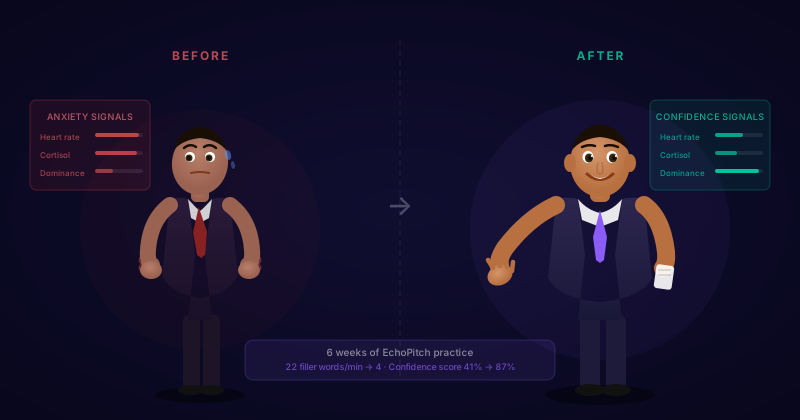
You're mid-sentence and suddenly... nothing. The next word vanishes. Your mind is empty. Panic rises. This experience is terrifying, but understanding why it happens makes it less scary — and easier to handle.
The neuroscience: What's actually happening
When you're stressed, your body releases cortisol (the stress hormone). High cortisol levels temporarily impair your hippocampus — the brain region responsible for retrieving memories.
This is called stress-induced memory impairment. Your knowledge is still there; you just can't access it in that moment. It's like a file on your computer that won't open because another program is hogging all the resources.
Prevention: How to reduce blanking
1. Practice until it's automatic
Information stored in procedural memory (habits, skills) is less affected by stress than information in declarative memory (facts, sequences). The more you practice, the more your presentation moves from "remembering" to "doing."
2. Structure for recovery
Organise your presentation into distinct chunks with clear transitions. If you blank in one section, you can jump to the next without the audience noticing.
3. Have bullet points visible
Use your slides or notes as prompts. You don't need a script — just enough to jog your memory. Even seeing one keyword can unlock the whole section.
Recovery: What to do when it happens
Technique 1: Pause and breathe
A pause feels like an eternity to you but looks natural to your audience. Take a breath. Often, the thought will resurface.
Technique 2: Summarise what you just said
"So, to recap..." or "As I mentioned..." — this buys you time and often triggers the next thought.
Technique 3: Look at your slides
Glance at your slides or notes. This looks completely natural. Your visual prompt will usually remind you where you were going.
Technique 4: Ask the audience
"Does anyone have questions about that point?" or "What do you think about this so far?" — this shifts focus away from you while you regroup.
Technique 5: Skip ahead
If you can't remember a section, move to the next one. You can return to it later, or not. The audience doesn't know your plan.
What NOT to do
- Don't announce it: "Sorry, I've completely forgotten..." — the audience might not have noticed
- Don't panic: This makes it worse by releasing more cortisol
- Don't rush: Speaking faster increases cognitive load
Practice builds resilience. The more times you've successfully delivered your presentation, the less likely you are to blank — and the faster you'll recover if you do.
Practice with EchoPitchKey takeaways
Why does your mind go blank when presenting?
- Mind blanks are caused by stress hormones impairing memory retrieval
- Your knowledge is still there — you just can't access it temporarily
- Practice moves content from memory to automatic habit
- Structure your presentation in recoverable chunks
- Have visual prompts available (slides, notes)
- Recovery techniques: pause, summarise, check notes, ask audience, skip ahead
- Don't announce the blank — the audience often doesn't notice
Sources
- McEwen, B. S. (2007). Physiology and neurobiology of stress and adaptation — Annual Review of Psychology, 58, 145-173.
- Phelps, E. A., & LeDoux, J. E. (2005). Contributions of the amygdala to emotion processing — Neuron, 48(2), 175-187.
- Stein, M. B., & Stein, D. J. (2008). Social anxiety disorder — The Lancet, 371(9618), 1115-1125.
Put this into practice
Record yourself presenting with EchoPitch and get instant AI feedback on confidence signals, delivery pace, and filler words. 5 sessions, paid once. No subscription.
Start practising free →Get daily tips on Reddit
Join our community for presentation tips, Q&A, and support.