
Quick Answer
Practise presentations out loud, not in your head, and record every session. The most common practice method — reading through notes or rehearsing mentally — feels productive but builds the wrong skill: deliberate practice must be performed out loud, generate feedback you can act on, and target a specific improvement. Memorise your structure and opening — not a word-for-word script, which becomes fragile and robotic under pressure — then watch each recording focused on one improvement at a time, pace, filler words, eye contact, or confidence, rather than trying to fix everything simultaneously. Three deliberate practice sessions with recording and review produce better results than ten sessions of reading through notes. Once solo practice feels solid, increase stakes progressively: practise in front of one trusted colleague, then a small group, then the actual room. This gradual exposure builds the muscle memory that holds up under real pressure.
How to Practice a Presentation — a Complete Guide
Why most people practise wrong
The most common presentation practice method — reading through your notes, perhaps running through it in your head a few times — is among the least effective ways to prepare. It feels like practice because it is effortful. But it is practising the wrong thing: reading and thinking, not speaking and delivering.
Deliberate practice — the kind that actually builds confident delivery — has three characteristics: it is performed out loud, it generates feedback you can act on, and it is structured around specific improvement targets.
Step 1: Know your structure, not a script
Memorising a presentation word-for-word produces two problems. First, delivery becomes robotic — audiences can tell they are hearing a recitation rather than a person thinking and communicating. Second, memorised scripts are fragile: when you lose your place, there is no recovery path.
Instead, memorise your structure (the sequence of key points), your opening (the first 30 seconds is the highest-anxiety moment — eliminate uncertainty there), and your close (end with intent, not a trailing off). The body of the presentation should flow from your understanding of the content. Prepare from an outline, not a script.
Step 2: Practise out loud from session one
Do not wait until you feel "ready" to practise out loud. The first spoken practice will be rougher than your mental version — that is expected and useful. Speaking activates different neural pathways than thinking. Voice, breath, pacing, and word choice are all different when spoken versus imagined. Every session of silent rehearsal is a session that fails to build the actual skill you will need.
Stand up. Speak at performance volume. Run through the full presentation without stopping when you make a mistake — stopping and restarting is a habit that does not exist in live performance.
Step 3: Record every session
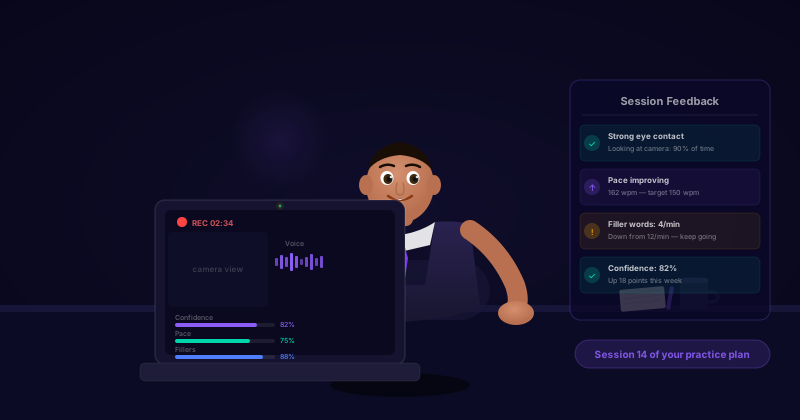
The camera reveals habits you cannot perceive from the inside. How often you say "um". Whether you are making eye contact with the lens or looking down. Whether your pace is actually appropriate or whether you are rushing. The gap between internal experience and external signal is almost always larger than people expect — and recording makes it visible.
Watch each recording with a single question in mind: what is the one thing to work on next? You will see many things to improve. Target one. This constraint is not laziness — it is how deliberate practice works. Focused attention on a single variable produces faster change than diffuse attention across all variables simultaneously.
Step 4: Increase stakes progressively
Gradual exposure to higher-stakes practice is the mechanism that transfers improvement from solo rehearsal to live performance. After solo practice is solid, practise in front of one trusted person who will give honest feedback. Then a small group. Then in the actual room if possible, or in a similar environment.
Each step up in stakes reveals new things to work on — that is the point. The goal is to encounter and manage the stress response in practice, so that by the time you reach the real presentation your delivery is automatic and your attention is free for the audience.
Step 5: Use AI practice between human feedback sessions
How many times should you practice a presentation?
Human feedback — from colleagues, coaches, or formal review — is valuable but infrequent. AI practice fills the gap, enabling daily deliberate practice with immediate structured feedback. The combination of frequent AI-assisted practice and periodic human feedback is consistently more effective than either alone.
If you want an instant read on a single run-through before committing to a full practice routine, EchoPitch's Pitch Scorer gives a free confidence, clarity and persuasion score on a 60-second clip with no signup. For a structured comparison of full practice apps once you know delivery is the thing to work on, see our best presentation practice app guide.
Record your next practice session
EchoPitch records your practice and gives instant feedback on pace, filler words, confidence signals, and clarity — so every session has a clear improvement target.
Start practising freeKey takeaways
- Practise out loud, not in your head — speaking and thinking use different neural pathways
- Memorise your structure and opening, not a word-for-word script
- Record every session and watch the playback with one improvement question
- Target one delivery element per session for fastest change
- Increase stakes progressively: solo → trusted colleague → small group → live environment
- Do not stop when you make a mistake — practise recovering