
You Look Calmer Than You Feel: The Perception Gap
Data shows your internal panic isn't visible to your audience. Here's what AI analysis reveals.
MBA, Bayes Business School · Founder, Cavefish · July 2026
Summary
There is a significant perception gap between internal anxiety and external appearance when presenting. AI facial analysis data from EchoPitch shows speakers consistently rate their internal anxiety 8-9/10 while their visible expressions measure only 3-5/10 — a 40-60% gap between how nervous you feel and how nervous you look. Paul Ekman's Facial Action Coding System (FACS) research identifies anxiety signals as specific Action Units (AU1+AU4 for worried brow, AU15 for lip depression, AU20 for tense smile) that flash across the face in 1/25 to 1/5 of a second. Untrained observers — which includes most audiences — miss the majority of these micro-expressions. Psychologists call this the "spotlight effect": we overestimate how much others notice because we're the center of our own attention. Your racing heart, sweaty palms, tight chest, and mental panic are invisible to your audience. A huge component of presentation anxiety is the fear of LOOKING nervous — not nervousness itself. The data consistently shows this fear is unfounded.
"Everyone can see how nervous I am."
This is one of the most common beliefs among anxious speakers — and one of the most wrong. Here's what the data actually shows.
What does AI analysis reveal about visible nervousness?
At EchoPitch, we analyze facial expressions and vocal patterns during practice presentations. One of the most consistent findings:
Speakers rate their internal anxiety far higher than what their face and voice actually show.
The pattern looks like this:
- Speaker's self-reported anxiety: 8-9 out of 10
- AI-measured visible anxiety signals: 3-5 out of 10
That's a 40-60% gap between internal experience and external appearance. What feels like visible panic often looks like mild tension at most.
Why does the perception gap exist?
You have full access to your internal state:
| Signal | Your experience | Audience sees |
|---|---|---|
| Racing heart | 10/10 intense | 0/10 invisible |
| Sweaty palms | Very noticeable to you | Not visible from distance |
| Spiraling thoughts | Overwhelming | Completely invisible |
| Micro-expressions | Feel dramatic | Flash by in 1/25 second |
| Voice tremor | Sounds terrible to you | Usually slight, if noticed |
This feels overwhelming because you experience all of it simultaneously. The intensity is real.
But your audience only sees external signals. And most anxiety signals are either:
- Invisible: Heart rate, sweating, internal panic
- Subtle: Micro-expressions, slight voice changes
- Brief: Anxiety expressions flash by in fractions of a second
The intensity of your internal experience creates a false belief that it must be visible. It usually isn't.
What does nervousness actually look like on camera?
Paul Ekman's Facial Action Coding System (FACS) identifies the specific muscle movements associated with anxiety:
- AU1 + AU4: Inner brow raise combined with brow lowering (worried look)
- AU15: Lip corner depressor (subtle frown)
- AU20: Lip stretcher (tense smile)
- Increased blink rate
- Gaze aversion: Breaking eye contact more frequently
Here's the key: these signals are subtle. They flash across your face in 1/25 to 1/5 of a second. Untrained observers — which includes most audiences — miss the majority of them.
Research shows people are remarkably bad at detecting deception and anxiety in others. We think we can read people, but we mostly can't.
What is the spotlight effect in public speaking?
Psychologists call this the "spotlight effect" — we overestimate how much others notice about us because we're the center of our own attention.
In one famous study, researchers had participants wear embarrassing t-shirts into a room. Participants estimated about 50% of people noticed the shirt. The actual number? About 25%.
We assume others are paying as much attention to us as we are to ourselves. They're not. They're thinking about themselves.
What does the perception gap mean for your presentations?
A huge component of presentation anxiety is the fear of LOOKING nervous — not nervousness itself.
If you knew, with data, that your internal experience wasn't visible to others, would you still be as anxious?
For many people, this reframe is transformative:
- You can feel anxious without looking anxious
- Your audience isn't cataloging your flaws
- The panic you feel isn't the panic they see
How can you see the perception gap for yourself?
The most powerful way to internalize this: watch yourself on video.
Record a practice presentation when you're feeling nervous. Predict how anxious you'll look. Then watch it back.
Almost everyone is surprised. "I thought I was dying inside, but I just look... slightly tense?"
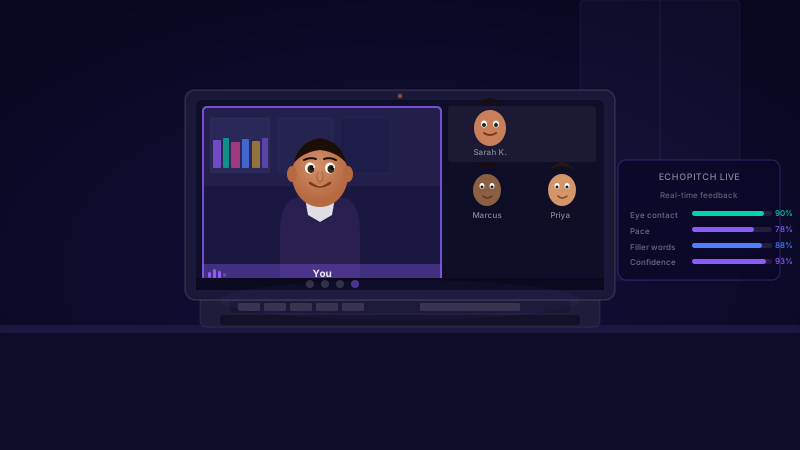
Tools like EchoPitch make this more precise — you can see an emotion timeline showing exactly when anxiety peaked versus when you looked composed. The gap is usually significant.
Watch: See how AI analysis reveals the perception gap in real-time
Read the transcript
Captions written by the EchoPitch channel.
You've got an interview next week. Or a sales pitch. Or maybe a board presentation that's keeping you up at night. You know you should practice. But practicing alone feels pointless — and practicing in front of colleagues feels worse. That's why I built EchoPitch. **EchoPitch is an AI presentation coach that gives you real feedback on how you come across** — not just what you say, but how you say it. Here's how it works. **Step one: choose your scenario.** Job interview, sales pitch, investor presentation — or upload your own job description for tailored questions. **Step two: record yourself.** Just hit record and answer the questions. No audience. No judgment. Just you and your camera. **Step three: get instant feedback.** EchoPitch analyses your confidence, your clarity, your pacing, and your filler words. You'll see exactly where you lost momentum — and where you nailed it. What makes this different from other tools? Most apps count your "ums" and call it a day. **EchoPitch uses emotional intelligence — 44 facial action units mapped to the same framework used in clinical research** — to measure how trustworthy and confident you actually appear. Because here's the truth: **audiences decide if they trust you in the first seven seconds.** Before you've made your point. Before you've shown your slides. EchoPitch helps you get those seconds right. **You get five free practice sessions.** No credit card. No commitment. Link's in the description. Go practice before your next big moment.
Does this mean you should dismiss your anxiety?
To be clear: the anxiety you feel is real. This article isn't saying "just stop being anxious."
It's saying: one component of that anxiety — the fear that everyone can see it — is usually unfounded. And that's worth knowing.
You can acknowledge the internal experience while recognizing it's not as visible as it feels. Both things are true.
The bottom line
Your internal experience of anxiety is not your external appearance. Data consistently shows a significant perception gap — speakers rate their nervousness far higher than what observers (or AI) actually see. The fear of looking nervous is often worse than actually looking nervous.
Your face isn't betraying you as much as you think.
Related guides
Get daily tips on Reddit
Join our community for presentation tips, Q&A, and support.