
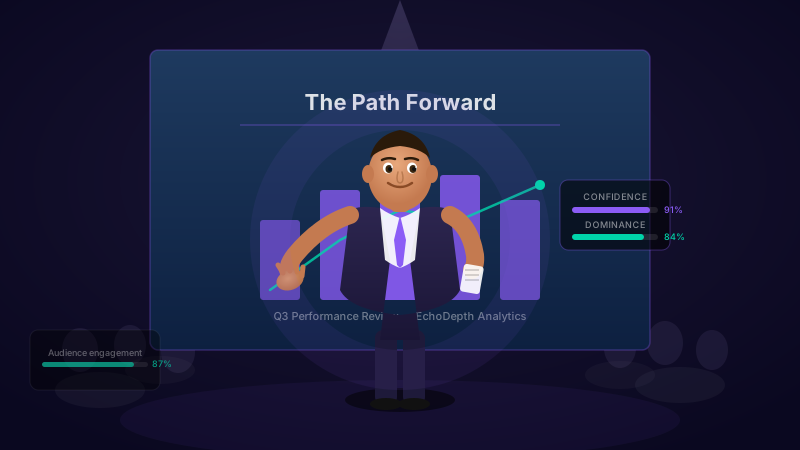
Every investor pitch runs two assessments simultaneously.Track 1 evaluates your business — the market, the product, the model, the traction. Track 2 evaluates you — your conviction, your composure, your self-awareness under pressure. Most founders prepare obsessively for Track 1 and assume Track 2 will take care of itself. It won't: within the first 2-3 minutes, investors form impressions about founder competence from your pacing and energy, before they've evaluated the business model. Founder credibility rests on four signals — conviction, resilience (recovering composure after tough questions), self-awareness about risks, and precision reciting your numbers without hesitation. Building these signals takes practice: 15-20 full run-throughs before a real pitch, with the final sessions devoted to Q&A simulation with advisors who challenge you. Investors are betting on founders as much as businesses, so they need to believe you can navigate uncertainty.
Want to see what investors read in your delivery? EchoPitch analyses the founder credibility signals that shape investor perception — not just your content.
Practise your investor pitch with EchoPitchInvestor Pitch Tips: The Founder Credibility Signals Investors Read in the Room
The two assessments every investor makes simultaneously in a pitch meeting
When you walk into a pitch meeting, investors start running two parallel evaluations. The first is familiar: they're assessing your business. Market size, product differentiation, business model, traction, team composition, financial projections. This is Track 1 — the explicit evaluation that pitch deck advice focuses on.
The second evaluation is less discussed but equally important: they're assessing you. Can this founder execute? Will they persist when things get hard? Do they understand the real risks? Are they coachable? This is Track 2 — the founder assessment that runs continuously through your delivery.
Track 2 matters because early-stage investing is largely founder betting. The business will change — market conditions shift, products pivot, initial models prove wrong. What doesn't change is who's running the company. Investors need to believe you can navigate uncertainty, adapt to challenges, and maintain conviction through setbacks.
How Track 2 operates
Track 2 operates primarily through delivery signals. Investors don't have time to deeply know you — they have 30-45 minutes to form a judgment. So they read what's available: your pacing when discussing challenges, your composure when questioned, your hesitation patterns when asked about numbers, your emotional consistency throughout.
These signals inform Track 2 conclusions. A founder who rushes through risk discussion signals discomfort with reality. A founder who hesitates before metrics signals poor business understanding. A founder who becomes defensive under questioning signals limited coachability.
The Track 2 assessment influences how investors interpret Track 1 content. If founder signals suggest lack of conviction, strong market claims feel like optimistic projection. If founder signals suggest composure and self-awareness, the same claims feel grounded.
The Dual Assessment Framework
The Dual Assessment Framework describes how investors evaluate pitches on two simultaneous tracks:
Track 1: Business Case
- • Market size and timing
- • Product differentiation
- • Business model viability
- • Traction and metrics
- • Team composition
- • Financial projections
- • Competitive positioning
Track 2: Founder Assessment
- • Conviction and belief
- • Composure under pressure
- • Self-awareness about risks
- • Resilience and recovery
- • Coachability signals
- • Precision on numbers
- • Emotional consistency
Most founders prepare extensively for Track 1 while hoping Track 2 takes care of itself. It doesn't. Track 2 signals inform how investors interpret Track 1 content — weak founder signals make strong business claims feel unconvincing.
What investors observe in the first 90 seconds before your content lands
Before you've presented your market size or explained your solution, investors have formed an initial hypothesis about you. This happens in the first 90 seconds — your opening remarks, introduction, and initial setup.
During this window, investors are reading:
- Pacing and fluency — Are you delivering smoothly or stumbling through the opening? Smooth delivery suggests ownership of the material. Hesitant delivery suggests memorisation without deep understanding.
- Energy level — Do you seem energised by your own pitch? Appropriate energy suggests genuine conviction. Flat delivery raises questions about your belief in the opportunity.
- Eye contact and presence — Are you present with the room or performing a script? Presence suggests adaptability. Performance suggests rigidity.
- How you handle the room — Do you acknowledge where the investors are looking? Do you adjust to their reactions? Social awareness predicts leadership capability.
The opening matters more than you think
Initial impressions create a filter for everything that follows. If the first 90 seconds establish founder credibility, subsequent claims receive benefit of the doubt. If the opening raises concerns, subsequent claims face heightened scrutiny.
This is why opening delivery deserves disproportionate practice time. Your first 2-3 minutes should be absolutely fluid — no hesitation, steady pacing, appropriate energy, natural delivery. This isn't about being polished; it's about signalling preparation and ownership.
Founder credibility signals: what investors are actually reading in your delivery
Throughout your pitch, investors are reading specific delivery signals that inform their founder assessment. Understanding these signals allows you to target your practice precisely.
Pacing under pressure
How does your pacing change when you discuss challenges, risks, or competition? Many founders rush through these sections, eager to return to positive territory. Investors notice. Rushed delivery on difficult topics signals discomfort with reality — a concerning trait for someone asking for capital to navigate uncertain markets.
The target is consistent pacing even during challenging sections. Your risk slide should be delivered with the same steady pace as your traction slide. Investors read steady pacing as comfort with complexity — you've thought through the hard parts and can discuss them without flinching.
Hesitation density during Q&A
Q&A is where many founders lose the credibility they built during the deck. Under questioning, hesitation increases. Filler words multiply. Pauses lengthen. Sentence structure breaks down.
This matters because Q&A simulates real investor-founder interaction. If you become scattered when questioned, investors wonder how you'll handle board meetings, customer escalations, and team challenges. Q&A delivery signals management capability.
Conviction markers
Conviction shows in vocal emphasis and pitch behaviour. When you make a claim you genuinely believe, you naturally emphasise it. When you state facts with certainty, your pitch falls at the end. Conviction markers are difficult to fake because they stem from genuine belief.
Investors read conviction markers throughout, especially during your core thesis: why this market, why this solution, why you. If conviction markers weaken during these sections, investors question whether you're as convinced as your slides suggest.
Composure signals
Composure is how quickly you recover from difficulty — a tough question, a skeptical response, a moment where you didn't know the answer. Recovery time is measurable. Some founders recover within seconds and return to steady delivery. Others remain rattled for multiple questions.
Short recovery time signals resilience — the ability to absorb setbacks and continue executing. This is a core founder trait investors are trying to assess. Your delivery after difficulty tells them more than your delivery during smooth sections.
Self-awareness indicators
How you discuss weaknesses and risks reveals self-awareness. Founders who acknowledge limitations directly and confidently demonstrate they've thought deeply about challenges. Founders who deflect, minimize, or become defensive suggest they're not seeing clearly.
Self-awareness indicators include: willingness to say "I don't know" without becoming flustered, ability to discuss risks with the same steady delivery as opportunities, and comfort with ambiguity in areas that genuinely are uncertain.
Why rehearsing the deck is not the same as practising the pitch
Most founders prepare for investor meetings by rehearsing their deck — running through slides until the content flows smoothly. This is necessary but insufficient. Deck rehearsal addresses Track 1 (content delivery) but doesn't prepare Track 2 signals.
Content fluency vs. delivery mastery
Content fluency means knowing what you're going to say. Delivery mastery means controlling how you say it. These are different skills developed through different practice.
A founder who has rehearsed content extensively might still:
- Rush through risk sections
- Hesitate before numbers they know perfectly well
- Lose composure during Q&A
- Drop energy in the middle sections
- Sound flat on claims they genuinely believe
These delivery gaps undermine Track 2 assessment even when Track 1 content is strong. Investors notice the disconnect between polished slides and unpolished delivery signals.
The practice gap
The typical founder practices pitch content 15-20 times and delivery signals 0 times. They review their deck repeatedly but never review recordings of their delivery. They anticipate questions but don't simulate the pressure of live Q&A.
This practice gap produces founders who know their material but don't control their signals — precisely the combination that creates Track 1/Track 2 mismatch.
How to practise investor pitch delivery, not just content
Preparing for Track 2 assessment requires specific delivery practice, distinct from content rehearsal. Here's a structured approach.
Phase 1: Content fluency (first 5-7 run-throughs)
Before targeting delivery, achieve content fluency. Run through your full pitch 5-7 times until you can deliver it without thinking about what comes next. This reduces cognitive load, freeing attention for delivery control.
Phase 2: Baseline recording and analysis
Once content is fluent, record a full pitch. Review specifically for delivery signals:
- Where does pacing vary? Mark sections where you rush or drag.
- Where does hesitation cluster? Note timestamps with filler words or false starts.
- Where does energy drop? Identify sections that feel flat.
- Where does conviction weaken? Listen for upward inflection on statements.
This analysis produces a specific target list — the delivery signals that need improvement.
Phase 3: Targeted signal practice (next 5-7 run-throughs)
Practice with specific delivery targets. If pacing rushes during risk discussion, re-record that section with deliberate slow pacing until consistency becomes natural. If hesitation increases at specific points, identify what's causing uncertainty and address it.
Signal-targeted practice produces faster improvement than general rehearsal. You're fixing specific problems rather than hoping repetition smooths everything.
Phase 4: Q&A simulation
Content rehearsal doesn't prepare for Q&A — the section where most founders lose credibility. Simulate Q&A with advisors or colleagues who will:
- Interrupt with questions mid-pitch
- Challenge your assumptions directly
- Ask questions you didn't anticipate
- Push back on your answers
- Ask follow-up questions that probe weaknesses
Record these sessions and review specifically for composure signals. Note where delivery weakened and practice recovery techniques for those specific moments.
Step-by-step investor pitch practice process
- 1Map your content for fluency. Rehearse until content is automatic. Target 15-20 run-throughs before investor meetings so you can focus on delivery rather than remembering what comes next.
- 2Record baseline delivery. Once content is fluent, record a full pitch. Review for pacing variance, hesitation clusters, and energy drops. These are your delivery targets.
- 3Identify conviction moments. Mark the 5-7 sentences that should carry the most weight: your core insight, key differentiator, and ask. These need deliberate emphasis and confident delivery.
- 4Simulate Q&A pressure. Have advisors challenge you with tough questions. Record these sessions and review for composure signals — where does your delivery weaken under pressure?
- 5Practise composure recovery. After difficult questions, notice how many seconds before your delivery returns to baseline. Practise shortening recovery time with deliberate breath and pause techniques.
- 6Rehearse numbers cold. Practice reciting all key metrics without hesitation. Any pause before a number signals you don't know your business. Investors notice this immediately.
- 7Get objective feedback. Use AI-based analysis to quantify your delivery signals across sessions. Track improvement on specific metrics rather than relying on subjective feel.
Q&A: the moment most founders lose credibility without realising it
The deck portion of an investor pitch is a controlled environment. You've practiced the content, you know what's coming, you can manage your delivery. Q&A removes that control. You don't know what will be asked. You can't prepare exact answers. You're responding in real time.
This is why Q&A is where Track 2 assessment intensifies. Investors are specifically reading your behaviour under uncertainty — the closest simulation they have to how you'll behave as a founder facing unexpected challenges.
Common Q&A delivery failures
- Over-answering: Rambling responses that try to address every possible angle. This signals lack of clarity or nervousness about leaving things unsaid.
- Defensive tone: Voice tightening, pace quickening, emphasis becoming aggressive. This signals limited coachability.
- Hesitation before numbers: Pausing to recall metrics you should know instantly. This signals you don't actually know your business.
- Energy collapse: Becoming flat after a difficult question. This signals poor resilience.
- Avoidance signals: Breaking eye contact, changing subject, giving circular answers. This signals awareness that you're evading.
Q&A delivery targets
Strong Q&A delivery demonstrates composure and precision:
- Concise answers: Respond directly, then stop. Silence is better than rambling.
- Steady pacing: Same pace answering difficult questions as easy ones.
- Quick recovery: If rattled, return to baseline within seconds.
- Instant numbers: Key metrics delivered without hesitation.
- Comfortable "I don't know": Honest acknowledgment of limits without becoming flustered.
Emotional consistency under pressure — what it signals and how to build it
Emotional consistency means your delivery matches the emotional significance of your content, and that match holds even under pressure. Excited claims delivered excitedly. Serious risks delivered seriously. And both delivered with appropriate energy whether it's minute 5 or minute 45.
Why inconsistency damages credibility
Emotional inconsistency creates cognitive dissonance for investors. When you describe a massive opportunity flatly, the mismatch raises questions. When you brush past serious risks with unchanged energy, investors wonder if you're seeing clearly. These mismatches accumulate and erode Track 2 assessment.
Building consistency under pressure
Emotional consistency under pressure requires:
- Genuine connection to content. Before each practice session, reconnect with why this opportunity matters. The emotion needs to be real; performed enthusiasm is transparent.
- Energy management. Long pitches and Q&A can drain energy. Practice full-length sessions to build stamina and identify where energy tends to drop.
- Recovery techniques. When you feel composure slipping, have practiced techniques: a deliberate pause, a breath, a moment to collect before responding.
- Acceptance of pressure. Fighting nervous feelings makes them worse. Acknowledging pressure as normal allows you to continue functioning through it.
Common investor pitch delivery mistakes and how to fix them
Certain delivery patterns appear frequently in investor pitches. Recognising them allows targeted correction.
Mistake 1: Rushing the opening
Many founders rush their first 2-3 minutes, eager to get into the meat of the deck. This signals nervousness and prevents establishing a strong Track 2 first impression.
Fix: Practice the opening with deliberately slow pacing. Your first sentences should be 20% slower than feels natural. This reads as confident to audiences even though it feels too slow to you.
Mistake 2: Monotone on key claims
When founders have practiced claims repeatedly, they often flatten them. The most important statements are delivered with the same energy as context-setting.
Fix: Identify your 3-5 most important sentences. Mark the key word in each. Practice with deliberate emphasis on those marked words.
Mistake 3: Speeding through risks
Risk slides often get the fastest delivery — founders want to acknowledge and move on. Investors notice the pace change and wonder what you're uncomfortable with.
Fix: Risk discussion should have the same steady pacing as opportunity discussion. Practice the risk section in isolation until you can deliver it without acceleration.
Mistake 4: Hesitation before numbers
Even founders who know their metrics cold sometimes pause before stating them. This delay, even if brief, signals uncertainty.
Fix: Practice reciting all key metrics in rapid succession until they come instantly. MRR, growth rate, CAC, LTV, churn, runway — these should flow without thought.
Mistake 5: Q&A energy collapse
After deck delivery, energy often drops during Q&A. Questions feel like attacks rather than opportunities, and delivery becomes defensive or flat.
Fix: Reframe Q&A as dialogue, not interrogation. Questions mean engagement — investors who are checking out don't ask questions. Practice responding with the same energy you bring to your strongest slides.
How AI pitch analysis gives founders objective delivery feedback
Traditional pitch preparation relies on self-assessment (unreliable) or advisor feedback (valuable but inconsistent and scheduling-dependent). AI-based pitch analysis introduces objective, quantified feedback available for every practice session.
What AI analysis can measure
- Pacing patterns: Words per minute across sections, with variance calculations highlighting where you rush or drag.
- Hesitation density: Precise counts of filler words and false starts, with timestamps marking problem sections.
- Energy tracking: Vocal energy levels throughout the pitch, highlighting drops and confidence drift.
- Q&A behaviour: How delivery signals change under questioning, with recovery time measurements.
- Progress tracking: Comparison across sessions to show which signals are improving.
The feedback advantage
Objective feedback makes practice more efficient. Instead of general rehearsal hoping everything improves, you target specific signals that need work and verify they're actually improving. This is particularly valuable for investor pitch preparation, where the stakes are high and opportunities to pitch the same investors are limited.
How EchoPitch helps founders practise investor pitch delivery
EchoPitch analyses the founder credibility signals that investors read during your pitch. Each practice session measures pacing patterns, hesitation density, and energy consistency — giving you specific targets for your highest-stakes presentations.
- • See where your delivery signals weaken during difficult sections
- • Track hesitation patterns that might undermine Track 2 assessment
- • Compare delivery across multiple practice sessions
- • Get quantified feedback without scheduling advisor time
Note: EchoPitch analyses communication signals to help you understand how your delivery might be perceived. It doesn't diagnose emotions or replace human judgment on pitch effectiveness.
Practise your investor pitch with EchoPitchReady to see what investors see in your delivery?
Your pitch deck might be ready. Is your delivery? EchoPitch gives you the signal-level feedback that shows what investors actually read when you present.
Try your first practice session freeKey takeaways
- Every investor pitch runs two simultaneous assessments: Track 1 evaluates your business, Track 2 evaluates you as a founder.
- Track 2 operates through delivery signals: pacing under pressure, hesitation density, conviction markers, composure, and self-awareness.
- Investors form initial impressions in the first 90 seconds, before evaluating your business case.
- Rehearsing deck content doesn't prepare Track 2 signals — delivery practice requires targeted signal work with objective feedback.
- Q&A is where most founders lose credibility; simulate pressure and practice recovery techniques.
- Emotional consistency under pressure signals resilience and clarity — key traits investors seek in founders.
- Hesitation before numbers instantly signals you don't know your business; key metrics should come without pause.
Practise with objective delivery feedback
Your pitch deck might be polished, but what are your delivery signals telling investors? EchoPitch analyses the founder credibility signals that shape Track 2 assessment.
Start practising freeFrequently asked questions about investor pitches
What do investors look for in a pitch beyond the deck?
Beyond deck content, investors evaluate founder credibility signals: how you handle pressure, how you respond to unexpected questions, whether your conviction matches your claims, and whether you demonstrate self-awareness about risks. These signals run on a parallel track to business evaluation — investors decide whether to invest by deciding whether to invest in you.
How do I sound confident in an investor pitch?
Confident-sounding delivery comes from five signals: pacing consistency (steady pace even during difficult sections), minimal hesitation during Q&A, conviction markers (emphasis on key claims, downward inflection), composure signals (quick energy recovery after tough questions), and self-awareness indicators (acknowledging challenges without defensiveness).
How many times should I practise before pitching investors?
For a new investor pitch, 15-20 full run-throughs minimum. The first 5-7 focus on content fluency, the next 5-7 on delivery signals, and the final runs on Q&A simulation. Include sessions with advisors who will ask difficult questions, not just solo rehearsal.
What do investors notice in the first few minutes of a pitch?
In the first 2-3 minutes, investors form initial impressions about founder competence and conviction. They read your pacing, your relationship to the material, and your energy level. By the time you reach your market slide, they've already formed a hypothesis about you that colours how they interpret everything after.
How do I prepare for investor Q&A?
Q&A preparation has two components: content (anticipating questions and preparing answers) and delivery (practising how you respond under pressure). For delivery, simulate with advisors who will interrupt and challenge — then review recordings to see where your signals weakened under pressure.
What makes a founder seem credible to investors?
Founder credibility comes from four signals: conviction (you sound like you genuinely believe), resilience (you recover quickly after tough questions), self-awareness (you acknowledge weaknesses without defensiveness), and precision (you know your numbers without hesitation).
How do I stop being nervous when pitching investors?
Eliminating nervousness entirely isn't realistic or necessary. The goal is preventing nervous feelings from producing nervous-sounding signals. This requires extensive practice, deliberate pause techniques, Q&A simulation, and physical preparation like breathing exercises before the pitch.
What is the difference between a good pitch and a great one?
Good pitches have strong content — compelling problem, differentiated solution, credible market. Great pitches have strong content AND founder delivery that makes investors want to work with you. The difference is delivery signals: conviction that makes claims feel inevitable, composure that suggests capability, and self-awareness that makes optimism feel grounded.