
Presentation Anxiety in Teenagers
Presentation anxiety in teenagers isn't just adult anxiety in a smaller body. The developmental context makes it more intense in specific ways — and the approaches that help need to account for that.
MBA, Bayes Business School · Founder, Cavefish · May 2026
Quick Answer
Teenage presentation anxiety is more intense than adult anxiety because the adolescent brain is neurologically more sensitive to peer evaluation— the limbic system is highly active while the prefrontal cortex that regulates emotional responses doesn’t fully mature until the mid-twenties, and glossophobia typically peaks in intensity between ages 15-18, exactly when peer judgment feels most threatening to identity. Effective help includes validating the anxiety rather than minimising it (‘this is genuinely hard and your feelings make sense’, not ‘it’s not a big deal’), since minimising increases shame while validation creates safety; practising to a trusted parent, sibling, or friend first before a wider audience; shifting focus from performing for evaluation to simply explaining something interesting; preparing specifically rather than generally, especially the anxiety-heavy first 30 seconds, until it feels automatic; reframing the physical symptoms of anxiety as normal, useful arousal rather than a sign something is wrong; and using school pastoral or counselling support when anxiety causes significant avoidance or distress.
is the age when glossophobia typically peaks in intensity — coinciding with the period of highest peer social evaluation and identity formation, when being seen negatively by peers feels most threatening.
Why is presentation anxiety more intense for teenagers?
Teenage brains are neurologically more sensitive to social evaluation — the limbic system is highly active while the prefrontal cortex is still maturing. Peer evaluation genuinely matters more during adolescence than at any other life stage, which makes the threat appraisal proportionally higher.
Why the teenage brain amplifies presentation anxiety
Adolescence is the developmental period when the brain's social reward and threat-detection systems are at their most sensitive. The prefrontal cortex — responsible for regulating emotional responses — is still maturing until the mid-twenties. Meanwhile, the limbic system (including the amygdala) is highly active, making social threats feel more intense and less manageable than they will in adulthood.
For teenagers, peer evaluation genuinely matters more than at any other life stage. Social belonging is central to identity development. Being seen to fail in front of classmates isn't just embarrassing — it activates the same brain systems as physical threat. This is not oversensitivity; it is neurologically accurate.
Validating the anxiety ('yes, this is hard and your feelings make sense') is more effective than minimising it ('it's not a big deal'). Minimising increases shame; validation reduces it and creates the safety needed to try.
What helps teenagers specifically
Practise to someone known and safe first
The threat in presentations comes from being evaluated by people whose opinion matters. Practising to a trusted parent, sibling, or friend first builds procedural memory in a low-threat context. This is the beginning of the exposure ladder.
Focus on the content, not the performance
Help teenagers frame the presentation as 'explaining something interesting' rather than 'performing for evaluation'. This outward attention shift reduces self-monitoring and improves both experience and outcome.
Prepare specifically, not generally
Vague preparation ('I'll review my notes') is less effective than specific practice ('I'll say the opening three times out loud'). Help teenagers practise the most anxiety-provoking parts — usually the first 30 seconds — until they're automatic.
Reframe anxiety as normal and useful
Teaching teenagers that adrenaline improves alertness and energy — rather than being a sign that something is wrong — changes the relationship with the physical symptoms. The research on anxiety-as-excitement reframing shows meaningful performance improvement.
Use available school support
Many schools have pastoral support, learning support, or counselling available for anxiety that affects academic performance. Presentation anxiety that causes significant avoidance or distress is a legitimate support need.
Teenage presentation anxiety is highest during the period when the skill matters most educationally. Building the skill now — with appropriate support — has career-long benefits. The students who learn to manage it in their teens arrive at university and the workplace significantly ahead.
Practice privately, build real confidence
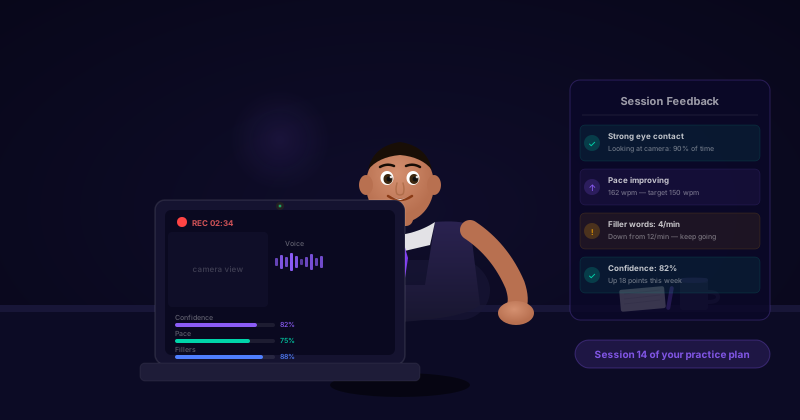
EchoPitch gives you private AI feedback on confidence, pace, and delivery — no audience, no judgement. 5 sessions, paid once. No subscription.
Try EchoPitch →