
Quick Answer
To calm nerves before presenting, use the 4-7-8 breathing technique — inhale through your nose for 4 seconds, hold for 7, exhale through your mouth for 8 — repeated for 3-4 cycles. This activates your parasympathetic nervous system and counteracts fight-or-flight within about 2 minutes. Pair it with the 5-4-3-2-1 grounding technique (name 5 things you see, 4 you touch, 3 you hear, 2 you smell, 1 you taste) to interrupt anxiety spirals, and release physical tension by shaking your hands vigorously and rolling your shoulders. A 2-minute power pose, standing tall with hands on hips, can boost confidence. Reframe nervousness as excitement: the two states share nearly identical physical sensations, and relabelling has been shown to improve performance. Finally, shift focus outward by asking what value you can provide the audience rather than worrying what they will think of you.
TL;DR: Quick Calm Techniques
- 4-7-8 breathing: Inhale 4s → Hold 7s → Exhale 8s (3-4 cycles)
- Grounding: Name 5 things you see, 4 touch, 3 hear, 2 smell, 1 taste
- Physical release: Shake hands vigorously, roll shoulders, relax jaw
- Power pose: Stand tall, hands on hips for 2 minutes (private)
- Reframe: "I'm nervous" → "I'm excited" (same physiology)
- Shift focus: From "What will they think of me?" to "How can I help them?"
Your heart is racing. Your palms are sweating. Your mind is spinning with worst-case scenarios. Sound familiar? Here are techniques that work right now — not in weeks of practice, but in minutes.
Important: Some nervousness is helpful. It means you care. The goal isn't to eliminate all anxiety — it's to manage it so you can perform.
How to Calm Your Nerves Before a Presentation
Immediate relief: 4-7-8 breathing
This technique activates your parasympathetic nervous system, directly counteracting the fight-or-flight response. It works in under 2 minutes.
- Breathe in through your nose for 4 seconds
- Hold your breath for 7 seconds
- Exhale slowly through your mouth for 8 seconds
- Repeat 3-4 times
Do this in the bathroom, at your desk, or even while walking to the presentation room. Nobody will notice.
Grounding technique: 5-4-3-2-1
When your mind is racing with "what ifs," this brings you back to the present moment:
- Name 5 things you can see
- Name 4 things you can touch
- Name 3 things you can hear
- Name 2 things you can smell
- Name 1 thing you can taste
This interrupts the anxiety spiral and brings your focus back to reality.
Physical release: shake it out
Adrenaline causes physical tension. Release it before you present:
- Shake your hands vigorously for 30 seconds
- Roll your shoulders back 5 times
- Relax your jaw — let it hang open, then close gently
- Walk briskly for 2-3 minutes if you can
Physical movement metabolises the stress hormones in your system.
Power posing
Research suggests that expansive postures can increase confidence:
- Stand tall with hands on hips (Wonder Woman pose)
- Or stand with arms spread wide (victory pose)
- Hold for 2 minutes
Do this somewhere private — a bathroom stall or empty corridor. You'll feel slightly ridiculous. That's okay.
Reframe "nervous" as "excited"
The physical sensations of nervousness and excitement are nearly identical: racing heart, heightened alertness, butterflies in stomach.
Instead of telling yourself "I'm so nervous," say: "I'm excited to share this."
This simple relabelling has been shown to improve performance in studies of public speaking anxiety.
Shift focus outward
Anxiety is self-focused: "What will they think of me?" "What if I mess up?"
Flip the script. Ask yourself:
- What value can I provide to them?
- What do they need to hear?
- How can I help them understand this better?
When you focus on serving your audience, there's less mental bandwidth for self-criticism.
The 5-minute pre-presentation routine
Here's exactly what to do in the 5 minutes before you present:
- 3-4 cycles of 4-7-8 breathing (2 minutes)
- Review only your opening line — not the whole presentation (30 seconds)
- Power pose somewhere private (1-2 minutes)
- Say out loud: "I'm excited to share this. I know my material. I'm here to help them."
Build long-term confidence
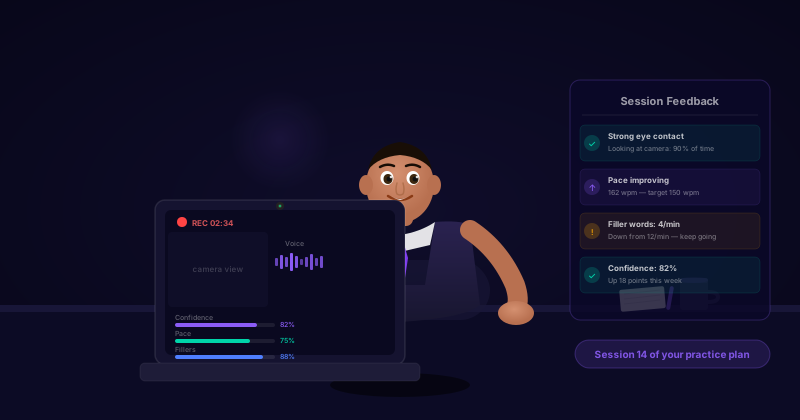
These techniques help in the moment. For lasting confidence, you need practice. EchoPitch lets you rehearse in private with AI feedback.
Try freeWhat NOT to do
Why do we get nervous before presentations?
- Don't re-read your entire presentation — this increases overwhelm
- Don't drink too much caffeine — it amplifies anxiety symptoms
- Don't tell yourself "don't be nervous" — this backfires
- Don't skip breakfast/lunch — low blood sugar worsens anxiety
- Don't over-apologise at the start — "I'm so nervous" undermines your credibility
Quick reference
- Breathing: 4-7-8 technique, 3-4 cycles
- Grounding: 5-4-3-2-1 senses exercise
- Physical: Shake hands, roll shoulders, power pose
- Mental: Reframe "nervous" as "excited"
- Focus: Shift from self to serving audience
Porges, S.W. (2011) The Polyvagal Theory — vagal tone and parasympathetic regulation. Benson, H. (1975) The Relaxation Response — diaphragmatic breathing and cortisol reduction. Brooks, A.W. (2014) Get Excited: Reappraising pre-performance anxiety as excitement. Journal of Experimental Psychology: General 143(3).