
Quick Answer
University presentation anxiety is intensified by the combination of academic stakes, peer evaluation from classmates you see daily, and formal grade consequences— a combination that 87% of students report makes it one of their most significant academic stressors, more than exams or deadlines. The most effective strategies include practising your opening until it runs on procedural memory, since the first 90 seconds are the peak of anxiety; recording yourself and watching it back once, since the gap between how nervous you feel and how calm you actually look is almost always significant; shifting the internal frame from ‘I am being evaluated’ to ‘I am explaining this to people who don’t know it yet’; and using available university support services, such as disability services, for accommodations if anxiety significantly impairs performance. It also helps to remember the grade maths: a below-average mark on a presentation worth 20% of a module has only a fractional effect on your final degree classification, however catastrophic it feels in the moment.
Student Presentation Anxiety
University presentations combine academic stakes, peer evaluation, and formal assessment in a way that amplifies anxiety beyond normal public speaking fear. Here's why — and what helps.
MBA, Bayes Business School · Founder, Cavefish · May 2026
of students report presentation anxiety as one of their most significant academic stressors — more than exams, deadlines, or financial pressure, according to UK university wellbeing surveys.
Why university presentations hit harder
Ordinary public speaking anxiety is amplified at university by a specific combination of factors that are rarely present simultaneously in other contexts. The grade consequence means failure has tangible academic cost. The peer audience means people you study alongside every day are evaluating you. The academic scrutiny means the audience includes an expert who may know more than you. And the comparison dynamic — watching confident classmates present — activates social comparison in a high-evaluation environment.
Other students look confident because you see their output, not their preparation or their internal experience. Research on presentation anxiety consistently finds that observers dramatically underestimate how nervous presenters feel.
Strategies that work in the academic context
Practise the opening until automatic
The first 90 seconds are the peak of anxiety. If your opening runs on procedural memory — practised enough times that it doesn't require active recall — you get through the worst window before you need to think. Practise your first two sentences out loud until they're completely natural.
Record one practice session
Record yourself on your phone and watch it back once. The gap between how you felt internally and how you appear externally is almost always significant — you look calmer than you feel. This recalibrates the threat appraisal before the real presentation.
Focus on explaining, not performing
Shift the internal frame from 'I am being evaluated' to 'I am explaining this to people who don't know it yet'. This outward attention shift reduces self-monitoring and improves actual performance.
Use available university support
Most UK universities have presentation anxiety provisions through disability services or student support. If anxiety significantly impairs your academic performance, this is a legitimate support need — equivalent to any other learning difference.
Accept some nerves as normal and useful
The adrenaline that makes you nervous also improves alertness, processing speed, and energy. The goal is not zero anxiety — it is a level of anxiety that improves rather than impairs performance.
A poor presentation is rarely as academically catastrophic as it feels. Most marking schemes weight presentations at 20–40% of a module. Even a significantly below-average presentation grade rarely has more than a fractional effect on a degree classification.
The peer comparison problem
One of the most distressing features of university presentation anxiety is the comparison dynamic — watching classmates who appear confident and competent, which amplifies self-doubt. The research on this is clear: you observe others' performances, not their internal experience. The student who looked calm in their presentation was almost certainly not calm internally. You see their output; you feel your own input.
Studies on social comparison in academic settings consistently find that students systematically overestimate their peers' confidence and competence relative to their own. This discrepancy is not evidence that you are uniquely anxious — it is evidence that everyone is managing internal experience you cannot observe.
Grade context and academic consequences
The academic consequences of presentation anxiety are almost always less severe than feared. Consider the actual mathematics: if a presentation is worth 20% of a module, and you score 50% on it instead of 70%, the effect on your module grade is a 4-percentage-point reduction. If the module is worth 30 credits of a 360-credit degree, the effect on your final classification is minimal.
The catastrophic consequence imagined — "my degree will be ruined by this presentation" — is arithmetically almost impossible. The emotional experience of presentation anxiety is disproportionate to the academic stakes in most cases.
This is not to dismiss the anxiety — it is real and distressing. But accurate assessment of actual consequences is one of the cognitive tools that reduces the secondary anxiety around the primary anxiety.
Building a sustainable practice habit at university
Practise to your phone — not just in your head
Most students rehearse mentally or re-read notes. Recording yourself on your phone and watching it back takes 30 minutes and produces more improvement than 3 hours of silent review. The external perspective is what changes self-assessment.
Use the library's presentation spaces
Most university libraries and student unions have bookable presentation rooms or study pods. Practising in a room with a projector or screen is meaningfully different from practising in your bedroom and closer to the actual experience.
Ask for a practice audience in your seminar group
Many seminar tutors will accommodate a brief practice run with feedback from peers. The social exposure is valuable and the feedback is directly relevant. If you don't ask, it doesn't happen.
Debrief immediately after
Immediately after a presentation, write down three things: what went better than expected, what you would change, and one thing you would practise differently. Do this within an hour, before the negativity bias colours your recollection.
Practice privately, build real confidence
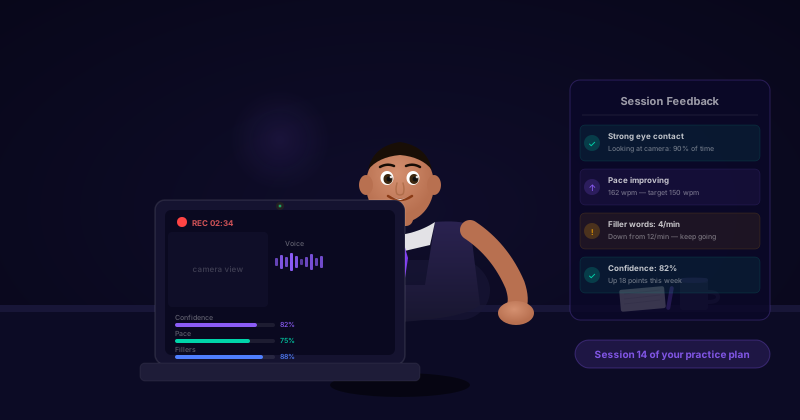
EchoPitch gives you private AI feedback on confidence, pace, and delivery — no audience, no judgement. 5 sessions, paid once. No subscription.
Try EchoPitch →