
Quick Answer
Presentation anxiety in children is developmentally normal— their emotional regulation systems, including the prefrontal cortex that helps manage fear, won’t fully mature until their mid-twenties, and around 1 in 4 children experience significant anxiety about speaking in front of their class. Children also lack the accumulated evidence adults have that presenting is survivable, so the stakes can feel enormous. Watch for behavioural signs since children often can’t articulate anxiety directly: stomach aches on presentation days, reluctance to attend school, tears during preparation, or speaking very quietly and avoiding eye contact. Help by validating feelings without amplifying them (‘I understand this feels scary’, avoiding both dismissal and catastrophising); building confidence through gradual practice — to a teddy bear, then a parent, then siblings; focusing on preparation, especially the opening few seconds, so they feel ready; teaching simple coping techniques like deep breathing (‘smell the flowers, blow out the candles’) or squeezing hands together; and celebrating the bravery it took rather than how ‘perfectly’ it went.
Presentation Anxiety in Children
For younger children, speaking in front of the class can feel genuinely terrifying. Understanding why — and how to help without making it worse — is crucial for parents and teachers supporting anxious children.
MBA, Bayes Business School · Founder, Cavefish · May 2026
children experience significant anxiety about speaking in front of their class. For some, this is temporary and resolves with positive experiences. For others, without appropriate support, it can develop into lasting public speaking fear.
Free Printable Checklist
8 strategies for parents — print it, stick it on the fridge, use it before each presentation.
Why presentation anxiety hits children differently
Young children experience presentation anxiety differently from teenagers and adults. Their emotional regulation systems are still developing — the prefrontal cortex that helps manage fear responses won't fully mature until their mid-twenties. This means the fear they feel is harder to control and rationalise.
Children also have less experience with social evaluation. Every class presentation is relatively novel, without the accumulated evidence that "I've done this before and survived" that adults carry. The perceived stakes feel enormous because the child's social world is their classroom — being laughed at or making a mistake in front of classmates feels like their entire social standing is at risk.
Children often cannot articulate their anxiety. Watch for behavioural signs: stomach aches on presentation days, reluctance to go to school, tears during homework about presentations, or suddenly "forgetting" when it's their turn.
Common presentation situations for younger children
Presentation anxiety in primary school children typically shows up in these contexts:
- Show-and-tell: Standing in front of the class to talk about something personal
- Reading aloud: Reading from a book to the class or in a reading group
- Answering questions: Being called on to answer in front of everyone
- Class presentations: Presenting project work or topic research
- Assembly participation: Speaking, singing, or performing in front of the whole school
- School plays: Having speaking parts in performances
Each of these contexts has different pressure points. Show-and-tell involves personal vulnerability. Reading aloud risks making mistakes in real-time. Assembly participation involves the largest possible audience.
Signs your child may be struggling
Children often express anxiety through behaviour rather than words. Signs to watch for:
Physical complaints
Stomach aches, headaches, or feeling sick specifically on days with presentations. These are often genuine physical symptoms caused by anxiety, not pretending.
Avoidance behaviours
Not wanting to go to school, "forgetting" about presentations, procrastinating on preparation, or asking to be excused.
Emotional responses
Tears, tantrums, or meltdowns when discussing upcoming presentations. Difficulty sleeping the night before.
Performance signs
Speaking very quietly, rushing through, freezing up, or being unable to make eye contact during presentations.
How parents can help
Validate without amplifying
"I understand this feels scary" acknowledges the feeling without making it bigger. Avoid both dismissing ("don't be silly, there's nothing to worry about") and catastrophising ("oh no, that sounds terrible"). Aim for calm acknowledgement.
Build confidence through practice
Start small: practise to a teddy bear, then to you, then to siblings or grandparents. Each successful practice builds evidence that they can do it. Make practice feel like play, not pressure.
Focus on preparation
Help them feel ready. Know the content well. Practise the opening especially — the first few seconds are the scariest. If they feel prepared, the anxiety reduces.
Teach simple coping techniques
Deep breaths ("smell the flowers, blow out the candles"), squeezing hands together, or having a small comfort object in their pocket. These give children something to do with the nervous energy.
Celebrate bravery, not perfection
Praise the courage it took to do something scary, regardless of how "well" it went. "You did something really brave today" matters more than "you did it perfectly".
Some nervousness is normal and even helpful. The goal is helping your child feel the fear and do it anyway — building evidence that they can cope with difficult feelings.
Guidance for teachers
Teachers play a crucial role in either reducing or amplifying presentation anxiety. Small adjustments can make a significant difference:
Offer graduated exposure
Start with low-stakes opportunities: sharing with a partner, then a small group, then the class. Build up gradually rather than expecting full class presentations immediately.
Give advance notice
Anxious children benefit from knowing when they'll be asked to speak. Surprise call-outs are especially difficult. "Tomorrow we'll do show-and-tell and I'd love to hear about your item" gives time to prepare mentally.
Create a supportive audience
Explicitly teach listening behaviour. "When someone is presenting, we look at them, we listen quietly, and we clap at the end." A kind audience reduces threat.
Offer alternatives when needed
For severely anxious children, consider accommodations: presenting to the teacher alone first, presenting with a friend, or using a recorded presentation. These are stepping stones, not permanent exemptions.
Acknowledge the courage
A quiet word afterwards — "I know that was hard for you, and you did it anyway" — can be transformative for an anxious child. Noticing their effort matters.
When to seek additional support
Some presentation anxiety is developmentally normal. However, consider seeking additional support from your child's school, GP, or a child psychologist if:
- The anxiety causes significant school avoidance (refusing to attend on presentation days)
- Physical symptoms are severe (vomiting, panic attacks)
- The distress persists for weeks and doesn't improve with support
- The anxiety is affecting friendships or overall wellbeing
- The fear generalises to other social situations beyond presentations
- You notice signs of selective mutism (speaking at home but not at school)
Early intervention for childhood anxiety has excellent outcomes. Seeking help is not overreacting — it is ensuring your child gets appropriate support.
Building long-term confidence
The presentations children do in primary school are building blocks for the rest of their lives. With appropriate support, most anxious children can develop genuine confidence over time. The key principles:
- Gradual exposure works: Small, successful experiences build confidence more than being thrown in at the deep end
- Avoidance makes it worse: While accommodations help, complete avoidance prevents the learning that "I can do hard things"
- Practice reduces fear: Familiarity breeds confidence — the more they do it, the less scary it becomes
- Support matters: How adults respond to children's anxiety shapes whether it resolves or persists
Children who learn to manage presentation anxiety in primary school — with appropriate support — arrive at secondary school and beyond with a significant advantage. The skills they build now will serve them for life.
Help your child practise in private
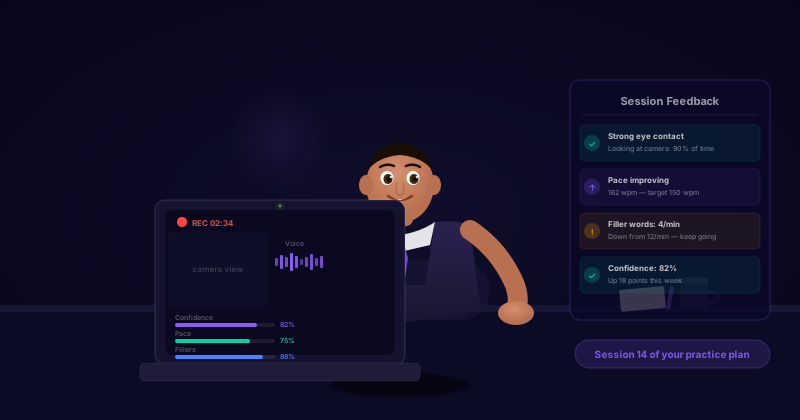
EchoPitch provides a safe, private space for presentation practice with AI feedback on pace and clarity. No audience, no judgement — just helpful practice.
Try EchoPitch →