
The Founder's Guide to Startup Pitch Practice: How to Win the Room
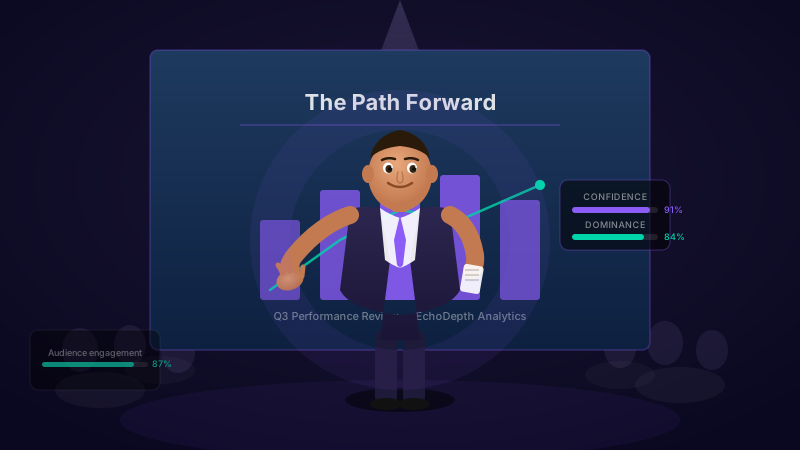
Your pitch deck is not your pitch. VCs spend an average of 2 minutes and 24 seconds reviewing your deck. The meeting is where funding is actually won or lost. This guide shows you how to practice your delivery so investors remember you, not just your slides.
MBA, Bayes Business School · Founder, Cavefish · June 2026
Key Takeaways
- ✓ VCs spend just 2:24 on decks — down 35% from 2015. The deck opens doors; the meeting closes deals.
- ✓ Vocal enthusiasm correlates with a 27% funding lift. Trustworthiness signals add 10 percentage points to funding probability.
- ✓ The first 90 seconds establish trust or suspicion. Practice your opening until it feels effortless.
- ✓ Elite founders run 50-100+ practice reps. Deliberate practice with feedback beats solo rehearsal.
- ✓ Q&A preparation is as important as the pitch itself. Build a bank of 50+ potential questions.
- ✓ Demo day requires strict timing discipline — practice to the second, not the minute.
Why Pitch Deck Practice Matters More Than the Deck Itself
There is a fundamental misunderstanding that pervades startup culture. Founders obsess over their pitch decks — agonising over font choices, slide order, and the perfect market sizing TAM slide — while neglecting the skill that actually determines funding outcomes: delivery.
The data is unambiguous. DocSend's research, conducted with Harvard Business School, found that investors spent an average of 3 minutes and 44 seconds reviewing pitch decks in 2015. By 2023, that number had fallen to 2 minutes and 24 seconds. A 35% decline in attention in less than a decade.
Deck review time (2015)
Deck review time (2023)
What does this mean practically? Your meticulously crafted deck receives less attention than a typical YouTube video. The deck is not the pitch — it is the permission slip. It gets you in the room. Once you are there, something else takes over.
Research by Lakshmi Balachandra at Harvard Business Review found that founders who projected trustworthiness increased their probability of being funded by 10 percentage points. Hu and Ma's Journal of Finance study found that vocal enthusiasm and positive emotional display correlated with 27% and 17% funding lifts respectively.
Your deck opens doors. Your delivery closes deals. The investor decision is emotional before it is analytical.
The investor decision process works like this: The deck gives them permission to take the meeting. The meeting gives them permission to like and trust you. Due diligence gives them permission to rationalise the decision they have already made. If you lose them in the room, no amount of financial modelling will save you.
Structuring Your Pitch for Maximum Impact
Before you can practice effectively, you need a structure worth practicing. The classic pitch deck sequence exists for a reason: it mirrors how investors naturally process information and make decisions.
The Opening Hook (30 seconds)
You have approximately 30 seconds before investors form their initial impression. This is not about your company — it is about you. Are you someone they want to spend the next 45 minutes with? Are you someone they would trust with their LPs' money?
Effective openings share three characteristics: they establish credibility, create intrigue, and signal confidence. The worst openings start with "So, um, thanks for having me, I'm really excited to be here..." The best openings drop you into a story, a startling statistic, or a bold claim.
Strong opening examples:
- • "Last month, a Fortune 500 CEO told me our tool saved his company $4 million. He was wrong. It saved them $11 million."
- • "By the time I finish this sentence, three more small businesses will have been rejected for a loan they deserve."
- • "I spent 15 years in operating rooms watching surgeons make the same preventable mistake. We fixed it."
The Problem (60-90 seconds)
Investors need to feel the pain before they care about the solution. The problem section is not a logical argument — it is an emotional one. Make them wince. Make them nod in recognition. Make them think "yes, that IS broken."
Common mistake: founders rush through the problem to get to their "exciting" solution. This is backwards. If the investor does not viscerally understand why the problem matters, your elegant solution is irrelevant.
The Solution (60-90 seconds)
Now — and only now — you earn the right to talk about what you have built. The solution section should feel like relief. If you have set up the problem correctly, the investor is primed to hear how you solve it.
Focus on the "aha" moment. What is the insight that makes your approach different? Why did no one else think of this? The solution is not a feature list — it is the key insight that unlocks the value.
Traction and Validation (60-90 seconds)
Numbers matter, but the narrative around numbers matters more. "We have 10,000 users" is a data point. "We launched in January, hit 10,000 users by March without paid acquisition, and 40% of them came from referrals" is a story of organic growth and product-market fit.
Whatever your traction, frame it as evidence that your hypothesis is correct. Early-stage companies should emphasise the slope of growth, not the absolute numbers.
Market and Business Model (90-120 seconds)
Investors are buying into a future outcome. The market section justifies why that outcome can be large. The business model section explains how you capture value from that market.
Avoid the classic TAM/SAM/SOM trap where every startup claims to address a $50 billion market. Instead, show bottom-up logic: "There are 50,000 companies that look like our current customers, our average contract is $50,000, that is a $2.5 billion serviceable market we can address in the next three years."
Team (60 seconds)
Why are you the team to win this? The question is not about credentials — it is about inevitability. What unique combination of experience, relationships, or insight makes you destined to build this particular company?
The Ask (30 seconds)
Be specific. "We are raising $3 million at a $15 million post-money valuation to get us to Series A metrics over 18 months." Vague asks signal unclear thinking.
Practicing Delivery, Not Just Content
Most founders practice by reading through their slides. This is almost useless. Knowing what to say is a completely different skill from saying it well.
Delivery practice focuses on: pace, pauses, vocal variety, eye contact, physical presence, and emotional modulation. These are not natural talents — they are skills developed through repetition and feedback.
Vocal enthusiasm alone correlates with 27% higher funding rates (Hu-Ma, Journal of Finance)
Pace and Pauses
Nervous speakers rush. They fill every moment with words, terrified of silence. But pauses are where emphasis lives. A strategic pause before a key number makes that number land. A pause after a bold claim lets it sink in.
Practice inserting deliberate pauses. Count to two in your head. It will feel uncomfortable at first. It will feel like eternity. To the audience, it reads as confidence.
Vocal Variety
Monotone delivery kills even brilliant content. Your voice needs contrast: louder and softer, faster and slower, higher and lower. The sections that matter most should sound different from the supporting material.
Record yourself and listen back. Most people are shocked at how flat they sound. The enthusiasm you feel internally rarely translates to your voice without deliberate practice.
Vocal techniques to practice:
- • Slow down for key points — emphasise by decreasing pace
- • Lower pitch for authority — higher pitch reads as nervous
- • Eliminate uptalk — statements should not sound like questions
- • Kill filler words — "um," "like," "so," "basically" undermine credibility
- • Breathe — shallow breathing creates a tight, stressed voice
Physical Presence
Where you stand, how you move, what you do with your hands — all of this communicates before you say a word. Investors read body language constantly, often unconsciously.
Stand with weight evenly distributed. Avoid pacing or swaying. Use hand gestures deliberately, not nervously. Maintain open posture. Make eye contact with individuals, not with the room in general.
Practice on video. Watch yourself with the sound off. Would you fund this person? Do they look like a leader?
The First 90 Seconds
Balachandra's research found that the trust signal investors pick up in the first 90 seconds carries more weight than the team slide in your deck. This is not fair. It is reality.
Your opening must be flawless. Not memorised word-for-word (that creates robotic delivery), but so practiced that it flows naturally under any conditions. You should be able to deliver your first 90 seconds while exhausted, distracted, or nervous — because you will be all three.
Practice the opening more than anything else. It sets the emotional tone for everything that follows.
Mastering the Q&A: Where Deals Are Won and Lost
Many founders practice their pitch diligently, then walk into Q&A unprepared and lose everything they built in the presentation. Q&A is not an afterthought — it is often where the real evaluation happens.
In Q&A, investors test three things: Do you know your business deeply? Can you think on your feet? How do you handle pressure?
Building Your Q&A Bank
Create a document with at least 50 potential questions across these categories:
Market Questions
Why now? How big is this really? Who are the incumbents? What happens if Google builds this? Why will you win?
Team Questions
What are your weaknesses? Why are you the team to build this? How did you meet? What happens if your CTO leaves?
Product Questions
How defensible is this? What is the technical risk? How long is the sales cycle? Why will customers switch?
Financial Questions
What are your unit economics? How long until profitability? What is your burn rate? How did you arrive at this valuation?
For each question, craft a 30-60 second answer. Practice until you can deliver these answers without hesitation. The goal is not to have scripted responses — it is to have thought through every angle so thoroughly that your answers sound natural and confident.
The Art of Redirection
Some questions are traps. Some highlight weaknesses. Some come from misunderstanding. The skill is not avoiding these questions — it is handling them while maintaining credibility.
A useful framework: Acknowledge, Answer, Bridge. Acknowledge the question ("That is the right question to ask"), give a direct answer (never dodge), then bridge to a strength ("What we are seeing from customers is...").
Never be defensive. Never argue with an investor. Never make them feel stupid for asking. Even hostile questions are opportunities to demonstrate composure.
Handling "I Don't Know"
You will get questions you cannot answer. This is fine. What matters is how you handle it.
"I don't know" followed by "but here is how we would find out" or "let me get back to you with that data" is perfectly acceptable. What destroys credibility is making up an answer, getting defensive, or showing that you have not thought about an obvious issue.
Practice saying "I don't know" with confidence. It is a skill.
Demo Day Preparation: The Three-Minute Gauntlet
Demo days are a different beast. You have 3-5 minutes to make an impression on a room full of potential investors, with no Q&A buffer to clarify or elaborate. Everything must land the first time.
Ruthless Timing
Demo day timing is absolute. If you run over, you look unprepared. If you end early, you wasted precious seconds. Practice to the second, not the minute.
Use a timer for every practice run. If your natural delivery runs 3:45, you need to cut 45 seconds of content, not talk faster. Rushed delivery undermines everything else.
Demo day timing drill:
- 1. Practice full pitch 10 times, tracking time each run
- 2. Identify sections that consistently run long
- 3. Cut content until you consistently finish 5-10 seconds early
- 4. Use that buffer for the pause that lets your closing land
Projection and Presence
Demo day stages are big. The investor you need to impress might be in the back row. Your voice needs to fill the room without a microphone (or project through one without feedback). Your energy needs to reach the back.
Practice in large spaces. Practice projecting. What feels like shouting to you often reads as appropriately energetic to an audience.
Technical Contingencies
Live demos fail. This is not a possibility — it is a near-certainty if you do enough pitches. Prepare for this.
Have a video backup of your demo. Have static screenshots you can reference. Practice the pitch without the demo entirely, so you can pivot without visible panic.
The founders who handle technical failures smoothly often impress investors more than those whose demos work perfectly. It demonstrates resilience.
Memorable Closing
In a day of pitches, investors will see 20-30 companies. You need to be remembered. Your closing line should stick.
Weak closing: "So, um, yeah, we're raising $2 million, happy to chat after."
Strong closing: "In three years, every hospital in America will use our system. The only question is whether you want to be part of that journey. We are raising $2 million. Find me after — I'd love to tell you why we are going to win."
The Practice Volume Game
How much practice is enough? More than you think. Elite founders often run 50-100+ practice reps before major fundraising events. This is not excessive — it is the minimum for mastery.
The volume of practice elite founders complete before major fundraising events
Research on expertise development suggests 20-30 deliberate practice sessions are needed to significantly improve a specific skill. But "deliberate" is the key word. Deliberate practice requires:
- Specific goals — "I will eliminate filler words" not "I will do better"
- Immediate feedback — you need to know what you did wrong
- Focus on weaknesses — practicing what you are already good at feels nice but does not help
- Repetition with variation — same core material, different conditions
This is why practicing alone is limited. You cannot give yourself objective feedback. You cannot simulate the pressure of an audience. You cannot identify the unconscious habits that undermine your delivery.
Practice Formats That Work
Effective startup pitch deck practice takes many forms. Use all of them.
Video Recording
Record every practice run. Watch it back with sound on and off. Note mannerisms, filler words, pacing issues. This is uncomfortable and essential.
Pitch to Strangers
Friends and family are too kind. Find startup communities, pitch nights, or accelerator office hours where people will give you honest feedback.
Mock Q&A Sessions
Have advisors or other founders grill you with the hardest questions they can think of. The more uncomfortable the practice, the more prepared you will be.
AI Coaching Tools
Technology can now provide objective feedback on pace, filler words, vocal variety, and emotional tone. This allows high-volume practice with consistent feedback.
What Elite Founders Do Differently
Having coached hundreds of founders through fundraising, patterns emerge. The founders who raise successfully share certain practice habits.
They Practice the Opening Obsessively
The first 90 seconds get more practice than everything else combined. They know that if they nail the opening, the rest flows. If they stumble at the start, the entire pitch is compromised.
They Seek Disconfirming Feedback
Weak founders practice with people who will tell them they are doing great. Strong founders seek out critics. They ask: "What would stop you from investing?" They want to find weaknesses before investors do.
They Simulate Stress
Practice should be harder than the real thing. They practice tired. They practice distracted. They practice after someone deliberately throws them off. When the actual pitch comes, it feels easy by comparison.
They Study Other Pitches
Watch every public pitch video you can find. Y Combinator demo days, Shark Tank, startup competitions. Analyse what works and what does not. Build a vocabulary for pitch craft.
They Never Stop Iterating
Even during fundraising, the pitch evolves. Every real pitch teaches something. They note what questions come up repeatedly and address those proactively. They notice when attention wanders and tighten those sections. The pitch at the end of the process is meaningfully better than the pitch at the beginning.
Common Practice Mistakes to Avoid
Most founders make the same practice mistakes. Avoid these traps:
Practicing Alone Without Feedback
You cannot objectively assess your own delivery. You need external feedback to identify blind spots.
Memorising Word-for-Word
If you lose your place, you crash. Memorise structure and key phrases, not scripts. Know the beats, not the words.
Neglecting Q&A Preparation
A flawless pitch followed by stumbling Q&A destroys credibility. Q&A is half the meeting.
Practicing Content, Not Delivery
Knowing what to say is not the same as saying it well. Practice the performance, not just the information.
Insufficient Volume
Five practice runs is not enough. Fifty is a starting point. The founders who raise consistently practice more than their competitors.
Building a Practice System
Random practice produces random results. Build a system.
Weekly Practice Schedule
In the weeks before fundraising begins, establish a rhythm:
- Monday: Full run-through with timing, video recorded
- Tuesday: Opening 90 seconds, 10 times with variations
- Wednesday: Q&A simulation, 30 minutes with a harsh critic
- Thursday: Weakest section deep-dive based on Monday's video
- Friday: Full run-through for a new audience
Pre-Pitch Ritual
Develop a consistent routine for the 30 minutes before any pitch:
- Physical warm-up (reduces tension in voice and body)
- Vocal warm-up (gets voice resonating fully)
- One full mental run-through of the opening
- Confidence anchoring (recall a previous success)
- Arrival 15 minutes early (never feel rushed)
Post-Pitch Debrief
After every pitch — practice or real — capture learnings immediately:
- What questions came up?
- Where did I see attention waver?
- What felt strong?
- What would I change?
These notes become the input for your next practice session. The pitch evolves.
The Competitive Advantage Is Preparation
In fundraising, the competitive advantage is not charisma. It is not the best market. It is not even the best product. The competitive advantage is preparation.
The founder who has practiced 100 times walks into the room with a different energy than the founder who practiced 10 times. The investor does not know why, but they feel it. It reads as confidence. It reads as competence. It reads as someone who will not fold under pressure.
The bottom line: Your pitch deck is not your pitch. VCs spend 2:24 on the deck. The meeting is where funding is won. Deliberate, high-volume practice of delivery — not just content — is what separates founders who raise from founders who do not.
The question is not whether you are a natural presenter. The question is whether you will put in the reps. The founders who do the work close the rounds.
Practice Your Pitch With Instant Feedback
EchoPitch provides AI-powered feedback on your pitch delivery — tracking pace, filler words, vocal variety, and the emotional signals that research shows drive investor decisions. Get the practice reps you need, with the feedback that actually helps.
Get daily tips on Reddit
Join our community for presentation tips, Q&A, and support.
Sources: DocSend/Harvard Business School pitch deck research (2015-2023); Balachandra HBR research on investor pitch judgments; Hu-Ma Journal of Finance study on emotional signals in fundraising; Ericsson deliberate practice research; Y Combinator founder preparation data.