
Facial expressions when presenting signal engagement, confidence and doubt before an audience has processed a single word. A genuine smile engages the muscles around the eyes as well as the mouth; a social smile uses only the mouth, and audiences read the difference even when they cannot name it. The two most common failure modes are the frozen face, which reads as disengaged, and over-smiling, which reads as nervous or insincere. Both are fixable once you know what your face is doing. The frozen face is usually a concentration artefact rather than a mood: under load the face defaults to neutral while attention goes to remembering the next point, which is why it appears most often in the sections you rehearsed least. That makes it a preparation signal as much as a delivery one. Material you can deliver fluently tends to bring expression back on its own, without any instruction to smile more.
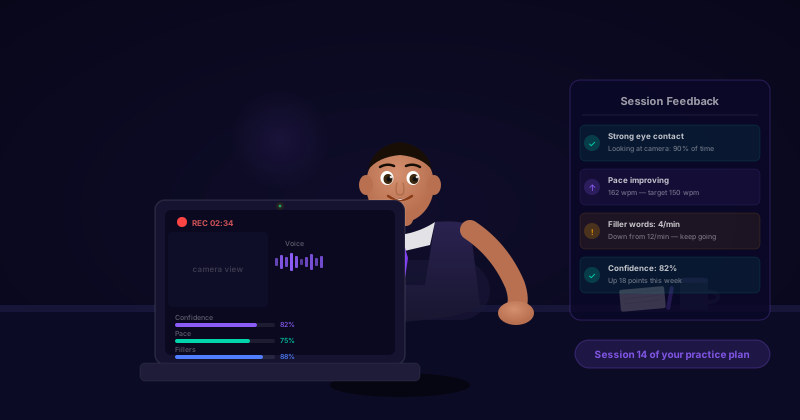
Part of the Speaking Signals series. The face is the fastest signal an audience reads, and EchoPitch's approach to measuring it is explained in full in how EchoPitch uses FACS and the science page.
What facial expressions signal to an audience
Before an audience has evaluated a single claim, it has already looked at your face and formed an impression. This is not a conscious process on the audience's side, and it happens in a fraction of a second. The face is processed faster than speech, which is one reason a mismatch between what you say and what your face does is so noticeable, even when nobody in the room could explain exactly what felt wrong.
The Facial Action Coding System (FACS), developed by psychologists Paul Ekman and Wallace Friesen in 1978, gives a precise vocabulary for what a face is doing. It defines 44 Action Units, each tied to a specific facial muscle. Two matter most for presenting:
- AU6, the cheek raiser. The muscle around the eye that activates in a genuine smile. It cannot be produced reliably on command, which is why it is the marker of authentic warmth rather than performed politeness.
- AU12, the lip corner puller. The muscle that pulls the mouth into a smile shape. It can be produced at will, and on its own, without AU6, it reads as a social smile: polite, but not warm.
A genuine smile combines both. A social smile uses AU12 alone. Audiences do not consciously count muscles, but they reliably tell the difference, which is why a forced smile so often reads as forced even to a viewer who could not say why.
Other Action Units carry their own signals. AU4, the brow lowerer, reads as concentration when paired with steady eyes and as concern or doubt when paired with a downward gaze. AU17, the chin raiser, reads as suppression or doubt, and often appears just before a hedge or a qualification in speech. None of these are inherently bad; a furrowed brow during a hard question can read as taking it seriously. The problem is a face that does not match its content, or a face that shows nothing at all.
The frozen-face failure mode
A common but counterproductive instinct under pressure is to still the face deliberately, on the theory that a face that does not move cannot betray nerves. It backfires. A face held rigid reads to an audience as disengaged, unreadable or robotic, which is a confidence signal in its own right, just a negative one. Viewers use facial movement to judge whether a speaker is present and reacting to their own content; a still face gives them nothing to read, and in the absence of information people tend to assume the worst rather than the best.
Frozen face usually stems from one of two habits: consciously suppressing expression to hide anxiety, or simply forgetting the face exists while focused on content and words. Both produce the same result. The fix is not relaxation alone. It is deliberately reconnecting the face to what is being said: letting a genuine point of agreement show, letting emphasis register, letting a moment of humour land on the face and not just in the voice.
The over-smiling failure mode
The opposite failure is a fixed, continuous smile held regardless of content, often a nervous habit rather than a reaction to anything specific. It costs credibility in two distinct ways. First, a held smile is usually AU12 without AU6, the social-smile pattern, so it reads as polite performance rather than genuine warmth, and audiences register the flatness even without naming it. Second, and more damaging, is the content mismatch: a speaker who smiles while stating a risk, a difficult number or a piece of bad news reads as either nervous or insincere, because the face is saying one thing and the words are saying another.
Over-smiling is common specifically because it feels safe. Smiling is a low-risk, socially rewarded default, so under stress speakers default to it regardless of what they are saying. The fix is not to smile less in general; it is to let the smile track content, present during genuinely positive moments and absent during serious ones.
Frozen face
No visible movement regardless of content. Reads as disengaged or robotic. Usually from suppressing expression to hide nerves. Fixed by deliberately reconnecting the face to the content.
Over-smiling
A held smile regardless of content. Reads as nervous or insincere, especially on serious points. Usually a default safety habit. Fixed by matching expression to what is actually being said.
Both failure modes have the same underlying cause: the face has stopped responding to content and started running on a fixed setting, either off or on. The correction in both cases is the same instinct: let the face do what it would do if you were saying the same words to one trusted person across a table, rather than performing an expression at an audience.
The audience reads less anxiety than you feel
EchoPitch's own perception gap data shows speakers rating their internal anxiety at 8 to 9 out of 10 while facial analysis measures visible anxiety at 3 to 5 for the same sessions. Most of what feels like an obviously anxious face to the speaker is not visible to the room. This matters for both failure modes: the frozen face over-corrects for anxiety nobody could see, and over-smiling tries to mask anxiety that was already far less visible than it felt.
Matching expression to content
The underlying principle for both failure modes is the same: expression should track content, not run independently of it. A few practical checkpoints:
- Serious claims, numbers and risks. A neutral or slightly concerned expression matches the content. A smile here reads as a mismatch.
- Genuine positive moments. Good news, a strong result, a point you are proud of. This is where a real smile, engaging the muscles around the eyes, belongs.
- Difficult questions. A furrowed brow while thinking reads as taking the question seriously. A fixed smile here reads as deflection.
- Transitions. A brief, natural reset of expression between sections is normal and expected; it does not need to be filled with anything.
Drills for facial expressions
- 1See your resting face. Record 30 seconds explaining something neutral, with no attempt to perform. Watch it back. Most people are surprised by what their face does by default, in either direction.
- 2Loosen before you start. A few seconds of jaw and brow release, an exaggerated wide-mouth stretch followed by a full relax, before presenting reduces the held tension that produces a frozen face.
- 3Mark the mismatches. Go through your talk and flag any sentence where a fixed smile would contradict the content: risks, difficult numbers, serious asks. Practise those lines with a neutral face specifically.
- 4Find the real smile moments. Identify the one or two points in your talk you are genuinely pleased about, and let the expression show fully there, rather than spreading a flat smile evenly across everything.
- 5Record and compare. Re-record the same section after the previous drills and compare against the baseline. Look specifically for whether the face now changes in step with the content.
How EchoPitch measures facial expressions
On video, EchoPitch tracks all 44 Action Units of the Facial Action Coding System frame by frame, detecting which are active, at what intensity, and for how long during each part of a session. Those combinations are mapped onto the Valence-Arousal-Dominance (VAD) model. Dominance is the dimension that matters most for presentation coaching: low Dominance, appearing controlled or submissive rather than in command, is the clearest facial marker of presentation anxiety, and it is what a frozen or mismatched face most often signals to a room.
The report timestamps where confidence signals were weakest on the face, alongside the voice signals, pace, pitch, volume and steadiness, recorded at the same moment, so you can see whether a facial mismatch coincided with a vocal one. The science page covers the full FACS and VAD methodology.
See what your face does under pressure
Record a short section with the AI speech coach and check the Action Unit timeline against your key claims. Or score a 60-second pitch free with the pitch scorer.
Get facial expression feedbackKey takeaways
- A genuine smile engages the muscles around the eyes (AU6) as well as the mouth (AU12). A social smile uses the mouth alone, and audiences read the difference.
- A frozen face reads as disengaged or robotic, even when it is intended to hide nerves. It is a negative confidence signal, not a neutral one.
- Over-smiling reads as nervous or insincere, especially when it contradicts serious content like risks or difficult numbers.
- The fix for both failure modes is the same: let the face track content instead of running on a fixed setting.
- Audiences see far less anxiety on a face than the speaker feels. Perception gap data puts felt anxiety at 8 to 9 out of 10 against visible signals of 3 to 5.
- EchoPitch tracks all 44 FACS Action Units and maps them to the VAD model, timestamping where facial confidence signals were weakest.
Frequently asked questions about facial expressions when presenting
What do facial expressions signal to an audience during a presentation?
Engagement, confidence and doubt, processed before the audience evaluates your content. A genuine smile reads as warmth, a furrowed brow as concentration or concern, a rigid jaw as tension. These judgments form within seconds and colour everything said afterward.
What is FACS and how is it used to measure facial expressions?
The Facial Action Coding System, developed by Ekman and Friesen in 1978, catalogues 44 Action Units tied to specific facial muscles. A genuine smile combines AU6 (around the eyes) with AU12 (the mouth); a social smile uses AU12 alone. EchoPitch tracks all 44 on video.
Why does my face freeze when I present?
Usually from consciously suppressing movement to hide visible anxiety. It backfires because a still face reads as disengaged or robotic. The fix is reconnecting the face to the content rather than trying to relax it into stillness.
What is over-smiling and why does it undermine credibility?
A fixed smile held regardless of content, usually AU12 without AU6, so it reads as polite rather than genuine. It undermines credibility further when it contradicts serious content, such as smiling while stating a risk.
How can I stop looking nervous in my facial expressions?
Loosen jaw and brow tension before you start, see your resting face on video, and let expression track content rather than holding one expression throughout. Remember that audiences read far less anxiety from a face than the speaker feels.
How does EchoPitch measure facial expressions?
It tracks all 44 FACS Action Units frame by frame and maps combinations onto the Valence-Arousal-Dominance model, with Dominance the key marker of anxiety, timestamping where confidence signals on the face were weakest alongside the voice signals.
Sources
- Ekman, P., & Friesen, W. V. (1978). Facial Action Coding System. Consulting Psychologists Press.
- Mehrabian, A. (1996). Pleasure-arousal-dominance: A general framework for describing and measuring individual differences in temperament — Current Psychology, 14(4), 261-292.