
Quick Answer
An AI presentation coach analyses your delivery and gives instant feedback on pace, filler words, confidence signals, and clarity. Available anytime without social judgement, AI coaches enable frequent private practice. Most users see measurable improvement in filler words within 3-5 sessions and confidence signals within 8-12 sessions.
AI Presentation Coach — Private Practice for Nervous Presenters
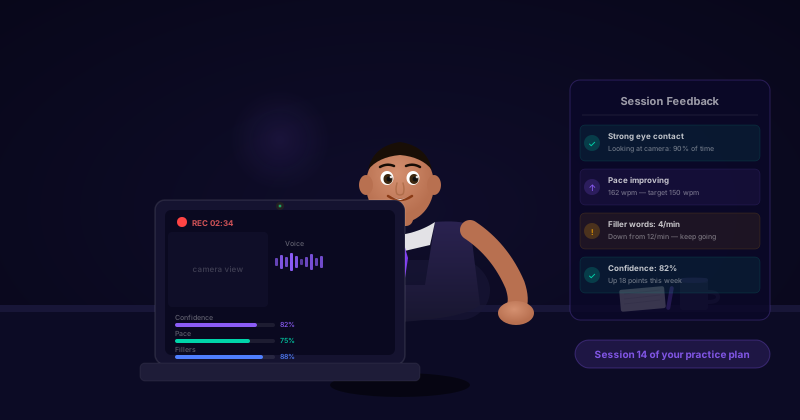
What an AI presentation coach actually does
An AI presentation coach records your practice sessions and gives structured feedback on the delivery elements that human coaches typically cannot measure systematically: exactly how many filler words you used, precisely where your pace broke down, which sentences you rushed through, and what your confidence signals looked like to the camera.
The feedback is immediate, objective, and unjudged. There is no social cost to performing badly in a practice session with an AI coach — which removes one of the biggest barriers to practice frequency.
What AI coaching measures that you cannot self-assess
Most presenters significantly misestimate their own delivery. The three biggest gaps between self-perception and objective measurement:
Filler words: Most people believe they use fillers occasionally. AI analysis typically reveals they appear every 8-12 seconds on average — far more frequently than perceived. Once you see the data, it is impossible to ignore in real-time delivery.
Pace: Nervous presenters rush. The internal experience of speaking at normal pace is often 180+ words per minute — well above the 130-150wpm optimal for comprehension and authority. You cannot reliably assess your own pace without measurement.
Confidence signals: EchoPitch's FACS-based emotional analysis detects the involuntary facial signals that accompany genuine confidence versus performed composure. These signals are read subconsciously by audiences and panels. The difference between them is not visible in the mirror — it requires frame-by-frame analysis of facial Action Units.
How to get the most from AI presentation coaching
Practise the same content across multiple sessions. The comparison between sessions is where the learning is. Practising different content each time makes improvement invisible.
Target one element at a time. The natural instinct is to try to fix everything simultaneously. This is the slowest path. Target fillers first (typically easiest), then pace, then pausing, then confidence signals. Focused practice on one variable produces faster change than diffuse attention across all variables.
Watch your playbacks. Watching yourself presenting is uncomfortable. It is also the single most powerful accelerant to improvement. The discomfort of watching your own delivery habits is the mechanism by which they change.
Practise before the high-stakes version, not instead of it. AI coaching is preparation infrastructure, not a substitute for live experience. The goal is to arrive at the real presentation, interview, or pitch having already practised it enough that the delivery is automatic — freeing your attention for the audience.
AI coaching vs traditional presentation training
What does an AI presentation coach actually do?
Traditional presentation training delivers insight in a single session — a workshop, a coach session, a feedback conversation. AI coaching delivers objective data across repeated practice sessions. Both are valuable, but they operate at different timescales and answer different questions.
Traditional training answers: what should I do differently? AI coaching answers: am I actually doing it differently? The loop from insight to measurable behaviour change typically requires weeks of deliberate practice. AI coaching makes that change visible in real time.
Try AI presentation coaching
EchoPitch gives you instant feedback on confidence, pace, filler words, and delivery signals. Private practice — no audience, no judgement.
Start freeKey takeaways
- AI coaches measure delivery mechanics objectively — pace, fillers, confidence signals — that human coaches cannot track across every session
- Most people significantly underestimate their filler word frequency and overestimate their speaking pace
- Target one delivery element at a time for fastest improvement
- Practise the same content across sessions to see longitudinal change
- Watching your own playbacks is uncomfortable and essential