
Getting Real-Time Sales Call Delivery Feedback: The Complete Guide
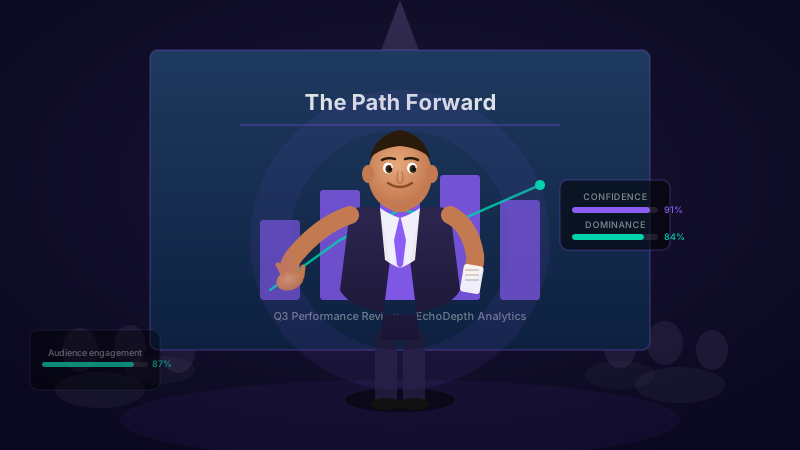
The difference between top performers and average reps is not what they say. It is how they say it. Here is how to get the sales call delivery feedback that transforms your performance.
Quick Answer
Sales call delivery feedback is objective analysis of how you sound and appear during sales conversations — talk-to-listen ratio, speaking pace, vocal energy, and camera presence — rather than what you say. Gong's analysis of millions of B2B sales calls found that top-performing reps talk just 43% of the time and listen 57%, compared to 65-75% talk time for average reps, because listening more signals genuine curiosity and respect for the prospect's time. Top performers also speak roughly 14% slower than average, since a measured pace at 140-160 words per minute signals confidence and gives prospects time to process, while rushed 180-200 wpm delivery reads as anxiety. Camera presence matters enormously too: turning your camera on during a video sales call raises win rates by 94%, and win rates rise a further 96% when the buyer also switches their camera on. This matters because 82% of buyers feel salespeople are underprepared emotionally for conversations, even when their product knowledge is solid.
MBA, Bayes Business School · Founder, Cavefish · June 2026
Key Takeaways
- ✓Top sales reps talk 43% of the time, listen 57% — average reps talk 65-75%
- ✓Top performers speak 14% slower than their peers, signaling confidence
- ✓Camera-on calls show 94% higher win rates; reciprocal video adds another 96%
- ✓82% of buyers feel salespeople are underprepared — not on product, but on presence
- ✓AI-powered feedback provides consistent, objective coaching at scale
- ✓Deliberate practice 2-3 times weekly produces measurable improvement within weeks
Why Sales Call Delivery Matters More Than Your Script
Every sales organization invests heavily in scripts, playbooks, and talk tracks. They train reps on objection handling, value propositions, and competitive differentiators. Yet research consistently shows that what you say accounts for only a fraction of how buyers perceive you.
The reality is that buyers make trust decisions in the first few seconds of a call — long before you have delivered your carefully crafted value proposition. They are reading your vocal tone, your pacing, your energy, and your presence. They are deciding whether you seem credible, confident, and worth listening to.
This is where sales call delivery feedback becomes essential. Without objective feedback on how you come across, you are flying blind. You might have the perfect script and still lose deals because your delivery undermines your credibility.
The Delivery Problem No One Talks About
Most sales reps have never heard themselves on a call. They have no idea that they:
- •Say "um" or "you know" every few sentences
- •Rush through key value points
- •Speak in a monotone that signals boredom
- •Interrupt prospects before they finish speaking
- •Sound nervous or uncertain during pricing discussions
The gap between self-perception and reality is enormous. A Harvard Business Review study found that people typically overestimate their communication effectiveness by 40-60%. You think you sound confident. Buyers hear uncertainty. You think you are being concise. They experience rambling.
Sales call delivery feedback closes this gap by giving you an objective mirror. It shows you what buyers actually experience, not what you intend to project.
The Metrics That Predict Sales Success
Gong has analyzed millions of B2B sales calls to identify the delivery patterns that correlate with closed deals. The findings are remarkably consistent and often counterintuitive.
Talk-to-Listen Ratio: The 43% Rule
Top-performing sales reps talk 43% of the time and listen 57% of the time. Average reps talk 65-75% of the time.
Top reps talk time
Average reps talk time
This ratio matters more than the content of what you say because it reflects fundamental qualities buyers value: genuine curiosity about their situation, patience to understand before prescribing, and respect for their time and perspective.
When you talk too much, you signal that you care more about your pitch than their problems. When you listen more, you demonstrate that you are there to understand and help, not just to sell.
Tracking this ratio through sales call delivery feedback reveals patterns you cannot see in the moment. Many reps are shocked to discover they dominate conversations they believed were collaborative.
Speaking Pace: Slower Wins
Top performers speak approximately 14% slower than their average peers. The optimal pace for sales conversations is typically 140-160 words per minute. Nervous or poorly prepared reps often speak at 180-200 words per minute.
Slower speaking pace of top-performing sales reps vs. average
Why does pace matter? Several reasons:
- Confidence signal: Speaking slowly and deliberately communicates that you are in control and comfortable
- Processing time: Prospects need time to absorb and process what you are saying
- Natural pauses: Slower pace creates openings for prospects to jump in, ask questions, or express concerns
- Reduced anxiety transfer: Rushed speech triggers the buyer's mirror neurons, making them feel anxious too
Most reps have no idea how fast they speak. Sales call delivery feedback provides objective pace measurements and helps you recognize when you are accelerating — often during pricing discussions, objection handling, or when you sense the deal slipping away.
Vocal Energy and Variation
Vocal energy is not about volume. It is about the variation in pitch, pace, and emphasis that makes your voice engaging and signals your emotional investment in the conversation.
High-performing reps demonstrate dynamic vocal energy that matches the emotional content of what they are discussing:
- Enthusiasm when presenting value or discussing possibilities
- Empathy and gravity when addressing concerns or problems
- Confidence and steadiness during pricing and commitment discussions
- Curiosity and openness during discovery questions
Monotone delivery, regardless of how compelling the words, fails to engage prospects and signals either disinterest or nervousness. Your voice should be an instrument that enhances your message, not a flat delivery mechanism that undermines it.
The Camera-On Effect
In the era of video sales calls, visual presence has become a critical delivery metric.
Win rate increase when rep has camera on
Additional increase when buyer turns camera on
The act of being visibly present creates human connection that audio alone cannot replicate. It enables reading and responding to facial expressions, demonstrates commitment to the conversation, and creates accountability on both sides.
But simply having your camera on is not enough. Delivery feedback for video calls includes:
- Eye contact: Looking at the camera lens, not your screen or notes
- Facial expressions: Appropriate expressions that match your words
- Posture and framing: Professional setup that does not distract from your message
- Gestures: Natural hand movements that emphasize key points
Why Traditional Feedback Falls Short
Most sales teams rely on three sources of delivery feedback, each with significant limitations.
Manager Coaching
Sales managers are often the primary source of performance feedback. But manager coaching has fundamental constraints:
- Limited observation: Managers might join 2-3 calls per rep per month, a tiny sample of actual performance
- Subjectivity: Feedback varies based on manager preferences and their own communication style
- Focus on content: Managers typically focus on what was said, not how it was delivered
- Delayed feedback: Even when delivery is addressed, feedback comes hours or days after the call
- Time constraints: Most managers simply do not have time for detailed delivery coaching across their entire team
Self-Review of Recordings
Listening to your own calls is valuable but limited:
- No objective metrics: You might hear issues but cannot quantify them
- Confirmation bias: People tend to hear what they expect to hear
- Incomplete picture: Audio-only review misses visual delivery elements
- Time intensive: Reviewing a 30-minute call takes 30 minutes, limiting how many you can analyze
Peer Feedback
Colleagues can provide useful perspectives, but:
- Social dynamics: People hesitate to give honest critical feedback to peers
- Varied standards: What one rep considers confident, another might see as aggressive
- Availability: Colleagues have their own calls to make and deals to close
The result is that most sales professionals develop their skills with minimal objective feedback on their delivery. They improve slowly, if at all, and may reinforce bad habits for years without realizing it.
How AI Transforms Sales Call Delivery Feedback
Artificial intelligence has fundamentally changed what is possible in sales call delivery feedback. Modern AI coaching tools can provide what human coaching cannot: consistent, objective, immediate, and comprehensive analysis of every call.
Real-Time Metrics
AI-powered sales coaching tools analyze your audio and video in real-time to provide instant feedback on delivery metrics:
- Talk-listen ratio: Tracked continuously throughout the call
- Speaking pace: Words per minute with alerts when you accelerate
- Filler words: Count and timestamp of "um," "uh," "like," "you know"
- Pause usage: Identification of strategic vs. awkward silences
- Vocal energy: Dynamic range and variation in your delivery
- Confidence signals: Markers of certainty and authority in your voice
What AI Feedback Can Detect
- •Speaking pace changes when discussing price (often acceleration)
- •Talk ratio shifts during different call phases
- •Filler word patterns under different stress conditions
- •Energy drops that signal disengagement or fatigue
- •Facial expression patterns on video calls
Practice Environment
Beyond call analysis, AI enables deliberate practice with immediate feedback. Rather than waiting for real calls to work on your delivery, you can:
- Practice your pitch with real-time metrics display
- Run through objection scenarios with delivery scoring
- Record multiple takes and compare delivery across versions
- Track improvement over time with objective measurements
This practice environment is transformative because it separates skill development from quota pressure. You can experiment, fail, and adjust without risking real deals.
Consistency and Scale
Perhaps the most significant advantage of AI-powered sales call delivery feedback is that it scales. Every rep on the team can get the same quality of feedback on every call. There is no dependency on manager availability or observation. The coaching is always available, always objective, and always comprehensive.
For sales leaders, this means visibility into team-wide delivery patterns. Which reps talk too much? Who needs pacing work? Where are filler words most prevalent? AI analytics surface these patterns across the entire organization.
The Metrics That Matter: A Deep Dive
Let us examine the specific delivery metrics that sales call delivery feedback should track and why each matters for sales performance.
Talk Time Analysis
Beyond the overall 43% talk ratio, sophisticated feedback breaks down talk time by call phase:
- Opening: Who speaks first and for how long sets the tone
- Discovery: This phase should be heavily prospect-dominated
- Presentation: More rep talk time is appropriate here, but still with pauses for engagement
- Objection handling: Should include significant prospect time to fully express concerns
- Close: Brief, confident rep statements with space for buyer response
A rep might have a perfect overall ratio but still dominate discovery (bad) while barely speaking during the close (also problematic). Phase-specific feedback reveals these nuances.
Pace Variability
It is not just about average pace. Smart feedback tracks pace variation:
- Baseline pace: Your natural conversational speed
- Acceleration patterns: When and why you speed up
- Strategic slowing: Whether you slow down for emphasis
- Stress indicators: Pace changes correlated with challenging topics
Many reps have good average pace but accelerate dramatically during pricing discussions — precisely when calm, deliberate delivery is most important.
Filler Word Intelligence
Not all filler words are equal. Detailed feedback distinguishes:
- Frequency: Total count and percentage of total words
- Patterns: Specific fillers you use ("um" vs. "you know" vs. "basically")
- Triggers: When fillers increase (complexity, objections, pricing)
- Trends: Whether frequency is decreasing with practice
The target is not zero filler words — some give you thinking time and make you sound natural. But awareness of patterns allows intentional reduction where fillers undermine your credibility.
Energy Mapping
Vocal energy feedback should track dynamic range throughout the call:
- Peak energy: Your highest points of enthusiasm and emphasis
- Energy valleys: Where your voice drops and potentially loses engagement
- Energy matching: Whether your energy aligns with content emotional weight
- Monotone detection: Stretches without sufficient variation
of buyers feel salespeople are underprepared emotionally for conversations
Building a Practice Routine for Delivery Improvement
Knowing the metrics is not enough. Improvement requires deliberate practice. Here is how to structure a routine that produces measurable delivery improvements.
Daily Warm-Ups (5 minutes)
Before your first call of the day:
- Vocal warm-up: Read a paragraph aloud at varying speeds and energy levels
- Pace calibration: Practice your opening at the target 150 wpm pace
- Posture check: Set up your camera-on presence before calls begin
Focused Practice Sessions (15-20 minutes, 2-3x weekly)
Choose one delivery metric to focus on each session:
- Talk ratio session: Practice discovery questions with a timer, forcing yourself to stop and listen
- Pace session: Deliver your pitch while watching real-time pace feedback, adjusting as needed
- Filler word session: Record yourself handling common objections, counting fillers
- Energy session: Practice the same content with intentionally varied energy to build range
Call Review (30 minutes weekly)
Select one call per week for detailed delivery analysis:
- Review the AI-generated metrics for the entire call
- Identify three specific moments where delivery could improve
- Practice the improved version of those moments
- Track whether similar situations improve in subsequent calls
Monthly Baseline Assessment
Once a month, record yourself delivering a standardized pitch or call script. Compare to previous months to see improvement trends across all metrics.
Sample Weekly Practice Schedule
- •Monday: 15-min pace practice session
- •Wednesday: 20-min talk ratio practice with objection scenarios
- •Friday: 30-min call review and deliberate practice on weak points
- •Daily: 5-min warm-up before first call
Implementing Sales Call Delivery Feedback Across Your Team
For sales leaders, the question is how to implement delivery feedback at scale. Here is a framework for rolling out a team-wide delivery improvement program.
Establish Baselines
Before setting improvement targets, measure where your team currently stands:
- Aggregate talk ratio across the team
- Average speaking pace distribution
- Filler word prevalence
- Camera-on rates for video calls
This baseline identifies team-wide patterns and individual outliers who may need additional support.
Set Specific, Measurable Goals
Rather than vague improvement targets, set specific delivery goals:
- "Reduce team average talk ratio from 68% to 55% within 60 days"
- "Achieve 90% camera-on rate for all scheduled video calls"
- "Reduce average filler words per call from 12 to under 5"
Create Accountability Structures
Delivery improvement requires ongoing attention:
- Weekly team review of aggregate delivery metrics
- Individual coaching conversations focused on delivery, not just deal strategy
- Recognition for reps showing strongest improvement
- Integration of delivery metrics into performance discussions
Invest in Tools
Manual delivery coaching does not scale. AI-powered tools that provide real-time feedback during practice and post-call analytics enable consistent improvement across the entire team without proportional increases in management time.
The Competitive Advantage of Delivery Excellence
In a market where products and prices rapidly converge, sales call delivery feedback creates durable competitive advantage. Your competitors can copy your features. They can match your pricing. But they cannot easily replicate a sales team that consistently delivers with confidence, presence, and genuine human connection.
The reps who invest in delivery improvement today will be the top performers tomorrow. Not because they have better scripts — everyone has access to similar playbooks now — but because they have mastered the human elements that no script can capture.
The 94% win rate improvement from camera-on calls, the 14% pace advantage of top performers, the 43% talk ratio that separates elite reps — these are not random statistics. They are evidence that delivery matters enormously and that it is measurable and trainable.
Sales call delivery feedback transforms an invisible skill into a visible, improvable practice. It closes the gap between self-perception and reality. It provides the objective data needed to get better systematically rather than haphazardly.
The question is not whether delivery matters. The research is clear. The question is whether you will invest in the feedback systems that make delivery improvement possible.
Get Real-Time Sales Call Delivery Feedback
EchoPitch analyzes your pacing, talk ratio, vocal energy, and presence — the delivery metrics that predict sales success. Practice with AI coaching and see your numbers improve.
Get daily tips on Reddit
Join our community for presentation tips, Q&A, and support.
Sources: Gong revenue intelligence platform analysis of millions of B2B sales calls; Harvard Business Review research on communication self-assessment accuracy; buyer perception studies on salesperson preparation and delivery; sales performance correlation research on talk ratios, pace, and visual presence.