
First Interview After Years Away? How to Shake Off the Rust
Your skills aren't gone. They're dormant. Here's how to wake them up.
MBA, Bayes Business School · Founder, Cavefish · July 2026
Summary
Interview skills are a specific performance ability that atrophies without practice. After years away from the job market, your general professional competence remains intact, but interview-specific skills need rebuilding. These include: staying composed while being evaluated, structuring coherent answers under time pressure, managing anxiety in high-stakes contexts, reading social cues from strangers, and selling yourself without sounding arrogant. The fix involves four steps: (1) practice out loud, not in your head — interviews are verbal and physical performances, (2) focus on your opening 30 seconds which sets the entire interview's tone, (3) complete 3-5 mock interviews using AI tools like EchoPitch or with friends before the real thing, and (4) prepare a concise, forward-focused explanation for your career gap. The first interview after a break almost always feels terrible — but your skills return faster than you expect once you get one under your belt.
You submitted hundreds of applications. Finally, a callback. Now you're facing your first interview in years — maybe 5, maybe 10 — and you feel like you've forgotten how to do this.
You haven't. But interview skills, like any performance skill, rust without use. Here's how to rebuild them fast.
Why do interviews feel harder after a career break?
Interviews are a specific type of performance. They require:
- Staying composed while being evaluated
- Structuring coherent answers under time pressure
- Managing anxiety in a high-stakes context
- Reading social cues from strangers
- Selling yourself without sounding arrogant
These skills don't transfer automatically from regular conversation. You can be excellent at your job and terrible at interviewing for one — they're different abilities.
After years without interviews, your general communication skills remain intact. But the interview-specific performance muscles have weakened. This is normal and fixable.
Is the first interview after a break always the worst?
Here's something nobody tells you: the first interview after a long break almost always feels terrible. You'll likely walk out thinking you bombed it.
Two things to know:
- You probably did better than you think. We judge ourselves more harshly than interviewers do. If they're moving forward (background check, next round), you did fine.
- The second interview will feel dramatically better. Just getting one under your belt breaks the ice. Your skills come back faster than you expect.
How should you prepare for an interview after years away?
Step 1: Practice out loud, not in your head
Reading through your notes silently doesn't rebuild interview skills. Interviews are verbal and physical — you need to practice the actual performance.
Speak your answers out loud. Record yourself. Watch the recording. This feels awkward, but it's how you identify what needs work.
Step 2: Focus on your opening
The first 30 seconds of an interview set the tone. If you start nervous and fumbling, you spend the rest of the interview trying to recover.
Rehearse these until they're automatic:
- Your greeting and handshake/video hello
- Your answer to "Tell me about yourself"
- Your posture and eye contact in the first moments
When your opening is solid, the rest flows more easily.
Step 3: Do mock interviews
You need at least 3-5 practice runs before your real interview. Options:
| Method | Pros | Cons |
|---|---|---|
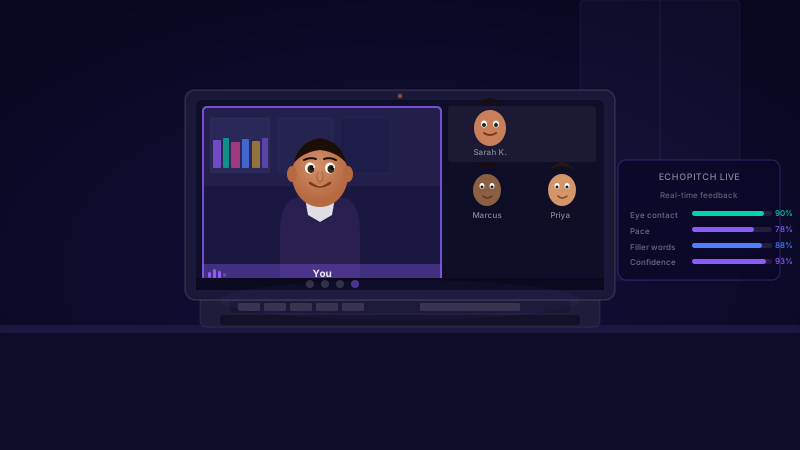
| AI tools (EchoPitch) | Private, unlimited practice, objective metrics | No human rapport |
| Friends/family | Free, supportive, available | May not give honest feedback |
| Career services | Professional, structured | Limited availability, may cost |
| Recording yourself | Free, see yourself objectively | No feedback, easy to skip |
- AI tools: Interview practice apps like EchoPitch let you practice privately with feedback
- Friends/family: Anyone willing to ask you questions and give honest feedback
- Career services: If available through alumni networks or job centers
The goal isn't perfection — it's getting reps in so the real thing isn't your first rodeo.
Step 4: Prepare your gap explanation
You'll be asked about your career break. Prepare a concise answer that:
- States the facts briefly: "I took time off to care for a family member / raise children / address health / travel / pursue study"
- Pivots forward: "Now I'm ready to return and excited about this role because..."
- Doesn't over-explain: The more you justify, the more it seems like you think you need to
Employers care less about the gap than whether you can do the job now. Don't make the gap bigger than it needs to be.
How do you manage interview anxiety after a long break?
Interview anxiety after a long break is intense. Your body treats it like a bigger threat because it's unfamiliar again.
What helps:
- Arrive early: Give yourself time to acclimate to the space
- Physiological sigh: Double inhale through nose, long exhale. Calms the nervous system fast.
- Reframe the stakes: This isn't your only chance. It's practice for the next one even if it doesn't work out.
- Focus on them: Shifting attention from "How am I doing?" to "What do they need?" reduces self-consciousness
Watch: Harvard research on reframing anxiety as excitement before interviews
Read the transcript
Based on YouTube's automatic captions, lightly edited. It may still contain errors.
So, welcome to part two of looking at ways of helping your presentation anxiety. The first part was talking about physiological breathing. The second one is about reframing anxiety as excitement. So, it sounds a little counterintuitive. Reframing anxiety as excitement sounds too simple, but Harvard research proves it works. When you feel your heart racing, don't tell yourself to calm down. Instead, say out loud, "I'm excited." So, anxiety and excitement are almost identical in your body. Same heart rate, same adrenaline. The only difference is the label your brain applies. When you say, "I'm excited," you shift from a threat response to an opportunity response. Your brain stops fighting and starts performing. Try it out. Try it out loud. I'm excited. It feels silly, but it works.
What should you do after the interview?
You'll probably spiral: "I should have said this instead of that. Why did I pause so long? They definitely hated me."
This is normal. A few reframes:
- You noticed more flaws because your awareness is up. Interviewers don't catch as much as you think.
- Awkward pauses feel longer to you than to them. What felt like 10 seconds was probably 2.
- If they said positive things, believe them. People don't lie about moving forward.
The bottom line
Interview skills rust after years away — this is normal. The fix is deliberate practice: speak out loud, record yourself, do mock interviews, and nail your opening. Your first interview back will feel rough, but the skills return faster than you expect.
You haven't forgotten how to do this. You just need to warm up.
Related guides
Get daily tips on Reddit
Join our community for presentation tips, Q&A, and support.