
Presentation Anxiety Statistics: The Research in Numbers
A comprehensive reference of the key statistics on public speaking anxiety — prevalence, demographics, career impact, and treatment outcomes — with primary source citations.
Quick Answer
Presentation anxiety affects around 75% of the general population to some degree, making it the single most commonly reported specific fear, ahead of death, heights, and spiders, according to the National Comorbidity Survey and the Chapman University Survey of American Fears. Roughly 10–20% experience it severely enough to meet DSM-5 criteria for specific phobia or social anxiety disorder, typically developing between ages 15 and 20. The most commonly reported physical symptoms are a racing heart, about 78% of sufferers, shaking at 64%, sweating at 61%, and dry mouth at 58%. Treatment outcomes are strong: cognitive behavioural therapy achieves an 80–90% response rate in clinical trials, among the highest of any anxiety disorder, with graduated exposure showing comparable results. The career stakes are significant too — oral communication has ranked among employers' top three desired attributes every year since 2000, and professionals who avoid presenting opportunities consistently show slower career advancement than those who don't, regardless of underlying technical skill or qualifications.
MBA, Bayes Business School · Founder, Cavefish · June 2026
of the general population experience some degree of fear of public speaking — making it the single most commonly reported specific fear, ahead of death, heights, and spiders.
Key figures at a glance
of the general population experience some degree of public speaking anxiety
National Comorbidity Survey (Kessler et al.)
experience presentation anxiety severe enough to meet clinical criteria for specific phobia or social anxiety disorder
DSM-5; Stein et al. epidemiological reviews
most commonly reported specific fear in population surveys — ranked above death, heights, and spiders
Chapman University Survey of American Fears
age range when glossophobia most commonly develops — coinciding with peak social evaluation pressure
Ollendick & Hirshfeld-Becker, 2002
response rate for CBT in clinical trials for public speaking anxiety — among the highest for any anxiety disorder
Powers et al., Cochrane review 2008
oral communication skills ranked in employer attribute surveys every year since 2000
NACE Job Outlook surveys
How common is presentation anxiety?
The most widely cited figure — 75% of the population — comes from multiple large population surveys, most notably the National Comorbidity Survey conducted by Kessler et al. This survey of over 8,000 US adults found public speaking to be the single most commonly feared situation in a social anxiety context.
It is important to distinguish between three levels of severity:
| Level | Prevalence | Description |
|---|---|---|
| Mild anxiety | ~55% | Nerves before presenting; does not impair performance significantly |
| Moderate anxiety | ~20% | Avoidance behaviour; noticeable impairment in performance |
| Clinical (phobia/SAD) | 10–20% | Meets DSM-5 criteria; significant life and career impact |
Who does presentation anxiety affect most?
Age
Glossophobia typically develops between ages 15 and 20, during adolescence when peer evaluation is at its most intense and identity formation is most active. Ollendick and Hirshfeld-Becker (2002) found that social fears including public speaking are among the earliest specific phobias to develop and among the last to remit without intervention.
Severity tends to diminish slightly in older adults through natural habituation, but the underlying anxiety response persists for most people who have not actively addressed it.
Gender
Clinical social anxiety disorder shows a slight female preponderance (approximately 60/40 female/male in treatment-seeking populations). However, general-population surveys of presentation anxiety show no consistent gender difference. Research suggests men may underreport anxiety due to social norms around emotional disclosure, meaning the actual gender distribution may be closer to equal than clinical data suggests.
Occupation and education
Contrary to the assumption that more experience reduces anxiety, research shows that professionals in high-presentation roles (executives, academics, lawyers, politicians) frequently maintain significant presentation anxiety throughout their careers. The anxiety reduces in situational intensity with experience but rarely disappears entirely without deliberate intervention.
Students show particularly high rates — UK university wellbeing surveys consistently find presentations ranking as a top-three academic stressor, with 87% of students reporting some level of presentation anxiety.
Neurodivergent populations
Prevalence is substantially higher in neurodivergent populations. ADHD is associated with presentation anxiety through working memory deficits and rejection sensitive dysphoria. Autism spectrum conditions are associated with social inference challenges, sensory sensitivity, and masking demands that amplify the standard anxiety response. Estimates suggest 80%+ of autistic adults experience anxiety in social evaluation contexts.
What are the most common physical symptoms?
Survey data on the physical experience of presentation anxiety shows consistent patterns across populations:
How does presentation anxiety affect your career?
The professional costs of presentation anxiety are substantial and well-documented. The National Association of Colleges and Employers (NACE) has ranked oral communication skills in the top three most desired graduate attributes in every annual survey since 2000. The gap between this employer priority and the prevalence of presentation anxiety represents a significant skills deficit in the workforce.
Earnings impact
Labour economics research consistently finds that professionals rated as strong oral communicators earn more than equally qualified peers. Warren Buffett's frequently cited claim that improving his public speaking increased his value by 50% is directionally consistent with this research, though the precise figure is anecdotal.
Leadership attainment
Studies of executive career trajectories find that willingness to present and visibility in speaking roles are among the strongest predictors of reaching senior leadership. Presentation avoidance — declining speaking opportunities, avoiding presentations to senior stakeholders — is inversely correlated with career advancement across industries.
The avoidance cost
The most significant professional cost of presentation anxiety is not the anxiety itself but the avoidance it drives. Research on career progression finds that professionals who systematically decline to present or speak publicly miss the visibility that drives advancement. The anxiety is manageable; the avoidance is career-limiting.
What treatments work for presentation anxiety?
CBT: 80–90% response rate
Cognitive behavioural therapy for public speaking anxiety achieves response rates of 80–90% in randomised controlled trials (Powers et al., 2008 Cochrane meta-analysis). This is among the highest response rates for any anxiety disorder. The majority of participants show significant improvement within 12–16 sessions, with gains maintained at 12-month follow-up.
Systematic desensitisation: comparable outcomes
Graduated exposure (systematic desensitisation) produces outcomes comparable to CBT in most studies, with the advantage of being partially self-directable through deliberate practice. Effects are durable at 12-month follow-up in most studies.
Beta-blockers: reliable symptom control
Propranolol and similar beta-blockers effectively control physical symptoms (racing heart, trembling, sweating) in 85–90% of users. The mechanism is adrenaline receptor blockade — it addresses symptoms rather than the underlying anxiety, which is why combination with exposure produces better long-term outcomes.
Self-directed practice: variable but positive
Research on self-directed practice interventions (recording, reviewing, structured rehearsal) shows more variable outcomes than formal therapy but consistently positive effects. Volume and quality of practice are the key variables — deliberate practice with feedback significantly outperforms unstructured repetition.
What the research does not show
It is worth noting some common claims that are not supported by strong research evidence:
- That people fear public speaking "more than death" — this claim is based on a single 1977 Book of Lists survey that did not ask about death directly
- That "most people" overcome presentation anxiety simply through experience — research shows avoidance is the dominant response to anxiety, not natural exposure
- That medication alone produces lasting improvement — evidence consistently favours combination of medication and behavioural intervention for durable outcomes
Sources
- Kessler, R. C., et al. (2005). Lifetime prevalence and age-of-onset distributions of DSM-IV disorders — Archives of General Psychiatry, 62(6), 593-602.
- Powers, M. B., et al. (2008). A meta-analytic review of psychological treatments for social anxiety disorder — Cochrane Database of Systematic Reviews.
- NACE Job Outlook Survey — Key attributes employers want (annual survey data).
- Ollendick, T. H., & Hirshfeld-Becker, D. R. (2002). The developmental psychopathology of social anxiety disorder — Biological Psychiatry, 51(1), 44-58.
- Chapman University Survey of American Fears — Annual survey ranking population fears.
Get the confidence guide — free
A weekly email covering one practical technique for managing presentation anxiety. No fluff — just what the research says works.
No spam. Unsubscribe anytime.
Practice privately, build real confidence
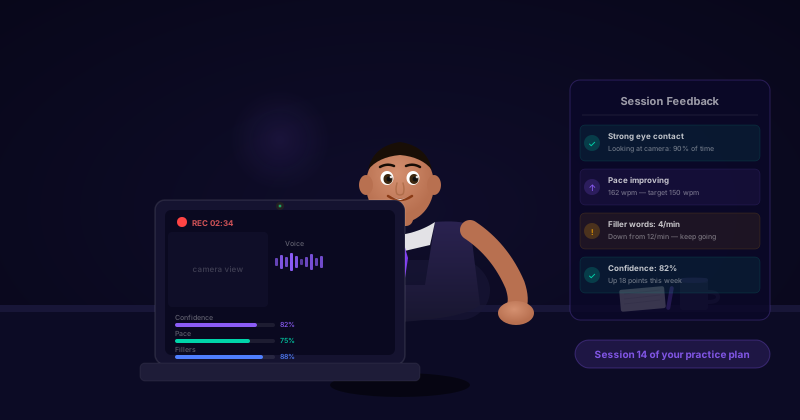
EchoPitch gives you AI feedback on confidence, pace, and delivery — with no audience and no judgement. 5 sessions, paid once. No subscription.
Try EchoPitch →Get daily tips on Reddit
Join our community for presentation tips, Q&A, and support.