
Autism and Presentation Anxiety
This guide is for general information only and isn't medical advice. It isn't written or reviewed by a licensed clinician. Talk to a doctor or qualified healthcare professional before starting, stopping, or changing any medication or treatment.
Autistic presenters face a distinct set of challenges that standard public speaking advice doesn't address. Here's what's actually different and what evidence-based approaches work.
MBA, Bayes Business School · Founder, Cavefish · May 2026
Quick Answer
Autistic presenters face four compounding challenges:real-time social inference is often effortful or unreliable, making it hard to read how an audience is responding; sensory sensitivity to lighting, sound, and the physical environment can create overload that competes with cognitive resources; masking — suppressing natural behaviours like stimming or atypical eye contact to appear neurotypical — adds exhausting cognitive load; and the unpredictability of Q&A is often harder than the scripted delivery itself. Around 80% of autistic adults report higher-than-average anxiety in social evaluation contexts like presentations. Effective strategies include thorough over-preparation to remove unpredictability, treating scripts or detailed outlines as legitimate tools rather than crutches, requesting environmental accommodations like lighting or microphone adjustments in advance, preparing specifically for Q&A by anticipating the most likely questions or requesting them in writing beforehand, building procedural memory through private practice before any audience is involved, and reframing directness and precision as genuine communication assets rather than deficits.
of autistic adults report higher-than-average anxiety in social evaluation contexts — with job interviews and presentations among the most consistently difficult situations.
What makes presenting harder for autistic speakers
Social inference in real time
Neurotypical presenters read the room continuously — detecting boredom, confusion, engagement — and adjust. For many autistic presenters, this real-time social inference is effortful or unreliable. The uncertainty about how the audience is responding can amplify anxiety significantly.
Sensory environment unpredictability
Presentation environments — bright lighting, microphone feedback, unexpected crowd reactions, background noise — can create sensory overload that competes with cognitive resources needed for the presentation itself.
Masking demands
Many autistic people have learned to suppress natural behaviours (stimming, atypical eye contact, unconventional body language) to appear neurotypical. Masking under the additional cognitive load of presenting is exhausting and can degrade performance.
Unpredictable Q&A
The question phase introduces the least structured, most socially unpredictable element of presenting. Autistic presenters often find the scripted delivery manageable but the Q&A genuinely anxiety-provoking.
Strategies that work with neurological difference
Over-prepare the content
Remove unpredictability through thorough preparation. Knowing your material deeply reduces the cognitive load during delivery, freeing resources for managing the environment. Scripts or detailed outlines are legitimate presentation tools — not crutches.
Prepare for Q&A specifically
Anticipate the 10 most likely questions and prepare answers. For formal presentations, consider requesting that questions be submitted in advance or in writing — a reasonable accommodation that benefits both autistic and non-autistic audience members.
Request environmental accommodations
Many presentation environments can be adjusted: lighting levels, microphone settings, the physical arrangement of the space. Requesting these in advance is professional and appropriate.
Practise the whole presentation privately first
Build procedural memory through private practice before any audience is involved. The delivery should be as automatic as possible before adding the social evaluation element.
Reframe unique communication style
Directness, precision, deep knowledge, and thoroughness — communication traits common in autistic presenters — are genuine assets in many contexts. Framing your style as different, not deficient, changes both your own experience and often how audiences receive you.
Research shows that sustained masking significantly increases post-presentation fatigue and anxiety. Strategies that reduce masking demands — scripted content, prepared Q&A, environmental accommodations — pay dividends in both performance and recovery.
Disclosure decisions: the evidence
One of the most practically significant questions for autistic professionals is whether to disclose in professional presentation contexts. The evidence suggests:
Disclosure framing matters more than disclosure itself
Research on workplace disclosure finds that framing matters enormously. 'I have autism' as a standalone statement produces worse outcomes than 'I communicate differently in this way, and here is what that means practically.' The latter is informative without triggering stereotyped associations.
Reasonable adjustments can often be requested without formal disclosure
Many presentation accommodations — advance Q&A questions, written format alternatives, specific seating, adjusted lighting — can be requested as practical preferences rather than as formal disability accommodations. This preserves more choice about formal disclosure timing.
Timing of disclosure affects outcomes
Research on workplace disclosure suggests that establishing competence and relationships before disclosing produces better outcomes than disclosing before the relationship is established. However, for reasonable adjustments that affect the quality of a presentation, earlier practical disclosure may produce better outcomes.
The post-presentation recovery
Autistic presenters often experience significant post-presentation exhaustion from the combination of masking demands, sensory exposure, and social cognitive load of presenting. This is sometimes called the autistic hangover — a period of significant fatigue and need for recovery that can last hours or days after an intensive social event.
Planning recovery time after significant presentations — reducing social obligations, allowing sensory decompression, protecting the following morning or afternoon — is not weakness but appropriate self-management. It also enables better performance in the presentation itself because the anxiety of anticipated recovery is reduced when recovery is planned.
Practice privately, build real confidence
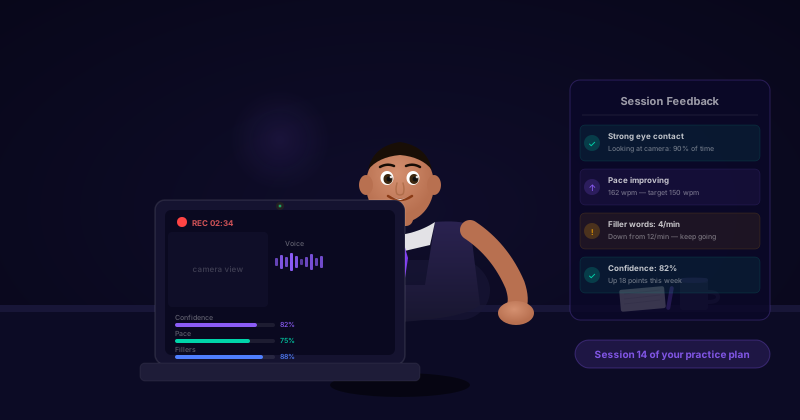
EchoPitch gives you private AI feedback on confidence, pace, and delivery — no audience, no judgement. 5 sessions, paid once. No subscription.
Try EchoPitch →