
Why Practising Alone Does Not Fix Presentation Anxiety
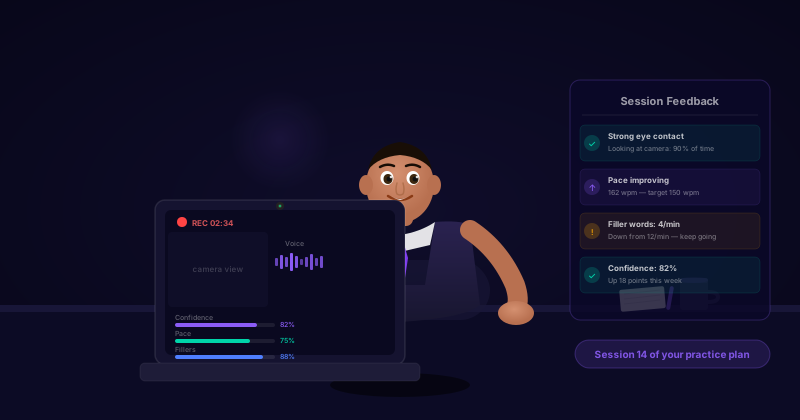
Most anxious presenters already practise constantly. In their head, in the shower, lying awake at night. Here is why it does not help — and what actually does.
Quick Answer
Practicing alone in your head doesn't fix presentation anxiety because mental rehearsal never activates the threat response that actually causes the fear — and your nervous system only learns a presentation is safe by genuinely experiencing it. Thinking through a talk repeatedly is a form of safety behaviour: it feels like preparation but avoids confronting the fear, so the anxiety persists no matter how many times you rehearse silently. Effective practice needs four things instead: speaking aloud at full volume, so your laryngeal muscles get the same activation they'll need for real; mild performance stress, such as recording yourself, which is enough to trigger the threat system at low intensity without being overwhelming; feedback on concrete metrics like pace, filler words, and confidence signals, since practice without feedback loops indefinitely; and consistency over intensity — five 10-minute sessions a week outperform one 50-minute session, because the brain needs repeated evidence over time. Recording yourself, ideally with AI feedback, hits that right level of challenge.
MBA, Bayes Business School · Founder, Cavefish · May 2026
The Practice Paradox
If you ask a presentation-anxious person whether they practise, the answer is almost always yes. They run through their talk repeatedly — in their head, in the car, in the bathroom mirror. They have usually rehearsed more than most people who are not anxious. And yet the anxiety persists. Why?
The answer is in what kind of practice is actually happening. Mental rehearsal — thinking through a presentation — does not activate the biological system that causes presentation anxiety. The threat response only fires when you are genuinely performing. And it is only during genuine performance that the nervous system can learn the situation is safe.
Why Does Mental Rehearsal Not Work?
Presentation anxiety is maintained by avoidance. Every time you think about a presentation without facing it — or face only the safe version in your head — you reinforce the idea that the real thing needs to be avoided. Mental rehearsal, paradoxically, is a form of safety behaviour. It feels like preparation but it is actually a way of not confronting the fear.
The brain learns safety only through direct experience. You need to actually speak, actually hear yourself, actually experience the mild version of the stress response, and then experience that it resolves without catastrophe. Repeating this experience is what gradually extinguishes the threat response.
What Does Effective Practice Require?
Speaking aloud at full volume
Not quietly, not mumbled under your breath. The laryngeal muscles need the same activation they will have during the real presentation. Silent or quiet rehearsal does not prepare them.
Mild performance stress
Some stress is required for the desensitisation to work. Recording yourself creates mild stress — enough to activate the threat system at low intensity. This is what makes it therapeutic.
Feedback on the right things
Practice without feedback loops indefinitely. You need to know whether your pace improved, whether filler words decreased, whether your confidence signals are changing.
Consistency over intensity
Five 10-minute sessions per week is more effective than one 50-minute session. The brain needs repeated evidence over time, not one big rehearsal.
Why Anxious Presenters Do Not Practice Effectively
The obvious practice method — speaking in front of people — triggers the full anxiety response. For someone with significant anxiety, this is too aversive to sustain consistently. They either avoid it entirely or white-knuckle through sessions that are more traumatic than therapeutic.
The solution is a middle path: practice that activates mild performance stress without the full social threat. Recording yourself alone — especially with AI feedback to direct your attention — is the right level of challenge. Enough to trigger the system, not enough to trigger avoidance.
Sources
- Powers, M. B., et al. (2008). A meta-analytic review of psychological treatments for social anxiety disorder — Cochrane Database of Systematic Reviews.
- Phelps, E. A., & LeDoux, J. E. (2005). Contributions of the amygdala to emotion processing — Neuron, 48(2), 175-187.
- Stein, M. B., & Stein, D. J. (2008). Social anxiety disorder — The Lancet, 371(9618), 1115-1125.
Practice That Actually Works
EchoPitch creates the mild-stress recording environment with instant feedback on what to improve. The kind of practice that actually changes the anxiety response — not just the content.
Start practising free →Get daily tips on Reddit
Join our community for presentation tips, Q&A, and support.